Most full frame lenses are large. That’s just physics. The larger the sensor, the larger the glass you need. But, that doesn’t mean you’re out of luck. Here are some of the smallest Sony lenses for full frame cameras.
Even when it first launched, Sony already included one of the smallest lenses for full frame mirrorless cameras in the tiny Sony Zeiss 35mm f/2.8.
Being the most mature of all full frame mirrorless systems, Sony’s full frame E-mount (FE) enjoys the widest selection of lenses, both autofocus and manual focus, and it also has the largest selection of small lenses with autofocus.
And with the release of its smallest full frame body yet – the Sony a7c – the Sony FE mirrorless system is one of the best ways to get a compact, yet fully capable full frame system.
Every lens is a compromise between quality, performance, price and size. You just can’t have everything. You can’t have a small f/1.8 10x zoom lens for full frame.
I mean, you can. But you’d need a sherpa to haul it around.
But, if you’re a fan of prime lenses, and you shoot with one of Sony’s full frame mirrorless bodies – especially compact bodies like the Sony a7c and a7c II – you do have a nice selection of ultra light and small lenses.
RELATED: 15 of the best lenses for the Sony a7c
Smallest Sony Lenses:
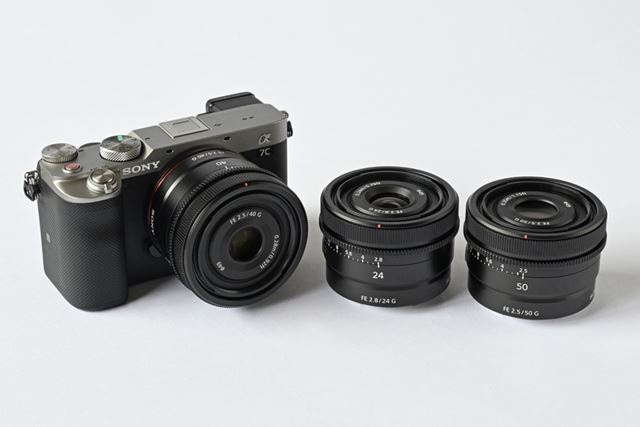
Sony’s trio of compact and lightweight lenses takes the Sony full frame (FE) ecosystem to another level. 24mm f/2.8 G; 40mm f/2.5 G and 50mm f/2.5 G!
While Sony has been busy with releases of high quality, fast aperture GM lenses, like the 35mm f/1.4 GM and the 50mm f/1.2 GM, they’re showing that they are not only about big and expensive pro glass.
With the release of these three G lenses – and the rumored release of a 28mm f/1.8 G lens – Sony is proving that they are looking to round out the system and provide options for all photographers and videographers.
That can only be great news for those of us who value size and compactness.
What’s especially great about these three is that they are inexpensive, but they don’t look and perform like budget lenses.
There is also a consistency in the design that translates to a great user experience.
All three are the same size – 1.8 inches long and 2.7 inches in diameter. Pretty much the same size as the Sony 28-60mm kit lens in its collapsed position.
All three lenses feature aperture rings, a switch for declicking the aperture ring, an AF/MF switch AND a programmable custom button.
They all have the same 49mm filter thread They are all within 12 grams of each other, with the heaviest being the 50mm f/2.5, clocking in at a svelte 174 grams.
All three lenses are the same compact size, measuring 1.8 inches in length, with a diameter of 2.7 inches. Stack them on top of each other, and they’ll still take up less space than most zoom lenses.
The biggest physical difference between them is in the hood design. The 24mm features a traditional round hood, while the 40mm and 50mm feature a thin, sloping hood, similar to the one on the Sony Zeiss 35mm f/2.8.
It’s a weird looking hood, resulting in a microscope-like look to the lens, that not everyone likes. But the benefit is that it’s okay to leave these hoods on all the time, without needing to reverse them just to save space in the bag.
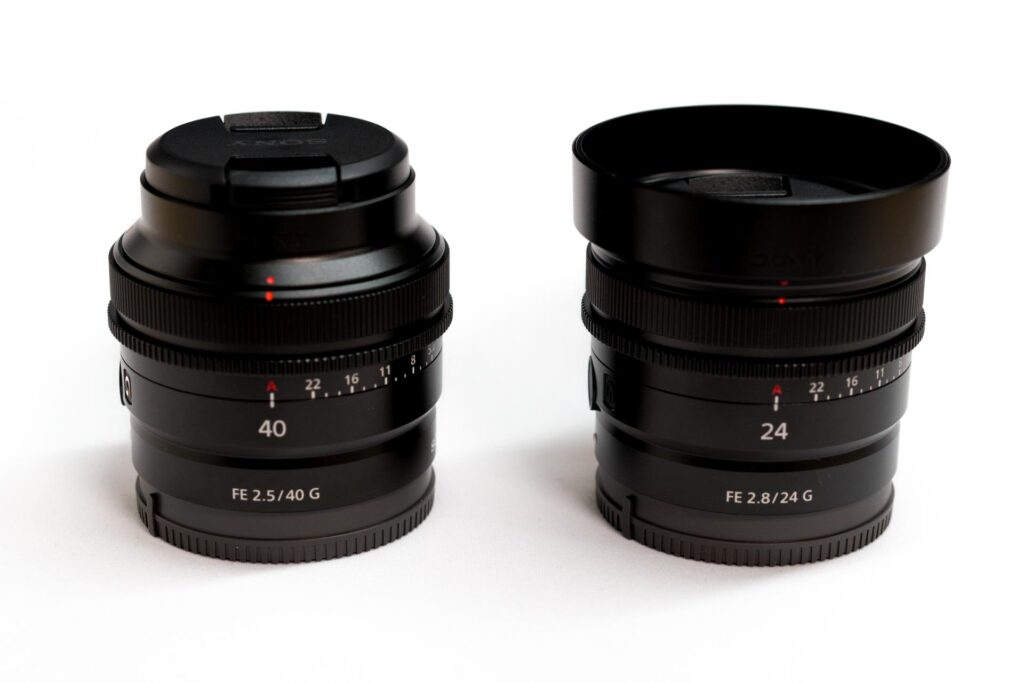
Personally, I’m okay with the look. The space saving benefits are great, plus, the hoods are still threaded on the outside. This makes it easy to add filters without fumbling around with removing the hood.
The icing on the cake is the dust and moisture sealed design in all three lenses, plus the use of Sony’s latest XD Linear autofocus motors (same AF motor used in the 135mm GM and the 24mm GM, and most of the recent GM lenses).
Sony FE 24mm f/2.5 G
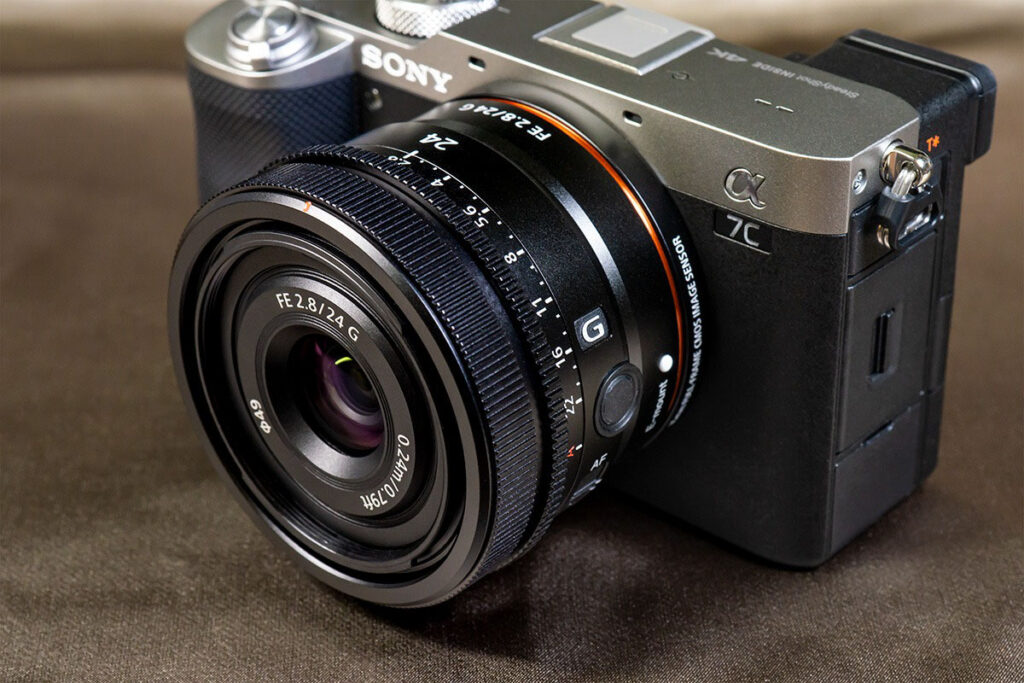
This is the most interesting lens of the trio for me. This lens is wider than your typical 24mm lens. Compared to the Sigma 24mm f/3.5 Contemporary or most zooms set to their 24mm focal length, the Sony 24mm f/2.5 has a wider field of view, closer to that of a 22mm lens.
As a result, despite its slightly brighter aperture, it doesn’t really have an advantage in blurring backgrounds vs the Sigma 24mm f/3.5. I’d actually rate the Sigma 24mm f/3.5 to have better blur quality, even though the Sony is technically brighter at f/2.8.
But, the wider FOV is a plus for me. It’s wide enough that you can justify carrying it in the bag, without worrying if it’s different enough to e.g. the Sony 28mm f/2 or a 35mm lens.
The 162 gram weight also means this is pretty much THE perfect gimbal lens for Sony film makers. It’s wide, it’s got the XD linear AF motors, it’s got the option to make the aperture ring clickless. Any vlogger or travel film maker will find this a useful addition to their kit.
It’s a great everyday carry lens, ready of anything. If you like quick snapshots, a wide, tiny lens like this is a no-brainer.
Check out the current street price of the Sony 24mm f/2.8 G on Amazon.
Filter size: 49mm
Dimensions (diameter x length): 68mm x 45mm or 2.67 x 1.77 inches
Weight: 162 grams
Sony FE 40mm f/2.5 G

I wondered why Sony decided to go for a ‘40’ here, instead of a traditional 35mm. If they didn’t also release the 50mm, maybe a 24mm/40mm combo would’ve made a lot of sense. But with the addition of the 50mm, it is a bit of a head scratcher.
Some say it was a way to differentiate it with the Sony Zeiss 35mm f/2.8 (still a much smaller lens), but I don’t buy that. From what I’ve seen, the Sony-Zeiss partnership seems to have ended, and the 35mm f/2.8 is one of the oldest lenses for the system.
Personally, I don’t think it’s a good ‘35’ replacement. You know where some 40mm lenses are actually a bit wider, maybe a 37mm or something, this is not one of those. It’s not a wide ‘40’. It’s a 40mm, period. Those who are used to a 35mm FOV will find themselves being ‘too close’ most of the time.
But, like all good 40mm lenses, this means it’s the perfect walk-around lens for those wanting something that can bridge the 35mm and the 50mm focal lengths. If you’ve ever felt that a 50mm was too long as a walk around, but always struggled with a 35mm, this could be what the doctor ordered for you.
Check out the current street price of the Sony 40mm f/2.5 G on Amazon.
Filter size: 49mm
Dimensions (diameter x length): 68mm x 45mm or 2.67 x 1.77 inches
Weight: 173 grams
Which one? Sony FE 40mm f/2.5 vs Sony 35mm f/2.8
I talk more about the Sony Zeiss 35mm f/2.8 below.
But, the TLDR here is that if you want the most compact lens possible, the Sony 35mm f/2.8 is the way to go.
Size and focal length differences aside, for everything else, I find the Sony 40mm f/2.8 the better choice.
It has better weather sealing, for one. And more importantly, it’s more fun to shoot with, because of the aperture ring and the programmable button.
The other thing going for the Sony – and this could be the big deciding factor for some – is that the Sony 40mm f/2.5 has a much better minimum focusing distance. The 40mm f/2.8 has an MFD of 9.8 inches (0.23x magnification) vs 13.8 inches (0.12x magnification) on the Sony Zeiss 35mm f/2.8.
That’s a huge difference.
Whether it will matter you will depend on what you shoot. If you’re mostly doing street photography or urban photography, that likely won’t be a factor. But if you’re looking for a small and lightweight general use lens, such as chasing kids around or for photographing in ‘social’ situations or close-ups of nature or food, the better minimum focus distance of the Sony 40mm will be useful.

Sony FE 50mm f/2.5 G
This is the walk-around lens for those who love the ‘normal’ 50mm field of view.

Why get an f/2.5 prime lens if you can instead get a relatively inexpensive, yet awesome, and still compact and lightweight Sigma 28-70mm f/2.8 zoom lens?
Why get this lens instead of the cheaper Sony 50mm f/1.8 or the superb Sony Zeiss 55m f/1.8 and get all the background blurring powers of an f/1.8 aperture?
Because size and weight matter.
If you don’t care about size and weight, then yes, this lens won’t make sense to you. None of the three lenses will actually, but especially for the 50mm, since there are many more options.
Personally, I’d pick this lens over the FE50 or the Sony Zeiss 55mm f/1.8. If I wanted more control over background blur, I’d pick a longer lens, like the Sony FE 85mm f/1.8.
f/2.5 is still fast enough for most low light situations, and can provide more than enough subject-background separation as long as I think about my shots.
It won’t obliterate background like an f/1.8 lens, but that can also be a crutch, resulting in careless framing, because you know you can just blur everything out.
Not only will this lens pair better with a compact body like the Sony a7c, it will also offer a much more enjoyable shooting experience.
Having the aperture ring alone, is already a big plus. Everything else is a bonus.
Check out the current street price of the Sony 50mm f/2.5 G on Amazon.
Filter size: 49mm
Dimensions (diameter x length): 68mm x 45mm or 2.67 x 1.77 inches
Weight: 174 grams
Sony FE 28mm f/2 (SEL28F20)
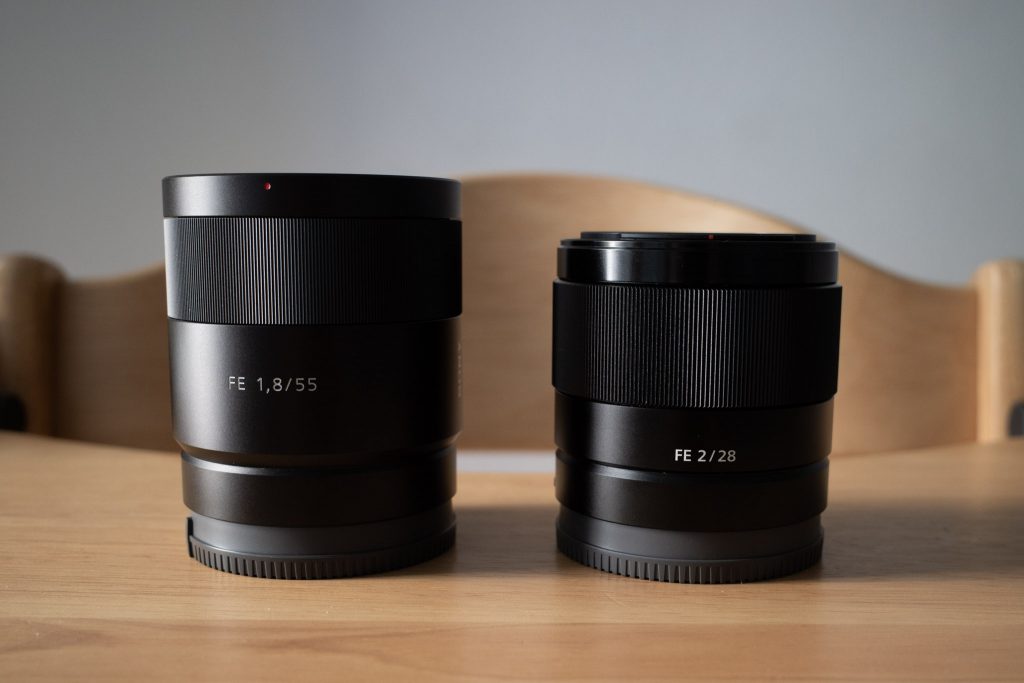
This is one of the most bang-for-the-buck lenses in Sony’s full frame lens line-up. It’s tiny, it’s fast and it’s relatively cheap.
Build quality is mostly plastic, but it doesn’t feel cheap. There is a plastic lens hood included.
The lens is rated as dust and moisture resistant. There are no buttons or switches on the lens.
A fast aperture of f/2 is extremely useful in low-light shooting and can also give some nice background blur at normal portrait distances. The lens also has a 9-bladed, circular diaphragm, which helps render some pleasing out-of-focus blur.
At a mere 200 grams, you can easily throw this lens on most three axis gimbals. And because it doesn’t protrude too far in front of the camera, it’s very easy to balance and re-balance your gimbal.
AF is fast and silent, and the lens works well with eye-AF and Sony’s excellent real time tracking autofocus.
I personally think it’s also a great lens for APS-C shooters. Especially if you think you’ll upgrade to full frame in the future. On APS-C cameras like the Sony a6400, a6100, a6500, a6600, a6300 etc… this lens will work similar to a ~42mm lens.
Pair this with the Sony FE 50mm f/1.8 or the Sony Zeiss FE 55mm f/1.8 and you’ve got an ultra-compact and ultra-light two lens kit that can fit in a small shoulder bag and can cover a lot of situations. All of these lenses (as well as the Sony 35mm f/2.8, see below) have a 49mm filter thread as well, which means you could save more space in your bag by just having 1 set of CPLs and ND filters.
As a bonus, you can also add two converters to this lens: a 21mm ultra-wide converter and a 16mm fisheye converter. These converters make the lens quite a bit bigger and are also very heavy on their own, but the converters themselves don’t take up a lot of space in the bag and it’s a good and cheap way to add versatility to your kit.
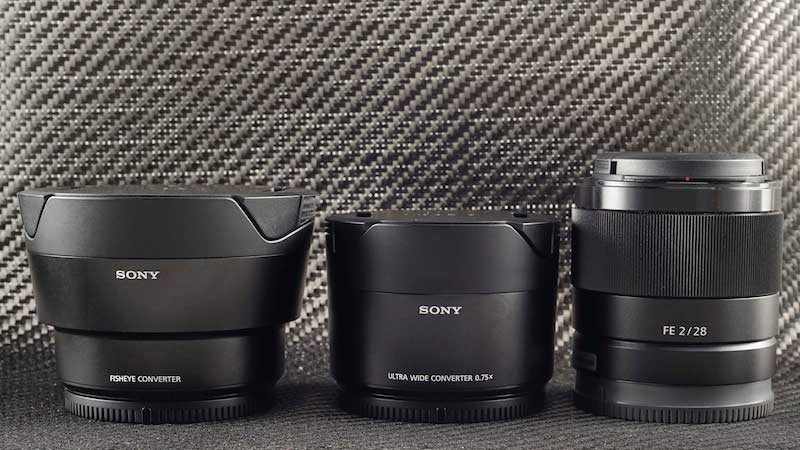
The 21mm converter in particular is a great value especially if you only need to occasionally shoot that wide. It’s significantly cheaper and smaller than getting a dedicated zoom like the Sony 16-35 f/4 or the Tamron 16-30mm f/2.8 G2 for example. One big downside of these converters is that they don’t have filter threads on them.
Although if you find yourself shooting at ultra-wide focal lengths a lot, I’d recommend springing for something like the Samyang 18mm f/2.8, which is a great small and light lens.
Because of its versatility when paired with the 21mm adapter and the ability to use crop mode in today’s high resolution full frame cameras, I also called this lens the “poor man’s Tri-Elmar lens“.
Check the current street price of the Sony 28mm f/2 on Amazon.
Filter size: 49mm
Dimensions (diameter x length): 64mm x 60mm or 2.52 x 2.36 inches
Weight: 200 grams
Sony Zeiss Sonnar T* 35mm f/2.8 ZA (SEL35F28Z)
This was one of the launch lenses for the Sony a7 series of mirrorless cameras. And with a length of only 1.4 inches, it is absolutely tiny!
It’s “only” f/2.8, but that’s the trade off for a lens that’s barely heavier than most smart phones. The size and focal length lends itself well to street photography, where the f/2.8 aperture is more than fast enough.
The exterior is mostly metal and the lens is rated as dust and moisture resistant. It comes with a nice and compact metal hood that barely adds length to the lens (it only adds 12mm to the overall length).
It’s also a popular travel lens because of its size. You can have your camera around your neck all day and barely feel it with a lens this small and light.
At f/2.8, it’s not going to completely throw backgrounds out of focus, but if you position your subject right, f/2.8 at 35mm is still sufficient to create some really nice bokeh.
One thing to note is that it’s a “long” 35mm. Probably around 37mm in actual field of view. Where it’s “spiritual” predecessor, the Sony RX1 had a “wide” 35mm, which was around 32mm in view, this one is quite a bit tighter compared to most 35mm lenses. Not a biggie in most circumstances, but something to take note of.
You do pay the ‘Zeiss tax’, so it’s a bit pricey for a f/2.8 lens. A cheaper alternative is the Rokinon/Samyang 35mm f/2.8, which is slightly smaller and lighter than this lens with similar optical performance, but lesser build quality.
Check the current street price of the Sony 35mm f/2.8 on Amazon.
Filter size: 49mm
Dimensions (diameter x length): 61.5mm x 36.5mm or 2.42 x 1.43 inches
Weight: 120 grams
Sony FE 35mm f/1.8 (SEL35F18F)
It took awhile for Sony to release this lens, but when it finally came, it definitely made a lot of Sony shooters happy.
Check out my full review of this lens here, where I call this lens “the best 35mm for most people“: Sony FE 35mm f/1.8 real world review.
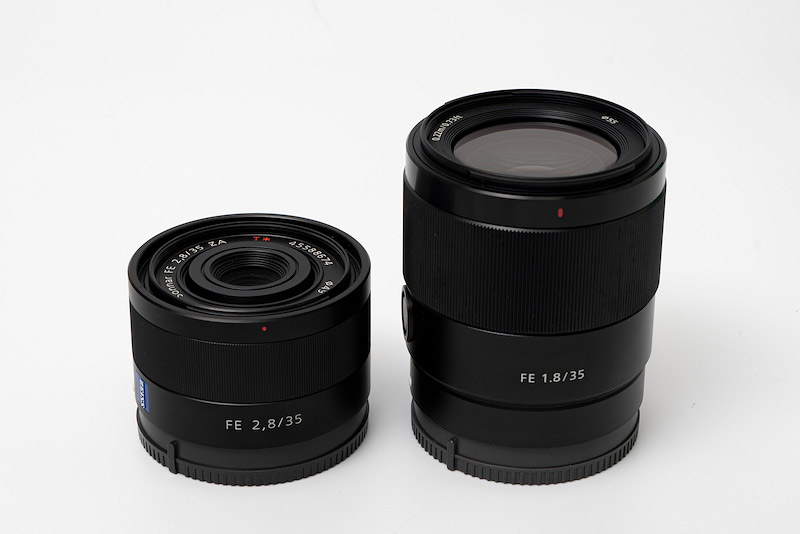
The FE 35mm f/1.8 is one of the most versatile primes in Sony’s line-up. It’s small enough to carry all the time, and with an f/1.8 aperture it’s bright enough for most situations.
This lens is half the size and less than half the weight of the Sony Zeiss 35mm f/1.4 monster.
It’s roughly the same size as the Sony 55mm f/1.8 lens. Roughly the same length, but it’s got more bulk than the 55mm.
The exterior is mostly metal, and it is rated as weather-sealed, with diagrams showing more seals than Sony’s other “dust and moisture resistant” lenses at this price point. It comes with a plastic hood.
The lens also has a programmable switch on the body, as well as a dedicated AF/MF switch.
Although it hasn’t been advertised, one thing I noticed is that the manual focus feel on this lens feels a lot more linear than your typical focus-by-wire lens. It’s still not going to feel as good as a real focus ring, but it’s definitely miles better than say the focus feel on the FE 28mm, Zeiss 35mm f/2.8 or the Zeiss 55mm f/1.8. It’s significantly easier to make precise changes in manual focus.
For most people, if they could have only one prime lens, a fast 35mm is usually one of the first choices. It’s wide enough to add some drama to a scene, without introducing too much distortion. And it’s long enough to allow for some control over depth of field.
It’s slightly more expensive than some other brands 35mm lenses (e.g. Canon RF 35mm f/1.8 IS STM and the Nikon Nikkor Z 35mm f/1.8 S), but it’s also got some advantages vs the Canon and Nikon.
It doesn’t do macro or have IS like the Canon, but it’s also able to focus significantly faster than the Canon, especially in continuous AF, and it’s much smaller and lighter than the Nikkor. The programmable button and the dedicated AF/MF switch is also a nice bonus.
If you’re undecided which 35mm lens to get for your Sony full frame camera, this is the best choice for most people.
It’s bigger than the Sony Zeiss 35mm f/2.8 (above), but it’s also significantly smaller and lighter than the f/1.4 versions from Sony or Sigma, or the optically superior but absolutely humongous f/1.2 version from Sigma.
Check out the current street price of the Sony 35mm f/1.8 FE on Amazon.
Filter size: 55mm
Dimensions (diameter x length): 65.6mm x 73mm or 2.58 x 2.87 inches
Weight: 280 grams
NOTE: Don’t confuse the Sony FE 35mm f/1.8 lens with the Sony 35mm f/1.8 OSS lens (SEL35F18). That is a different lens, designed for Sony’s APS-C cameras such as the a6400 and a6600. On those crop bodies, that lens becomes a ~50mm prime. If you use this lens on a Sony full frame body, you’ll trigger auto crop mode and get a cropped ~50mm field of view and use up less pixels.
Make sure you get the one designed for full frame – Sony FE 35mm f/1.8 – model # SEL35F18F.
Sony FE 50mm f/1.8 (SEL50F18F)
Sony’s nifty fifty, the FE 50mm f/1.8 is Sony’s most affordable prime lens and is a great choice for those on a tight budget, but want a lens that can perform well in low light.
NOTE: Don’t confuse this lens with the Sony 50mm f/1.8 OSS (SEL50F18), this is a different lens designed for crop sensor cameras (not full frame!).
Make sure you get the one designed for full frame – Sony 50mm f/1.8 – Model SEL50F18F.
Being one of the cheapest lenses in Sony’s line-up, we can’t expect much from build quality. It’s mostly high quality plastics, but it isn’t rated as dust and moisture resistant. A nice bonus though is that a plastic hood is included.
Another thing that was sacrificed to keep the price low is the AF motor. The lens comes with a DC motor, not the usual ultrasonic motor, so it won’t have the fastest AF, and the lens will make some noise when focusing. NOTE: Make sure you update the lens to its latest firmware, because Sony has made a few improvements to its AF speed since it was first released.
Using the lens in C-AF mode actually helps quiet it down a bit, and offers a bit of a speed bump in AF acquisition. Curiously, this lens is one of the lenses rated as capable of keeping up with the Sony a9’s 20 frames per second shooting when in continuous AF – something which it’s more celebrated and significantly more expensive sibling, the Sony Zeiss 55mm f/1.8, is not able to do.
The one thing that Sony did not skimp on is the optical quality. This lens is crazy sharp, and in terms of image quality, there is very little to complain about. It can more than go toe-to-toe with lenses 2x the price.
Overall, this is a nice budget lens that can find space in many kits. Even if it’s not your main lens, it’s small enough to throw in the bag, so you can reserve it for those low light shots or when you need some control over depth of field.
It’s not my choice for head shots (I prefer an 85mm or longer), but it can more than do the job, and the results are always sharp and pleasing.
If you’re shopping for your first prime lens to pair with a zoom, this is a great option. It also makes for a great two lens kit when paired with the Sony FE 28mm f/2.
Despite not having the best AF motor, do not be misled, this lens is more than capable of keeping up in most leisure shooting situations. It won’t satisfy professionals or demanding hobbyists, but for the vast majority of people, the AF is more than adequate.
Check out the current street price of the Sony 50mm f/1.8 FE on Amazon.
Filter size: 49mm
Dimensions (diameter x length): 68.6mm x 59.5mm or 2.7 x 2.34 inches
Weight: 186 grams
Sony Zeiss Sonnar T* 55mm f/1.8 ZEL55F18Z
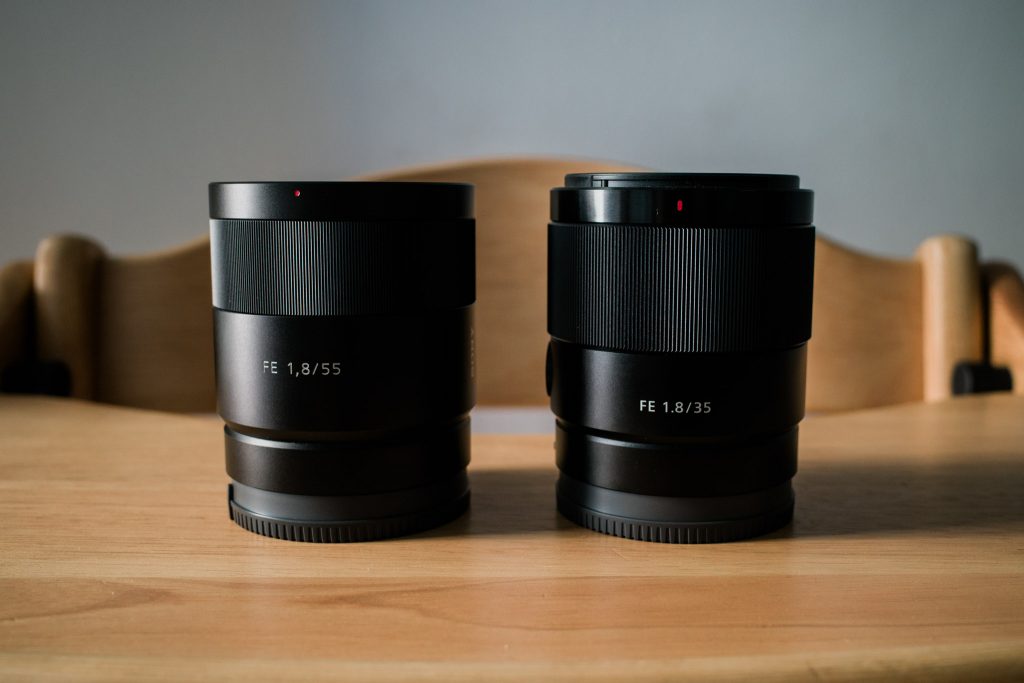
One of the most popular lenses for Sony full frame, and with good reason. It’s insanely sharp with great 3D pop. It was tested by DXO Mark as one of the best lenses ever tested in a lab.
The slightly narrower 55mm field of view is also an interesting choice because it adds some versatility to the lens in terms of controlling depth of field, vs the usual 50mm.
Build quality is exceptional, with a metal barrel. The hood is plastic, but still feels premium, in line with the rest of the lens. There are no buttons or switches on the lens. Neither is there an aperture ring, like on the bigger, heavier and much more expensive Sony Zeiss 50mm f/1.4.
The lens is rated as moisture and dust resistant.
It is exceptionally sharp, with great resolution. It is useful in such a variety of conditions, that even if you’re not primarily a “50mm shooter” you’d still find space for this in your bag.
I should know, I’m one of them. I throw this in my bag or my pocket (without the hood) – “just in case” – when I go out with a wide prime like the Sony 24mm f/1.4 GM or the FE 28mm f/2.
One big advantage of this lens over the cheaper FE 50mm f/1.8 is its fast and silent AF, which also makes it great for video use. With a length of only 2.78 inches and a weight of 281g it’s perfect for gimbal use.
Despite being one of the “older” lenses in the system (released in 2013), this lens has aged well, and continues to be a top notch performer in a lot of situations.
When it first launched, the price was considered too high for a typical f/1.8 50mm lens, but the price has since settled down, it was released over a decade ago after all. And to be fair, prior to the release of this lens, there weren’t many f/1.8 fifties with this kind of optical quality and build quality. After the release of this lens, premium 50mm f/1.8 options also started coming out, such as the Nikon S-line 50mm f/1.8.
Check the current street price of the Sony Zeiss 55mm f/1.8 on Amazon.
Filter size: 49mm
Dimensions (diameter x length): 64.4mm x 70.5mm or 2.54 x 2.78 inches
Weight: 281 grams
Smallest Sigma lenses for Sony
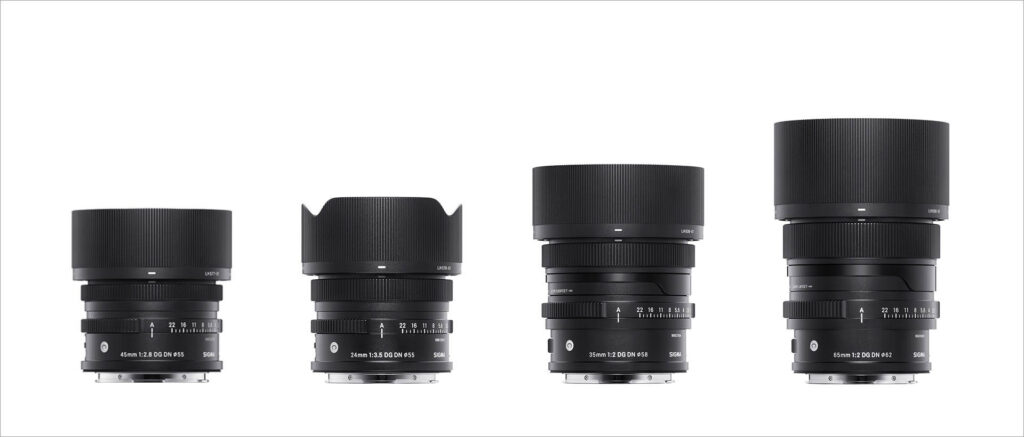
When the first full frame E-mount cameras first launched, Sigma had been content to simply take their lenses designed for DSLR’s, sticking a built-in adapter on the back and calling it a day. The result are some optically stellar lenses that were absolutely huge and heavy.
They’ve since started to release new lenses, designed from the ground-up for full frame mirrorless systems, with Sony E-mount and the Leica L-mount alliance (of which Sigma is a part of) being the biggest beneficiaries of Sigma glass.
RELATED : The Complete list of Sigma lenses for Sony Full Frame
Some of the first Sigma lenses for Sony FE have all been stellar, but absolutely large and heavy, such as the Sigma 14-24mm f/2.8 and the Sigma 35mm f/1.2.
Specifically designed for mirrorless cameras, Sigma’s ‘I series’ was first launched in 2019. The first lens released was the tiny and underrated Sigma 45mm f/2.8.
This was followed by 3 other lenses in 2020 – the Sigma 24mm f/3.5, Sigma 35mm f/2 and the Sigma 65mm f/2.
Sigma now calls this series of compact lenses with aperture rings as the “I series”, a sub-brand of their ‘Contemporary’ line of lenses.
And, let me tell you, Sigma have hit this one out of the park.
These are some of the best built lenses out right now. There’s a lot of metal (even the hoods are metal) and they all have aperture rings and physical AF/MF switches.
The metal build, the aperture rings and the manual focus implementation all result in a ‘hand feel’ that you rarely see in today’s AF lenses.
This is hard to describe, and maybe some people don’t care about ‘hand feel’ at all.
If you’ve ever wished that Voigtlander made AF lenses – this is exactly how they’d feel.
Best of all, they’re small and are relatively inexpensive.
A note on the aperture Rings: If you don’t like using on-lens aperture rings, these lenses have an “A” setting. This allows you to control your aperture via the camera dials. The aperture rings are not de-clickable for video use.
Sigma 17mm f/4 DG DN Contemporary
This is one of those lenses that you will either understand or not. Most people will already be turning away because of the f/4 aperture. “Might as well get a zoom!” will be the common refrain, as if every prime should be f/1.2 or something.
But, if you do ‘get’ this lens, you’ll be in for a treat. All the usual Sigma Contemporary series bells and whistles are here, well-built, well-dampened aperture ring, and most of all: light and compact.
You either understand that or you don’t. And, seeing as you’re here, reading a list of the smallest Sony full frame lenses in a website called compactshooter, you probably understand the appeal of carrying tiny lenses. Tiny ultra-wide lenses built like this on the other hand, are a rarity.
This lens is just like all the other “I series” lenses, tactile and fun. 17mm isn’t a focal length for everybody, it can be hard to use most times. But, if you’re the type who favors wide angles, you can’t go wrong with this one.
If you’re a street shooter who favors a slightly wider than 28mm field of view, this lens is also an excellent street lens for APS-C bodies, where it has a field of view equivalent to a lens that is about 25mm.
Check the current street price of the Sigma 17mm f/4 on Amazon.
Filter size: 55mm
Dimensions (diameter x length): 64mm x 50.8mm or 2.5 x 2 inches
Weight: 220 grams
Sigma 24mm f/3.5 DG DN Contemporary
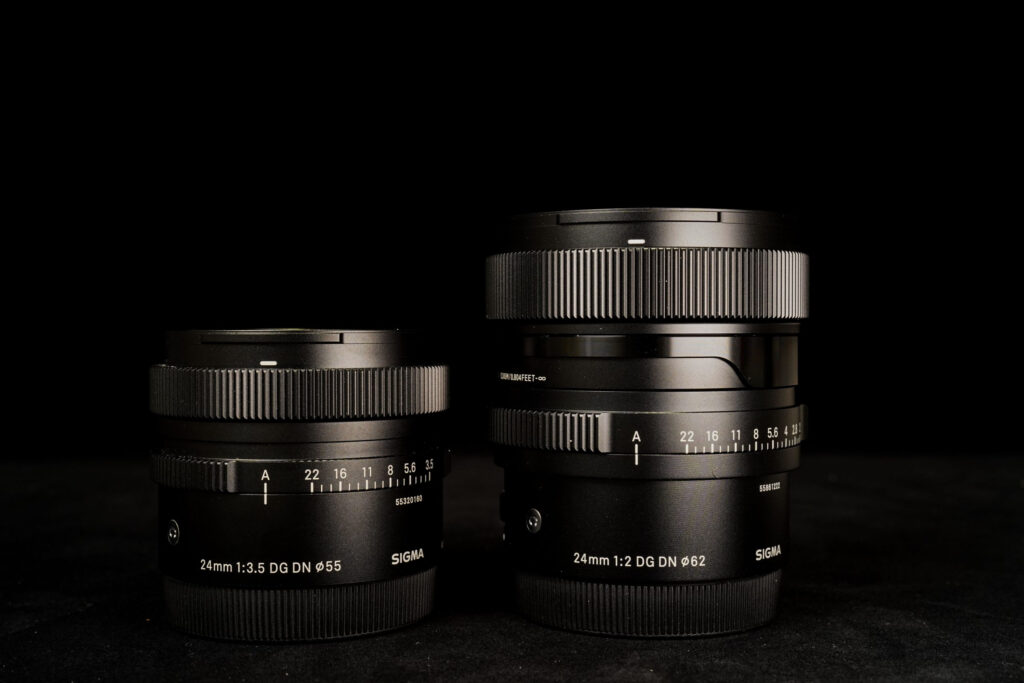
This is the first ultra-wide in the series, and is the one closest in size to the 45mm f/2.8.
It’s about the same girth as the 45mm (they share the same 55mm filter size), but the 24mm is slightly longer in length.
One great thing about the 24mm is it’s ability to focus as close as 10cm. This gets you to a 1:2 macro reproduction, which is very useful and can be a lot of fun.
This is the first one I ordered from Sigma’s “I series” and it easily became one of my favorite lenses.
24mm is the same field of view of the main 1x lens on most current iPhones, so most people are probably familiar with the field of view. But, what is hard to convey here is just how nice this lens is to use. The aperture ring, the well dampened focus ring, the metal body, it all just comes together nicely.
Check the current street price of the Sigma 24mm f/3.5 on Amazon.
Filter size: 55mm
Dimensions (diameter x length): 64mm x 50.8mm or 2.5 x 2 inches
Weight: 230 grams
Sigma 35mm f/2 DG DN Contemporary
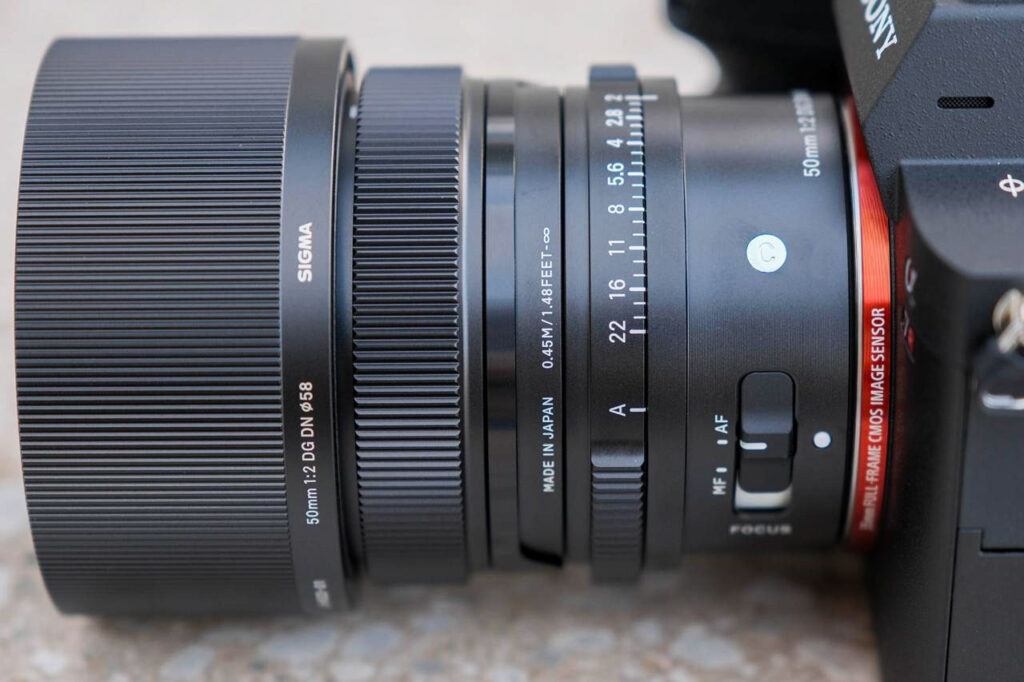
As of this writing, this 35mm f/2 DG DN is the third current production 35mm lens that Sigma makes for Sony E-mount.
The first one is the Sigma 35mm f/1.4 DG DN Art lens. Sigma’s competitor to Sony’s 35mm f/1.4 GM lens.
The second one is the superb Sigma 35mm f/1.2 DG II Art lens. The second version of Sigma’s excellent 35mm f/1.2 lens has shed a lot of weight and heft, making it considerably more portable than the Mark I lens, which has been discontinued.
But, if you’re a fan of small lenses like me, this Sigma 35mm f/2 DG DN Contemporary I series lens is probably the one that interests you most.
Like its f/1.4 and f/1.2 big brothers, this 35mm f/2 lens is designed from the ground up for mirrorless.
It’s slightly shorter in length than the Sony FE 35mm f/1.8, but is quite a bit heftier, because of the metal build.
Compared to the Samyang 35mm f/1.8, the Sigma 35mm f/2 is both wider and longer in length. It’s also a full 100g heavier than the Samyang.
One interesting thing about this lens is that it’s a “wide” 35mm. At near-infinity focus and at close focus, the angle of view is wider than most 35mm lenses.
It’s closer to a ~32mm lens, like the 35mm f/2 Zeiss Sonnar on the Sony RX1R III compact camera. Or, if you’ve used the excellent Pentax 31mm f/1.8 Limited, you should be right at home with this field of view.
AF performance is very good. It’s close to the Sony FE 35mm f/1.8, with the advantage to Sony in challenging situations.
This means that in scenarios like someone running towards the camera, or a child jumping on a bed in low light, the Sony will have a better hit-rate.
But for most scenarios such as portraits with eye AF and general everyday scenes, there isn’t much difference in AF performance.
Check the current street price of the Sigma 35mm f/2 on Amazon.
Filter size: 58mm
Dimensions (diameter x length): 70mm x 67.4mm or 2.8 x 2.7 inches
Weight: 325 grams
Sigma 45mm f/2.8 DG DN Contemporary
This lens has been a bit of a surprise. And also very controversial as well.
The Sigma 45mm f/2.8 is one of the first handful of lenses that have been designed ground up for mirrorless systems. (The lens is also available in L-mount, for Sigma, Leica and Panasonic full frame cameras)
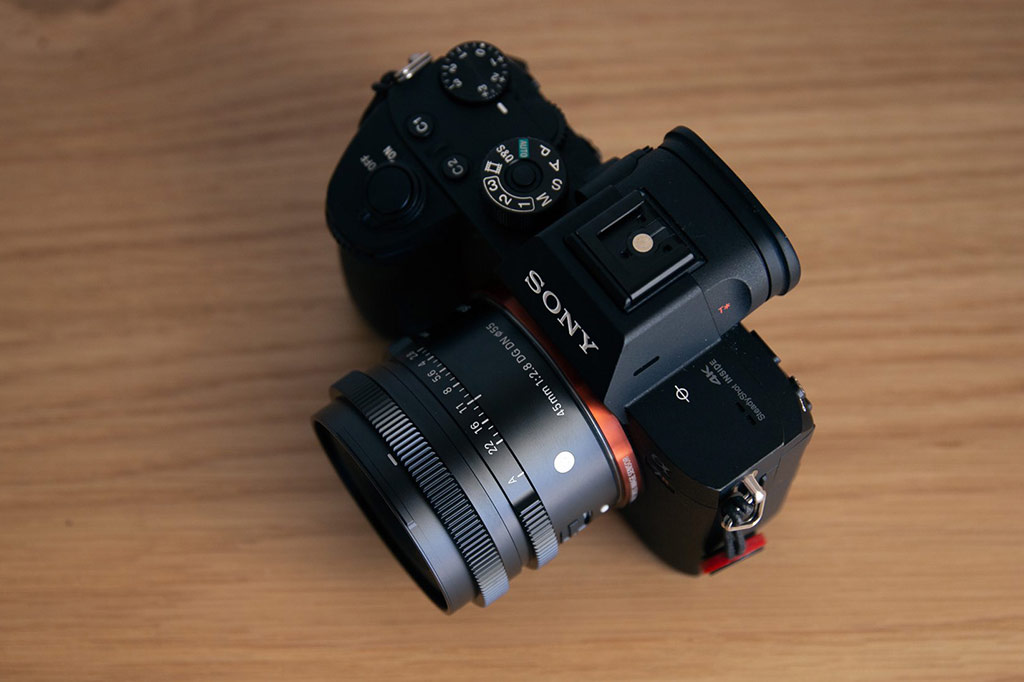
The first thing that stands out about this lens is its build quality. It’s a real beauty. When it first launched, it was so unlike other Sigma lens designs. It’s an all metal build – even the hood is metal – with a really distinctive look. Fast forward a few years later, and Sigma has carried over this look the rest of its Contemporary “I-series” of primes.
It’s hefty for its size, because of all the metal – but it’s tiny. Slightly longer than the Sony Zeiss 35mm f/2.8, and overall smaller than the plastic Sony FE 50mm f/1.8.
So, what’s not to like? Well, it’s not for everyone.
Aside from the obvious aperture difference between this and the Rokinon/Samyang 45mm f/1.8 – a lens that is slightly larger, but cheaper, this Sigma also has a unique design that results in “soft” images (low resolution and low contrast) at close focus when shot wide-open.
It is best if you first read this article from Sigma, which explains the design philosophy and the decisions that went into making this unique lens.
Basically, this lens was designed with the priority of keeping bokeh smooth in a compact, everyday sized lens. And in order to do that, there were certain compromises in design that had to be made – first was the aperture of “only” f/2.8, second is the “soft” look of images at close focus and third is a rather inconsistent performance when using continuous AF.
Again, this isn’t a lens for everybody, and most people won’t even appreciate the “look” the lens is able to deliver. This is why I think it is important to read the linked article from one of the lens designers.
Once you understand the parameters with which this lens was designed, and can appreciate the unique look that the lens is able to produce, this is an incredible lens that doesn’t really have any competitors.
Check the current street price of the Sigma 45mm f/2.8 on Amazon.
Filter size: 55mm
Dimensions (diameter x length): 64mm x 48.2mm or 2.5 x 1.9 inches
Weight: 235 grams
Sigma 65mm f/2 DG DN Contemporary
About half-way between the usual 50mm “normal” lens and an 85mm “short-tele”, the 65mm is an unusual focal length.
Size-wise, this is the largest lens in the I series line-up, so far. At 3 inches long, it’s longer than either the Sony 55mm f/1.8 or the Samyang 75mm f/1.8.
It’s also noticeably heavier than either of those lenses. But, this is due to the generous use of metal on the Sigma.
The decision to go to 65mm instead of 50mm or even 55mm is definitely very interesting.
This makes it gap better with any of the existing lenses in the I series line-up. Depending on how you like to build your lens line-up, the 65mm can work well with either the 35mm f/2 or the 45mm f/2.8.
Because of its longer focal length, the 65mm is capable of rendering the same amount of background blur as the Sony 55mm f/1.8. It looks great, even for full body shots:

This can be a great alternative for those who find the 50/55mm primes to be too wide, but want a shorter working distance than an 85mm portrait lens.
Check the current street price of the Sigma 65mm f/2 on Amazon.
Filter size: 52mm
Dimensions (diameter x length): 72mm x 76.7mm or 3 x 2.8 inches
Weight: 405 grams
Sigma 90mm f/2.8 DG DN Contemporary
If you’re like me, who carries a mirrorless setup almost everywhere I go, even to the grocery and dentist, one of the hardest focal lengths to cover is that short telephoto/mid-telephoto range.
Until now, that is. When I first took it out of the box, what hit me first about the Sigma 90mm f/2.8 is how un-intimidating it is in hand. At only 295 grams and with a length under 60mm, it doesn’t dominate the camera body the way many 85-90mm lenses do. The filter thread is modest (55mm), and the whole lens feels balanced even on a7c series bodies.
Despite its compact size, it delivers a lot of optical performance. Wide open at f/2.8, sharpness in the center is very good, and it cleans up further when stopped down to f/4–f/5.6. The bokeh is smooth, thanks to the 9-blade rounded diaphragm, so portraits are very pleasing, despite being “only” f/2.8. The minimum focusing distance (about 50 cm) is also great for tighter headshots or details without making me take a step back.
If you want something you can stick in a small bag, to shoot portraits or zoom-in on details, and not feel weighed down, this is one of very few choices for full frame shooters. The other being the Rokinon 75mm f/1.8, but can’t quite match the reach of this lens. The usual Sigma “I-series” build quality is here, and overall, the results I’ve been able to get are way better than I expected given that it’s “only” f/2.8.
Check the current street price of the Sigma 90mm f/2.8 DG DN on Amazon.
Filter size: 55mm
Dimensions (diameter x length): 64mm x 61.7mm or 2.5 x 2.4 inches
Weight: 295 grams
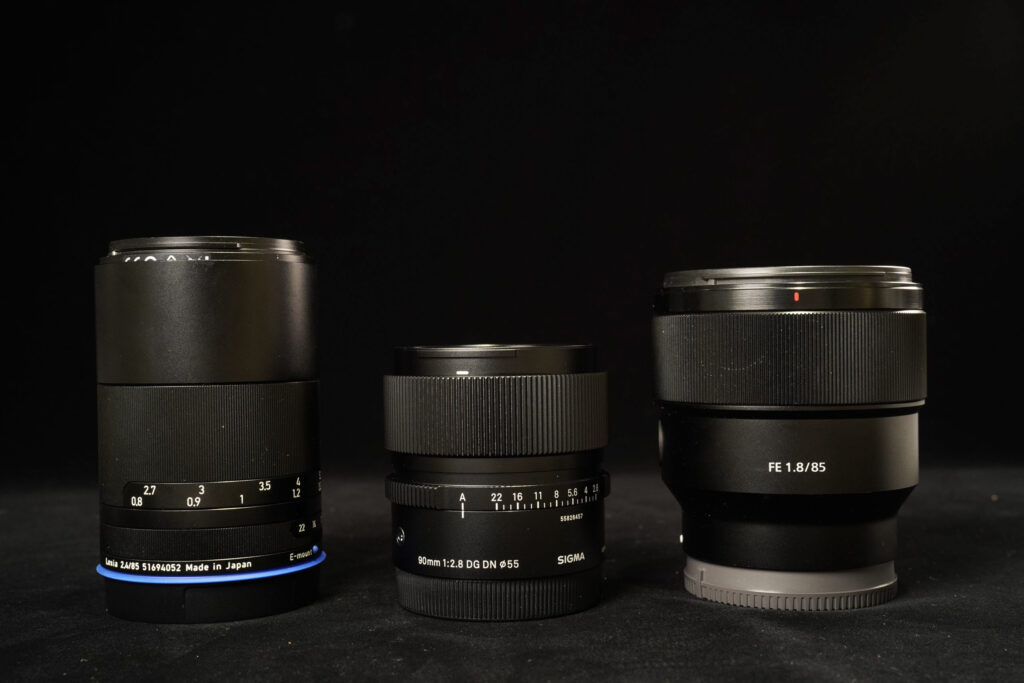
Here, you can see the Sigma 90mm f/2.8 compared in size to the Zeiss Loxia 85mm f/2.4 (a manual focus only lens), and the Sony FE 85mm f/1.8 lens.
Given that its field of view becomes 135mm-equivalent when used on an APS-C body, the Sigma 90mm f/2.8 is also an intriguing choice for APS-C shooters. The biggest downside is the lack of image stabilization, since some Sony APS-C bodies don’t have IBIS. But, size-wise, this lens works well with the Sony a6400 or a6700.
RELATED:
Best Lenses for the Sony a6400
Best Small lenses for the Sony a6700
Viltrox Full Frame Autofocus lenses
Viltrox has been one of the biggest surprises out of the Chinese lens makers. They started off with budget lenses for various APS-C mounts, then they’ve slowly upped their game with the release of their LAB series lenses (their premium line) and their Pro line of fast primes for both APS-C and full frame. We’re not listing any of their Lab or Pro lenses here, because they’re not exactly compact, but their entire Air series line is more our liking.
RELATED: The Complete List of Viltrox Lenses for Sony
Viltrox 14mm f/4 Air
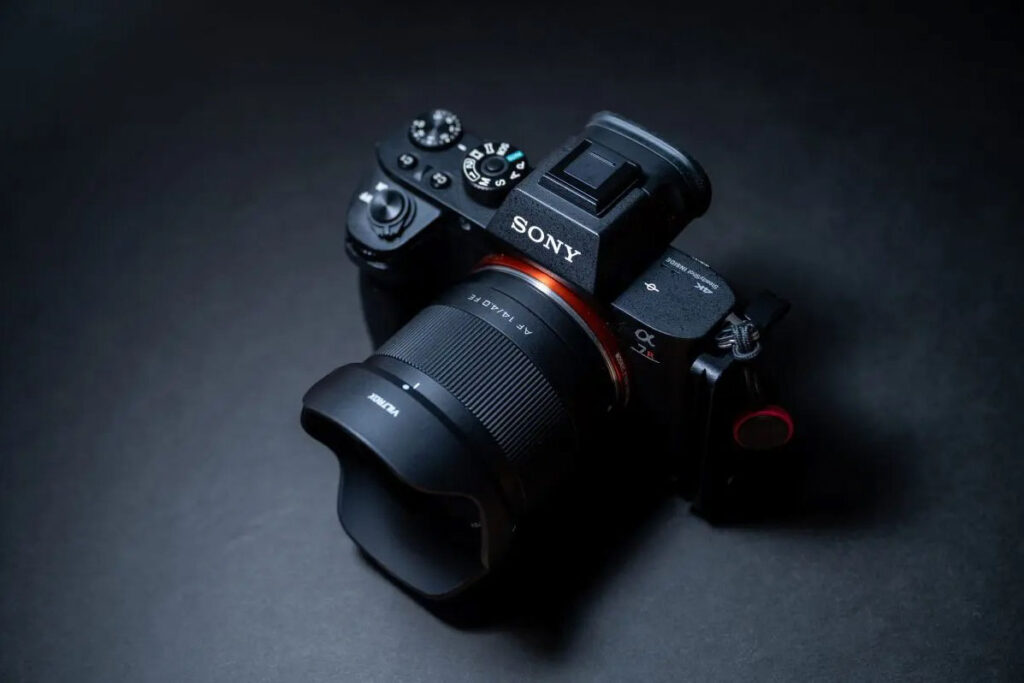
Announced at the same time as the Viltrox 9mm f/2.8 for APS-C, it’s easy to say that this lens is the full frame version of that lens, or vice versa.
The Viltrox AF 14mm f/4 Air is a very compelling lens. It doesn’t try to be a “super-fast ultra-wide pro lens” with all possible features. Instead, it focuses on delivering strong optical performance, good features (autofocus, decent coatings, close focus), and excellent portability, all at a very reasonable price.
If your shooting often involves wide landscapes, travel, architecture, or you want a second lens for dramatic wide shots without lugging around heavy gear, this lens is extremely attractive.
Check Current Street Price: Viltrox 14mm f/4 Air on Amazon
- Filter thread size: 58 mm
- Dimensions (diameter x length): 65mm x 56mm or 2.55 x 2.2 inches
- Weight: 170 grams (Sony E-mount)
Viltrox 20mm f/2.8 Air
At an SRP of under $160, this is one of the best value lenses in full frame land.
And, it weighs under 160 grams and is a mere 60mm or about 2.3 inches long. That’s pretty tiny!
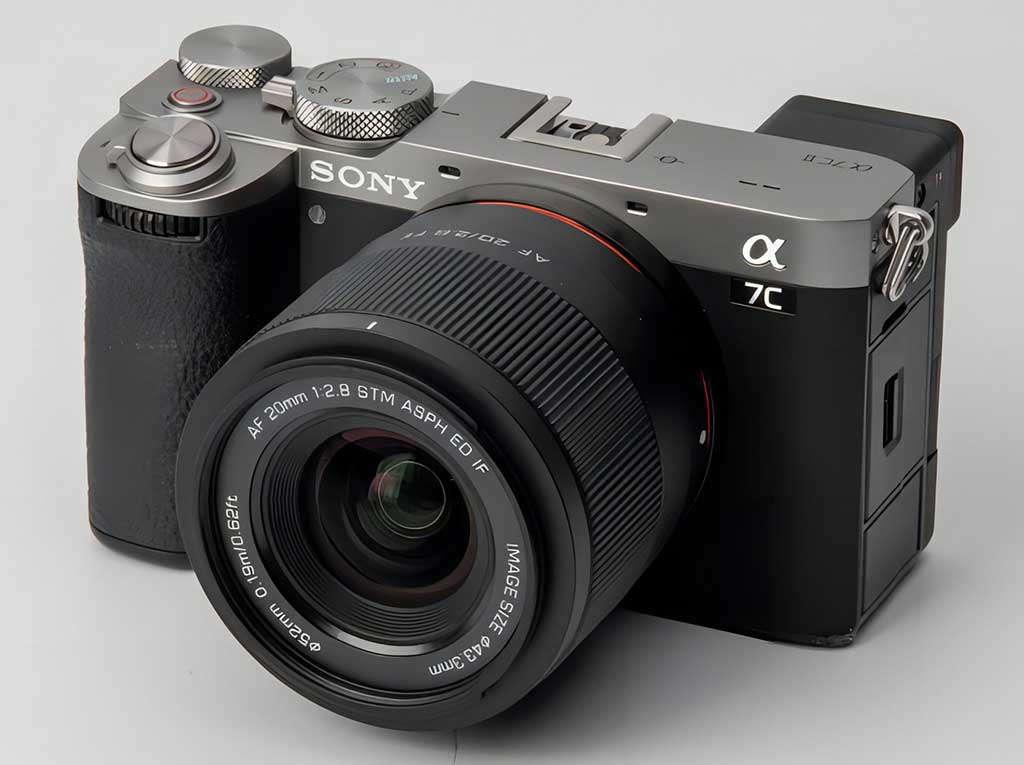
Sony does have a pancake 20mm f/2.8 lens, but that lens is NOT for full frame. The Viltrox is about the size of 2 Sony 20mm f/2.8 stacked on top of the other.
Sony does have a full frame 20mm lens – the Sony 20mm f/1.8 G. But, that’s a pretty premium lens. The Viltrox is almost half the length of the full frame Sony 20mm f/1.8 G lens. It’s more than a stop slower, has a plasticky build, has no weather sealing, but it also costs a hell of a lot less.
In line with its price point, the Viltrox 20mm f/2.8 is a pretty bare bones lens. There’s no aperture ring, not even a focus hold button. But, it does have a USB-C port for easy firmware updates. No need for a dock like the Samyang lenses (below).
Check the current price: Viltrox 20mm f/2.8 on Amazon
- Filter thread size: 52 mm
- Dimensions (diameter x length): 65mm x 59.5 mm or 2.5 x 2.2 inches
- Weight: 157 grams
Viltrox 28mm f/4.5
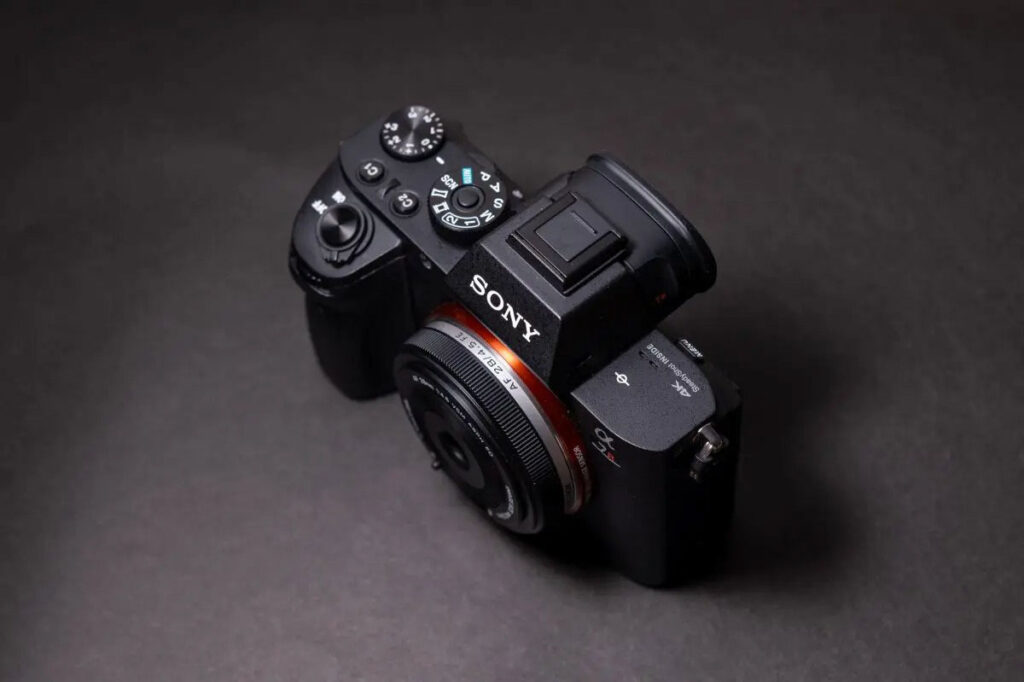
Some call this the “Ricoh GR” lens for Sony. It’s tiny, barely bigger than a lens cap, and almost makes an a7c series camera pocketable. Maybe that’s where the comparison comes from.
Unfortunately, it’s a bit of a party trick. Optically, it’s no match for the GR, but that’s not really a surprise. But, it’s still decent. More than decent, actually. It’s miles better than a toy lens, or a ‘body cap’ lens, that’s for sure. It’s not a lens that will knock your socks off because of it’s sheer sharpness, but once you factor in the size and the price? It’s surprisingly good.
My biggest issue with this lens is that it’s fixed at f/4.5. You can’t stop it down to f/8 or f/11, for example. That severely limits its usefulness in my book. While the size is absolutely incredible, I’m not sure if it’s a worth trade off.
But if you just want the smallest possible walk-around lens? This might be the perfect lens for you. There isn’t even a lens cap to mess around with, it has a built-in lens cover.
Check the current street price: Viltrox 28mm f/4.5 pancake lens on Amazon
- Filter thread size: None
- Dimensions (diameter x length: 60.3 x 15.3 mm or 2.4 x 0.6 inches
- Weight: 60 grams
Viltrox 40mm f/2.5
Being the exact same size as the Viltrox 20mm f/2.8, this 40mm f/2.8 comes in at less than a third of what the Sony 40mm f/2.5 G retails for.
It’s the perfect walk around lens for those who find the classic “35” field of view too boring, yet also find a 50mm-equivalent too tight and restrictive.
Check the current street price: Viltrox 40mm f/2.5 Air Lens on Amazon
- Filter thread size: 52 mm
- Dimensions (diameter x length): 65mm x 59.5 mm or 2.55 x 2.34 inches
- Weight: 167 grams
Viltrox 50mm f/2
The Viltrox 50mm f/2 Air offers an appealing and affordable alternative to first-party 50mm options.
Sure, Sony’s 55mm f/1.8 and 50mm f/1.4 GM are excellent performers, but you’re paying the Zeiss and Sony taxes. Here you’ve got a superb lens that comes in at $200.
Just like the rest of the Air series, this lens punches above its price point with surprising bokeh and sharpness wide open. If someone were to ask me for a recommendation for a cheap 50mm “nifty fifty”, the Viltrox 50mm f/2 Air would certainly be at the top of the list.
Check current street price: Viltrox 50mm f/2 Air on Amazon
- Filter thread size: 58 mm
- Dimensions (diameter x length): 65mm x 56.5 mm or 2.55 x 2.22 inches
- Weight: 205 grams
Samyang & Rokinon Autofocus lenses
South Korean lens manufacturer Samyang Optics has continued to up its game with its line of autofocus lenses for Sony full frame.
Most of its lenses are rebranded as Rokinon in the US market or as Bower lenses in some parts of Europe. But while there are some cosmetic differences, Rokinon, Samyang and Bower lenses are all the same – they are all manufactured by Samyang in South Korea.
This is almost the same as laptop original design manufacturers, where some Dell and HP laptops are actually made by a company called Compal and Sony VAIO laptops are made by Quanta etc..
Most of their early lenses are fast aperture manual focus lenses for DSLR’s and mirrorless mounts or their CINE and XEEN line for video/cinema use, but in 2016 they released their first AF lenses.
While some of Samyang’s early autofocus lenses had AF motors that couldn’t really keep up with Sony’s amazing C-AF, they’ve really worked on their AF technology and their more recent releases have all seen marked improvement, providing as good as native performance.
Samyang Lens Station Required
The biggest downside for Samyang lenses, in my opinion, is that firmware updates cannot be done in-camera. You must buy the Samyang Lens Station, which is a USB dock where you can update firmware for their lenses. It’s an unfortunate additional cost, but it’s relatively inexpensive. It’s also a one time purchase, since you can use it for all their lenses, including future releases.
One of their most popular lines is their “Tiny series” of compact lenses, which are mostly fast aperture primes with an emphasis on keeping size down, all at budget-friendly prices.
Rokinon AF 18mm f/2.8 FE (aka Samyang 18mm f/2.8) – SYIO18AF-E
With a super wide angle view of 100 degrees, this rectilinear ultra-wide is a great addition to any kit.
At a mere 145 grams, it’s perfect for gimbal use, or drone use.
The ultra-wide view also makes it great for selfie style vlogging
Autofocus performance is good in either AF-S or AF-C, I have no complaints, even when shooting back-lit situations.
Center sharpness is very good, but corner sharpness suffers a bit, even when stopped down, but that’s the trade-off for such a small lens. I know a lot of people would gladly give up some edge sharpness to have a fast ultra-wide lens that is this small in their bag.
As expected, for a tiny lens with a 49mm filter thread there is also visible vignetting when wide-open.
Other than that, image quality is really quite good, and like most Samyang/Rokinon lenses, it punches way above its weight and price.
This makes for a great travel lens, great for e.g. church interiors or museums. It’s also great for adding a bit of drama to street scenes or for kids and pets.
Despite the lack of corner sharpness wide-open, I personally would have no problem using this for architecture or interiors. The weight and price savings alone are worth it.
And I can’t stress that enough. A fast ultra wide usually means big and heavy and expensive. Which this little Samyang is definitely not. Given its size and weight, there is practically no penalty to bringing it along.
It is extremely rare to get a compact and fast ultra-wide with this kind of performance in this price range.
Check current price: Samyang 18mm f/2.8 on Amazon
- Filter thread size: 58 mm
- Dimensions (diameter x length): 63.5mm x 60.5 mm or 2.5 x 2.38 inches
- Weight: 145 grams
Rokinon AF 24mm f/2.8 FE (aka Samyang 24mm f/2.8) – SYIO24AF-E
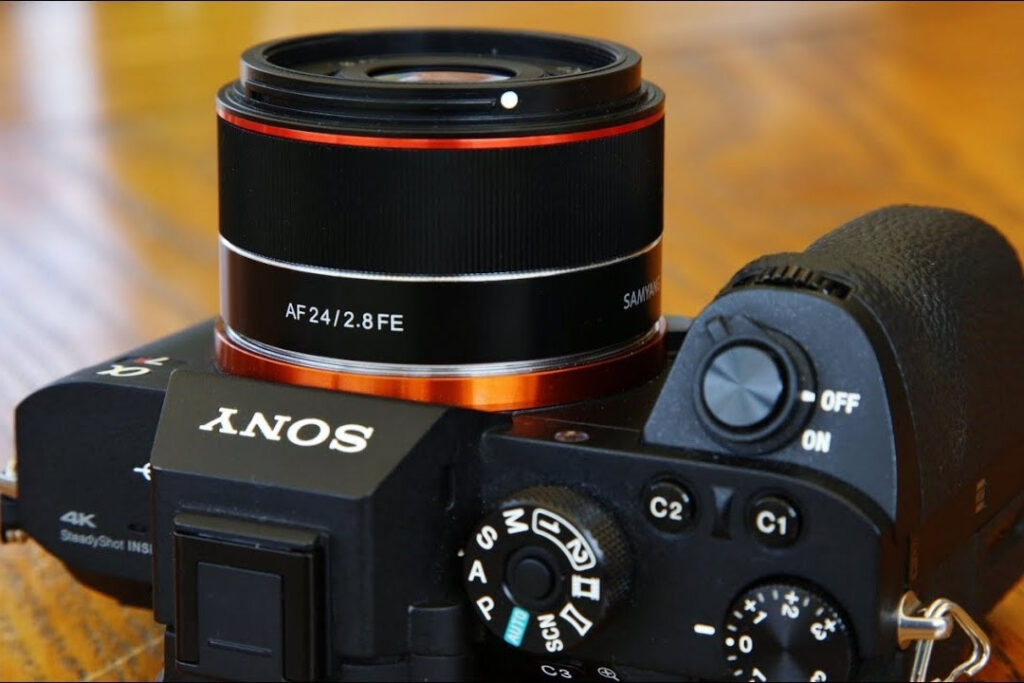
This is one of the smallest lenses available for Sony full frame. Without the hood, it’s about as small as the Sony Zeiss 35mm f/2.8 Sonnar. It’s less than an inch and a half in length. You’ll barely know it’s there.
With an angle of view of 82 degrees, the Samyang/Rokinon 24mm f/2.8 FE is a great everyday carry lens, perfect for everything from landscapes to travel to street photography.
It also has a rather decent 0.24 meter minimum focusing distance, allowing you to get pretty close. This is great for photographing pets, for example.
There is some vignetting, but again, that’s the trade-off for such a compact design, and this can be corrected in post processing.
As expected, build is mostly plastic. The is a small, plastic hood included, as well as a nice little pouch, similar to those cases for earbuds.
Optically, this is the weakest of the “Tiny” series. It’s not the sharpest lens in the world at f/2.8, but for most uses, it’s more than adequate. Stop it down, and it improves a bit.
I won’t recommend it for pro landscape shooters, or for anyone with an A7R series body who loves to crop or who loves to pixel peep. But for the majority of shooters who output for web use or social media use, I would recommend it wholeheartedly.
Trust me, if you just want to take shots at the pub, or at a birthday party, you’d rather have a small, unobtrusive lens with you rather than an ultra-sharp, but large and heavy lens.
Paired with either the 35mm f/2.8 or the 45mm f/1.8 (both shown below), you’ve got an ultra-compact kit that you can keep in a small shoulder bag.
Check current street price: Rokinon 24mm f/2.8 on Amazon
- Filter thread size: 49 mm
- Dimensions (diameter x length): 61.8mm x 37 mm or 2.43 x 1.46 inches
- Weight: 120 grams
Rokinon AF 35mm f/2.8 FE (aka Samyang 35mm f/2.8) – SYIO35AF-E
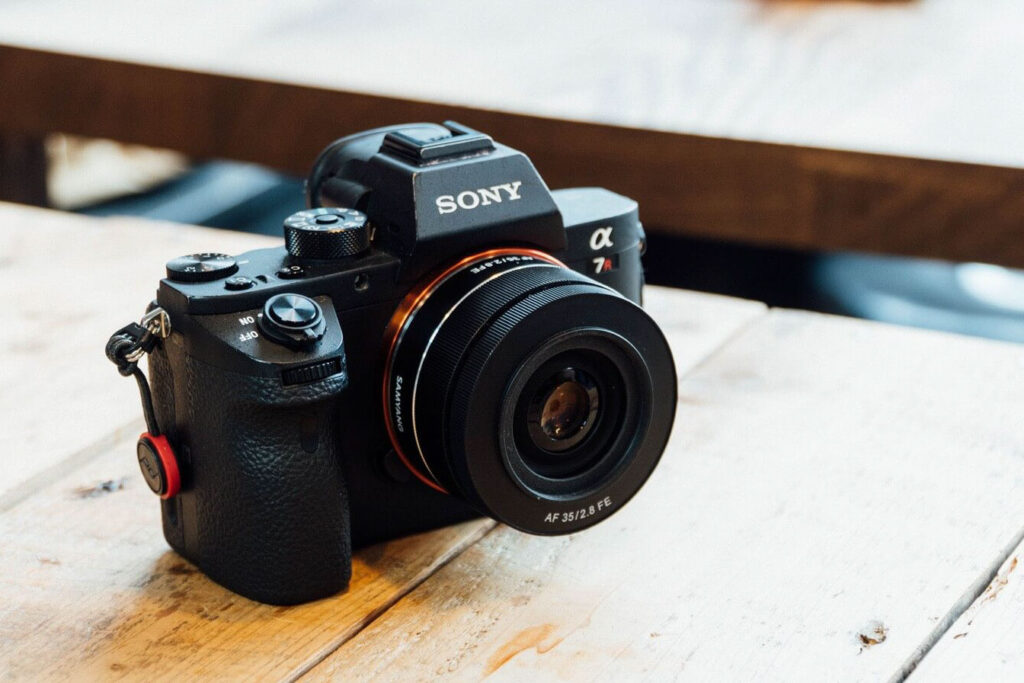
The Samyang 35mm f/2.8 is very slightly smaller than the Sony Zeiss 35mm f/2.8 Sonnar which is about 3x the price. This is as close to a pancake lens as you’ll get on Sony full frame.
This is where Samyang started to hit their stride with their AF motors. It’s fast and decisive. Make sure you get the latest firmware though, but to update the firmware on Samyang lenses, you need their lens dock.
This is one of my go to lenses for street shooting. It’s plenty sharp in the center when shot wide-open, and it’s razor sharp stopped down to f/8 and f/11 which is where I mostly like to shoot street shots.
It’s even got a pretty decent minimum focusing distance of 0.35 meters. Great for your instagram food shots. 😉
And did I mention it’s tiny? An absolute bang for the buck lens. A bargain even. It’s about a third of the price of the Sony Zeiss Sonnar 35mm f/2.8. Although build quality is better on the Sony, I find the Samyang to be sharper across the frame and in all apertures.
Check current price: Rokinon 35mm f/2.8 on Amazon
Filter size: 49mm
Dimensions (diameter x length): 61.8mm x 33mm or 2.43 x 1.29 inches
Weight: 86 grams
Rokinon AF 45mm f/1.8 FE (aka Samyang 45mm f/1.8) – SYIO45AF-E
This is a nice middle-ground between something like the Zeiss Batis 40mm f/2 and the Sony Zeiss 55mm f/1.8. Or for photographers who want a wider view, closer to a 35mm/40mm, but with the isolation of a fast fifty.
This lens is again smaller and lighter than the Sony 50mm f/1.8. Despite the tiny size, this lens employs Samyang’s latest AF technology, using a linear stepping motor. It’s fast, zippy and decisive, even with eye-AF and C-AF.
I don’t find any meaningful difference in AF speed between this and the Sony Zeiss 55mm f/1.8 in real world shooting, which is saying something. Samyang have really arrived.
I love pairing this lens with the Sony 28mm f/2. It’s one of my favorite two-lens combo especially for business travel, when I don’t have space for a dedicated camera bag.
This will also pair well with the Sony 24mm f/1.4 G Master or the new Sony 20mm f/1.8 G lens, when walking around. It’s so tiny, it can easily slip into most jacket pockets.
Optically, this is probably the strongest in the entire Samyang/Rokinon “Tiny” lineup. It’s razor sharp, with really pleasing rendering, and smooth bokeh. I won’t hesitate to recommend this even to pixel peepers who shoot with high megapixel A7R-series or A1 bodies.
I’d also highly recommend this to anyone who finds the 50mm or 55mm field of view to be a bit narrow, especially indoors. You might be surprised by how much a difference the slightly wider FOV actually makes in real world use.
It’s a great “kitchen-table” lens. Perfect for documenting family moments and events.
Check the current street price of the Samyang 45mm f/1.8 on Amazon.
- Filter thread size: 49 mm
- Dimensions (diameter x length): 61.8mm x 56.1 mm or 2.43 x 2.2 inches
- Weight: 162 grams
Rokinon AF 75mm f/1.8 FE (aka Samyang 75mm f/1.8) – SYIO75AF-E
This is Samyang’s latest addition to their ‘Tiny’ series, and it’s a real beauty. It’s the largest of their “Tiny” series, but make no mistake, it is still a small lens.
This 75mm just might be one of the smallest short telephoto lenses out right now. It’s barely larger than the Sony FE 50mm f/1.8! The Sony FE 50mm f/1.8 is 68.6mm long, this 75mm lens is 69mm long. Think about that for a moment.
This lens is tiny especially compared to the Sony FE 85mm f/1.8, a lens that I would classify as a medium-ish lens.
It looks positively diminutive next to most short-telephoto lenses.
It’s as small as fully manual focus lenses in this focal range, but this lens still employs the latest Samyang/Rokinon STM AF motor.
Samyang has made a lot of noise about the new ‘custom’ switch on the lens which allows you to change the function of the focus ring to control aperture. But honestly, this isn’t something I’ll be using at all. The selling point of this lens is its size. Samyang marketing department should show more images of this lens next to the Sony FE 85mm f/1.8. That’s a big enough selling point.
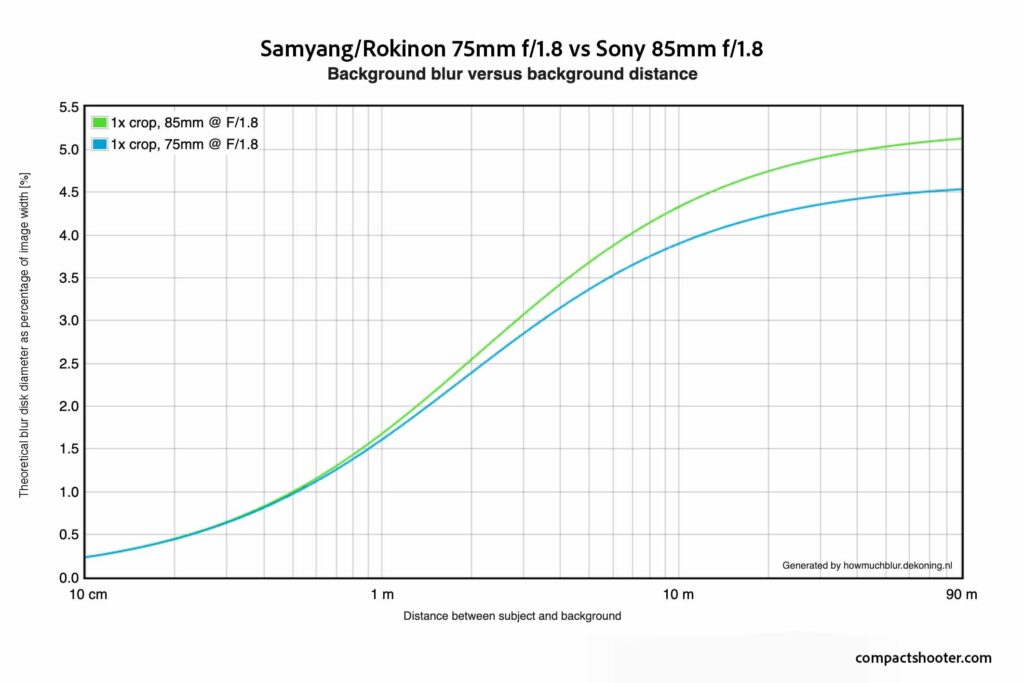
It’s got a rounded nine-blade diaphragm which allows for some smooth bokeh. It’s shorter than your typical 85mm portrait lens, but as you can see in the chart below, its ability to blur backgrounds is pretty similar to an 85mm f/1.8 lens, especially if the backgrounds aren’t too far away.
Check current price: Samyang 75mm f/1.8 on Amazon
- Filter thread size: 58 mm
- Dimensions (diameter x length): 65mm x 69 mm or 2.56 x 2.7 inches
- Weight: 230 grams
Tamron Autofocus lenses
In 2019, Tamron announced a trio of f/2.8 primes. At first, there was a bit of head scratching, why only f/2.8? Well, it turns out that these primes have a trick up their sleeves – they are all capable of focusing really close, up to 1:2 macro reproduction!
RELATED: Complete list of Tamron lenses for Sony Full Frame
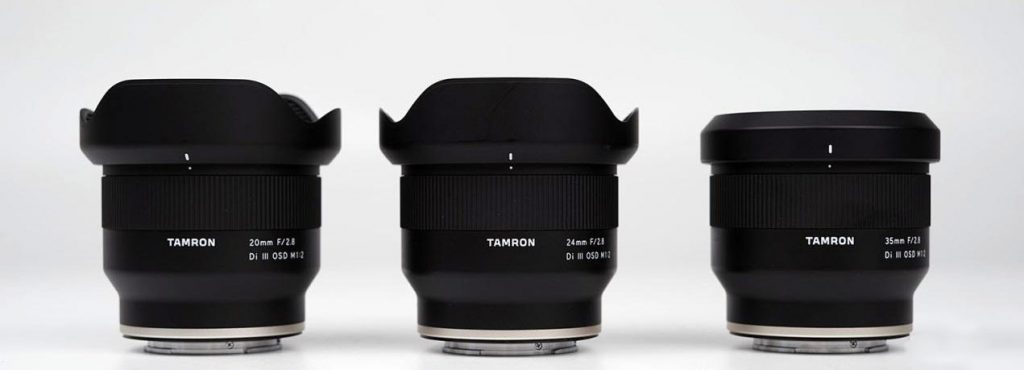
And in a well thought out design, these three lenses all have a 67mm filter thread, same as the three Tamron zooms for Sony FE – the 17-28mm f/2.8, 28-75mm f/2.8 and 70-180mm f/2.8.
And all three primes are almost all the same size and weight – differences of about 5g only.
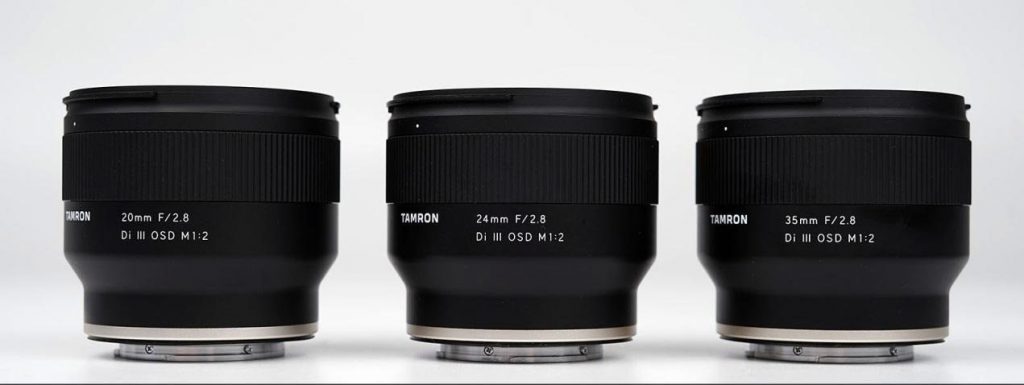
Build quality is also a noticeable step-up from the Samying/Rokinon lenses (above), and are as good as Sony G lenses, if a step-down from GM build quality. All Tamron lenses for Sony FE are rated as moisture and dust resistant, for example.
Another advantage that Tamron lenses have is that you can update their firmware in-camera, no need for a dock.
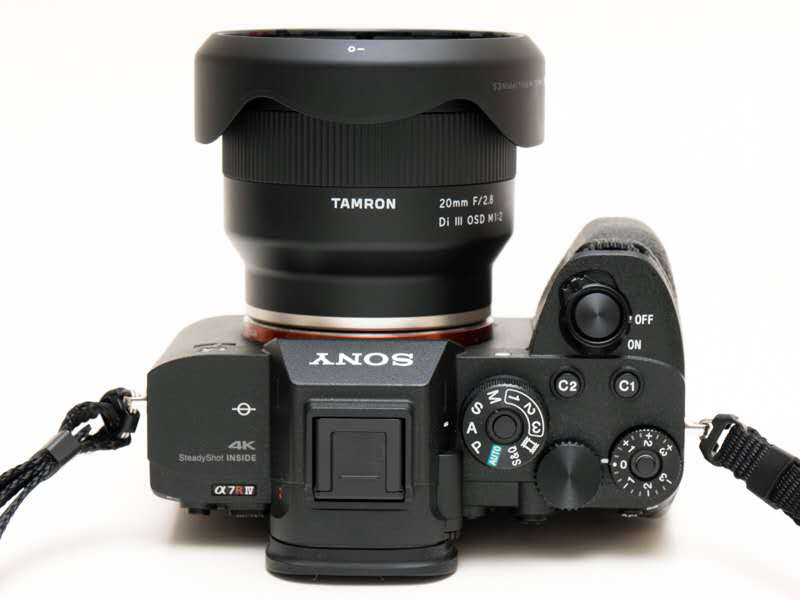
Tamron 20mm f/2.8 Di III OSD – Model F050
This is an excellent and compact ultra-wide lens. It’s not as small as the Rokinon/Samyang 18mm f/2.8 (above), but it’s also a step-up in optical quality.
It’s more than a full stop faster than Sony’s new 20mm f/1.8 G lens, but it’s also able to focus much closer, capable of 1:2 magnification. Build quality is great, I would say it is only a slight step down from the Sony 20mm f/1.8. Although that is more a testament to the really great “GM-like” build of the Sony.
If you don’t need the faster aperture of the Sony, this Tamron is an EXCELLENT choice at a much lower price.
One big downside though is the noise AF when shooting in C-AF. It is virtually silent when in S-AF. This might be an issue for video shooters, especially since this lens would be great on a gimbal. But if you’re overlaying music or have off-camera microphones anyway, I’d get this for gimbal use.
Check the price of the Tamron 20mm f/2.8 on Amazon.
Tamron 24mm f/2.8 Di III OSD – Model F051
This is one of the more under-rated lenses for Sony A7 series cameras, in my opinion.
It is crazy sharp, even wide-open, very close to the sharpness of the much more expensive Sony 24mm f/1.4 GM at f/2.8 (where the Tamron is wide-open and the Sony is stopped down two stops). That’s crazy good considering how much cheaper this Tamron is.
Like the other two primes, this lens is also capable of 1:2 macro, with a minimum focus distance of 0.12 meters.
Unfortunately, it also suffers from noisy AF when using C-AF. It’s mostly silent when shooting in S-AF though, so not a huge problem for still shooters. Video shooters, take note, this might be an issue for you. If not, this is a great little lens to fly on a gimbal.
Check the price of the Tamron 24mm f/2.8 on Amazon.
Tamron 35mm f/2.8 Di III OSD – Model F053
Like its siblings above, the Tamron 35mm f/2.8 is optically outstanding, able to go toe-to-toe (in terms of sharpness) with other more expensive lenses like the Sony FE 35mm f/1.8 and the Sigma 35mm f/1.2 at similar apertures.
Unlike the other two though, it’s a bit of a hard sell vs something like the Sony FE 35mm f/1.8 – a similarly sized, but more expensive lens that is also more than a stop faster and with better AF performance; or the Samyang 35mm f/2.8 lens – a cheaper and smaller lens.
Like the other two Tamron lenses above, it also suffers from noisy AF when using C-AF – which can be an issue for video shooters, or those who leave their cameras mostly on C-AF, such as Sony a9 users, perhaps.
Like I said, it’s a bit of a hard sell, because a lot of people will willingly give up the optical qualities and macro ability of this lens to get a faster (f/1.8 lens) or a smaller lens (Samyang 35mm f/2.8 or Sony Zeiss 35mm f/2.8).
But if you value the macro capabilities (can focus as close as 5.9 inches!) and want something that is bitingly sharp across the frame at all apertures, at a budget price and a light weight size, the Tamron is the only game in town.
Check the price of the Tamron 35mm f/2.8 on Amazon.
RELATED LINKS
Complete list of Full Frame Sigma Lenses for Full Frame
Complete list of Tamron Lenses for Sony E-mount (Full Frame and APS-C)
Good Job!
Very useful information. You are doing well in updating the content with new releases.
Its been a while I am looking to find a referencing web page on minimalistic lens set up.
Best Wishes
Dr. Photo
Pingback: Best Lenses for the Sony a6400, a6100 (a6000 series) - Compact Shooter
Pingback: 15 of the Best Lenses for the Sony a7c - Compact Shooter
Great article, but please stop using absurd obsolete measurement units like inches, ounces, feet, cubits, whatever other medieval stuff, and stick to international metric system. Is really annoying reading useful descriptive info like «The 40mm f/2.8 has an MFD of 9.8 inches (0.23x magnification) vs 13.8 inches» and having to use a calculator to translate because some people in the anglo world still live in the XIXth century.
Best.
Agree
Just a remark: the Sony 50mm f/2.8 Macro SEL50M28 has a minimum focus distance of 16cmm – not 16mm as mentioned in the review.
Excellent article. As a Sony shooter who values compact lenses, it’s a treat to see an article that represents my philosophy. Any thought on the Sigma 90mm F/2.8?
Pingback: Sony FE 35mm f/1.8 Real World Review - the best 35mm for almost everyone - Compact Shooter
Good article that covers a lot of the smaller lighter weight lenses I have owned quite a few of those mentioned. It’s a pity the Sony 35 f/1.8 has such messy out of focus areas and C.A because I really like the fact that it can focus so close. Surprised the Batis 25mm and 40mm don’t get more of a mention would have been interesting to hear your thoughts on these vs the others.
Pingback: Best Small Lenses for the Sony a6700 - Compact Shooter
Pingback: The Smallest Telephoto Lens? Olympus 75mm f/1.8 Real World Review - Compact Shooter
Pingback: The Complete List of Sigma Full Frame Lenses for Sony E Mount (FE) - Compact Shooter