Here is our complete guide to all Tamron lenses for Sony E mount. It’s broken down into full frame lenses (zooms followed by primes), then APS-C lenses, which are all zooms at this time.
Tamron’s lens line-up for Sony are designated Di III for full-frame and Di III-A for APS-C lenses.
Full Frame zooms
Tamron’s real strength lies in making zoom lenses, whether it’s pushing boundaries with never-before-seen focal ranges like the 17-50mm or 35-150mm or creating well-balanced zooms that offer pro-level optical performance, useful features, and consumer level pricing.
Tamron’s f/2.8 zoom trinity is now in its second-generation (Tamron calls them G2 lenses), and it remains a favorite among Sony users. The original 28-75mm f/2.8, in particular, remains as one of the best-selling mirrorless lenses ever made.
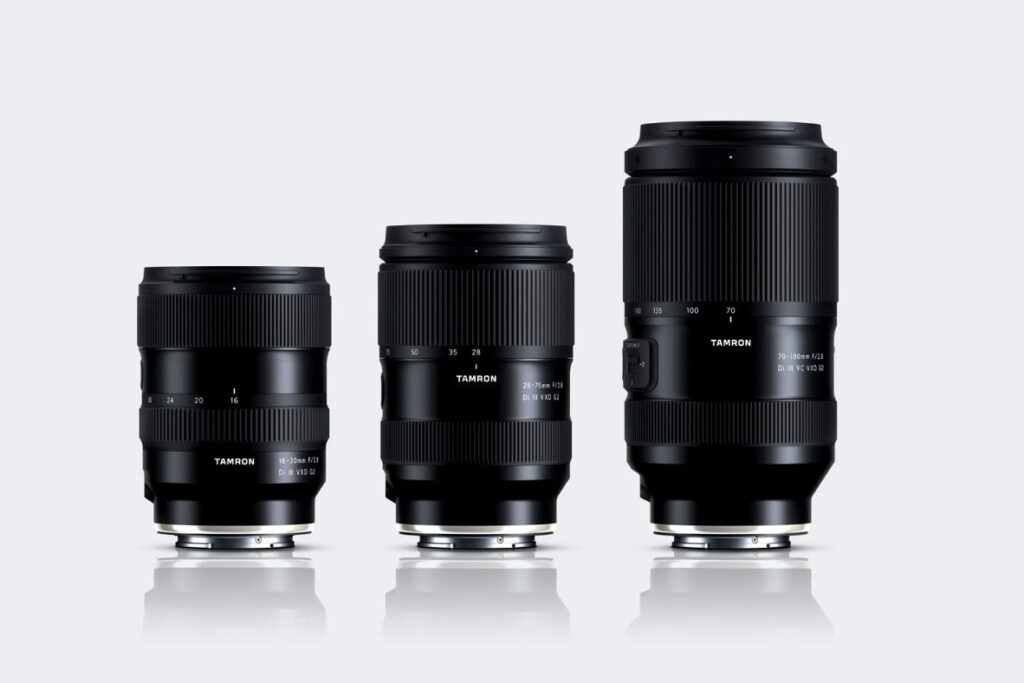
Tamron 16-30mm f/2.8 VXD G2
The long-awaited update to Tamron’s popular 17-28mm f/2.8 RXD.
Despite the increase in zoom range, it only gained a few millimeters in size. It’s still roughly the same size as the old lens. Weight is roughly the same as well.
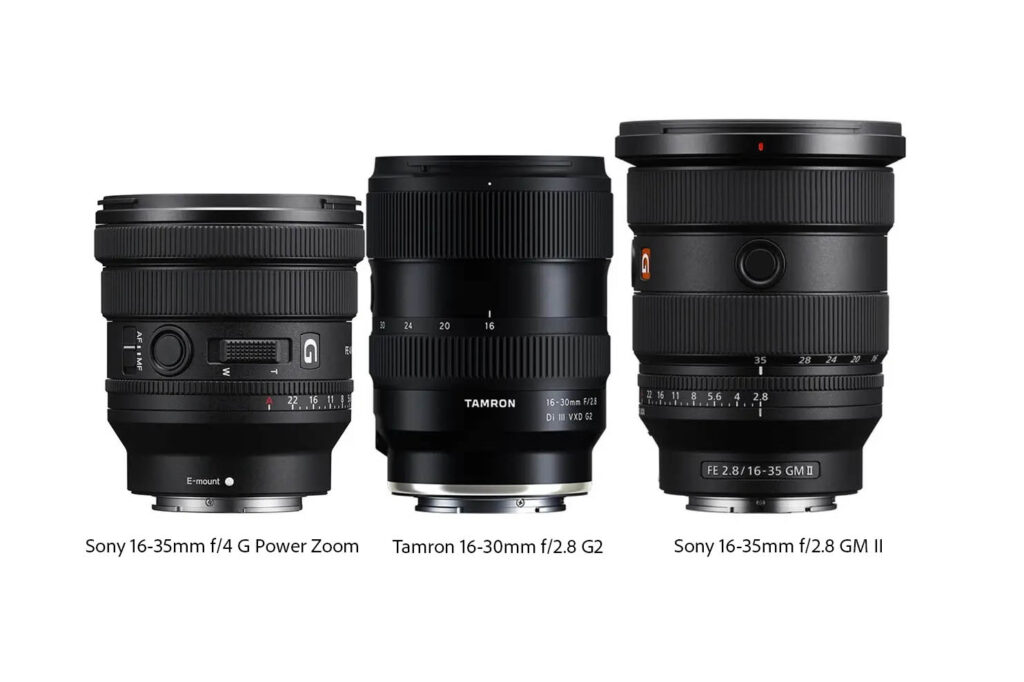
It’s only slightly longer than the Sony 16-25mm f/2.8 G. The Sony lens extends when zooming though, and annoyingly, it is at its longest when the lens is set to 16mm. Size-wise, it’s between the Sony 16-35mm f/4 Power Zoom and the Sony 16-35mm f/2.8 GM II.
It gets Tamron’s latest VXD linear AF motor vs the older RXD motor on the older lens.
Excellent at 16mm. Resolution was definitely optimized for the wide-end. Weakest at 30mm when wide-open, improves when stopped down, but it never equals the wide-end.
If you turn off the lens profile, you’ll see barrel distortion at the wide-end and pincushion distortion from 24-30mm.
To my eyes, bokeh quality is greatly improved from the 17-28mm. Gone is the harshness of the G1 lens, this new version is so much more smoother.
Excellent sunstars.
Overall, highly recommended. I’d pick this over the Sigma 16-28mm for the better seals (Sigma only has a gasket on the mount) and the better AF motor. If you want the best-of-the-best autofocus though, the Sony 16-25mm f/2.8 G should be your top choice.
Tamron 16-30mm f/2.8 specs:
Weight: 440 grams
Dimensions (Φ diameter x length): Φ74.8mm x 101.8mm
Filter size: 67mm
Check current street price: Amazon
Tamron 17-50mm f/4 VXD
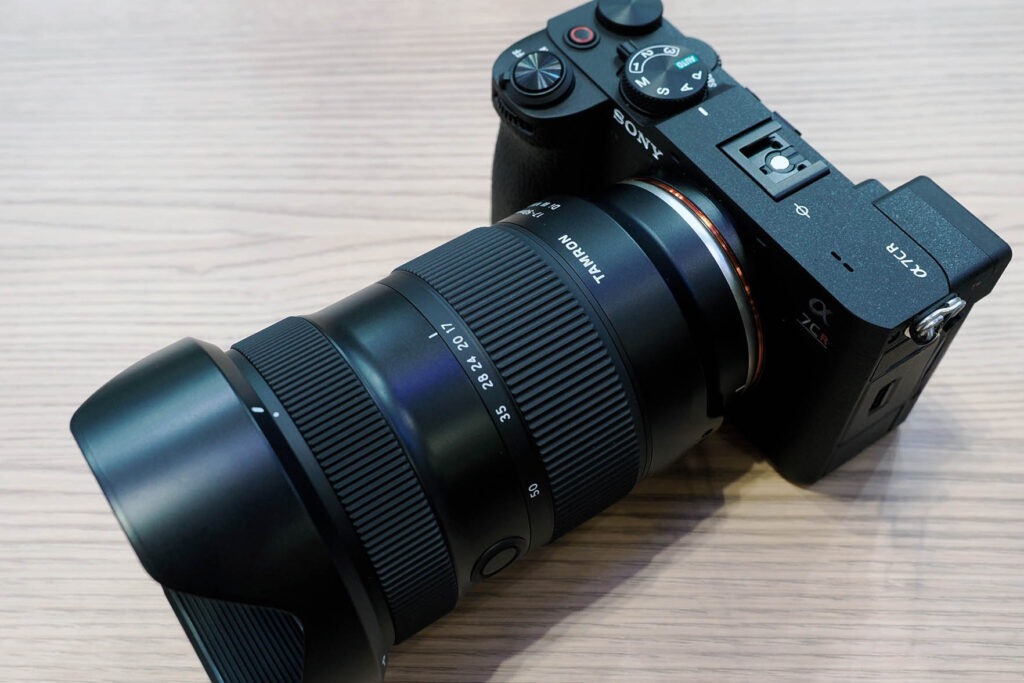
An ambitious zoom range. Can’t think of many lenses with this range. The m43 Olympus 8-25mm f/4 is the closest I can think of. For Sony, I don’t know if I would really compare it with 16-35mm lenses. Perhaps the Sony 20-70mm f/4 G is the closest competitor, although the Sony is quite a bit more expensive.
Non-extending barrel when zooming. Though I wouldn’t exactly call it an internal zoom, since I can feel an inner barrel moving when zooming. Despite that, there is minimal shift in the center of gravity. In my opinion, it is still usable on most gimbals. A non-extending outer barrel is also good for weather sealing.
Sharp in the center, but corners don’t match up to the Sony 16-35mm f/4 PZ or the Tamron 20-40mm f/2.8 (below), at any aperture. Corners are strongest at 17mm, weakest at 50mm. Corners at 17mm are noticeably better than the old Tamron 17-28mm f/2.8 RXD though.
It’s not a small lens (it’s roughly the same size as the Tamron 28-75mm f/2.8), it has a long but thin barrel, but it’s relatively light for what it is. The Tamron 20-40mm f/2.8 and Sony 20-70mm f/4 are smaller.
Focus breathing is well suppressed, but it’s still there.
Overall, this is one of those lenses where you really have to want the focal length. Personally, for my style of shooting, I prefer either the Tamron 20-40mm f/2.8 (below) or the Sony 20-70mm f/4. But, take note, the difference between 17mm and 20mm is huuuuge. And it’s not just in what you’re able to take in in a small room, for example. Even for regular ‘scapes, the difference in perspective is huge.
Tamron 17-50mm f/4 specs:
Weight: 460 grams
Dimensions (Φ diameter x length): Φ74.8mm x 114.4mm
Filter size: 67mm
Check current street price: Amazon
Tamron 20-40mm f/2.8 VXD
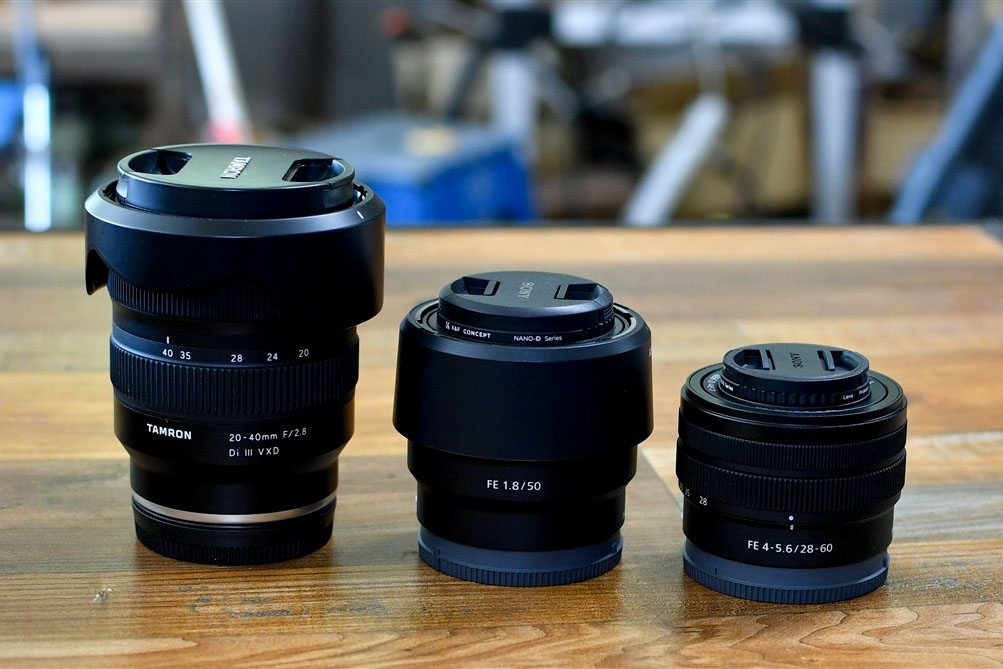
This is an excellent range, covering what most people would consider to be their everyday focal lengths. The fast f/2.8 aperture keeps it shooting in low light. The small size + the range makes this the perfect walkaround lens. It’s a perfect “family day-out” lens, or a backyard barbecue lens.
Some people view this as a standard zoom with the tele end chopped off. But, I think that’s the wrong way of looking at it. I think of this more as a 16-35mm f/2.8 with the wide-end chopped off to make it smaller.
My main disappointment with this lens is the lack of the customizable button. Tamron’s Lens Utility software has a lot of great features, such as the ability to program the lens buttons into a “focus preset” button to jump to a set focus point. This is great for those of us who prefer “zone focusing” for street photography. This would have been the perfect lens to do that, unfortunately, Tamron opted not to try and squeeze it into such a small lens. But, I do understand that it’s a very niche use case and not many people are looking to do that.
Overall, it’s a well-executed sharp little lens. Resolution is excellent whether at close-distances or at infinity. Optically, the biggest issue is the loss of resolution in the corners due to corrections for vignetting. At almost half the price of the Sony 24-50mm f/2.8 G, this is an incredible value. It’s a lens with no fatal flaws.
40mm f/2.8 is fast enough to get some nice background blur:

Tamron 20-40mm f/2.8 specs:
Weight: 365 grams
Dimensions (Φ diameter x length): Φ74.4mm x 86.5mm
Filter size: 67mm
Check current street price: Amazon
Tamron 28-75mm f/2.8 VXD G2
The successor to one of the best selling lenses of all time.
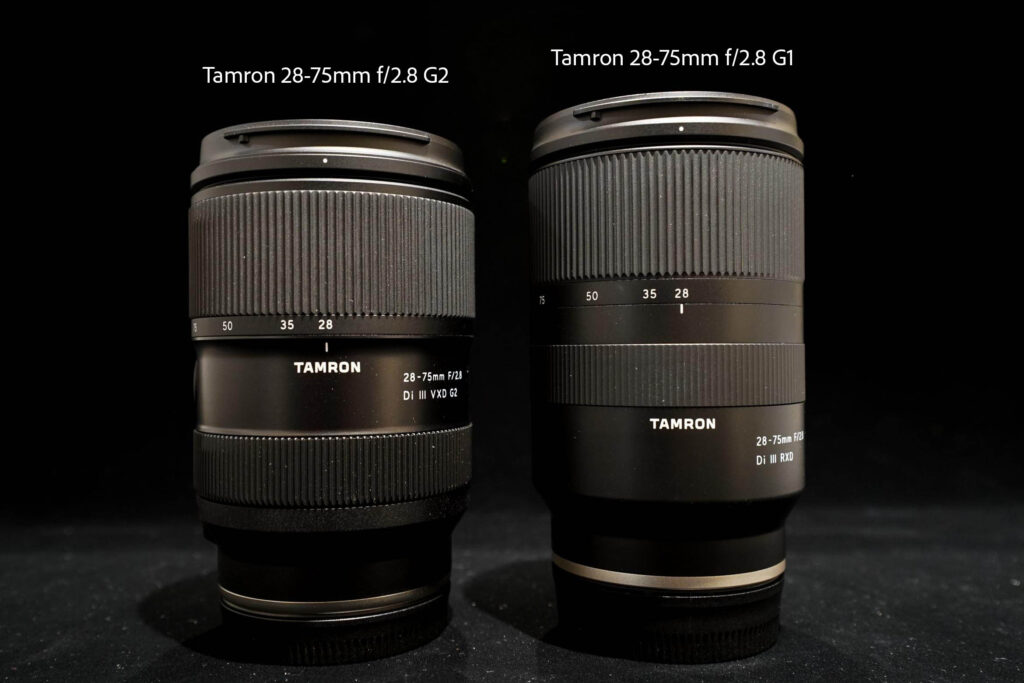
If you’ve used the G1 version, the first thing you’ll notice upon first picking this up is the improved texture and grip. The tapered barrel is also more comfortable for long sessions.
Anyone hoping for a decrease in weight will be disappointed, as Tamron only managed to shave off 10 grams. BUT, considering the increase in lens elements, Tamron should be lauded for keeping the weight the same.
Tamron chose to continue on their winning formula, focusing on optical improvements and an update to the AF motor (RXD to VXD). Unlike the Sigma 24-70mm f/2.8 Art II and the Sony 24-70mm f/2.8 GM II, Tamron eschews an aperture ring here.
It does add a customizable ‘Fn’ button, which you can customize using Tamron’s Lens Utility software or app. The app allows for a lot of functions such as digital follow focus options and switching the functions of the focusing ring, among others. Due to licensing restrictions, third party manufacturers are prohibited from creating lens docks for Sony lenses, so, Tamron cleverly dances around this by instead incorporating a USB-C port on
The lens proudly displays “Designed in Japan” on the barrel, just like the first version. BUT, unlike the first version, this lens is actually Made in Japan as well.
Optically, this G2 is a noticeable improvement over the G1 in almost everything. Resolution and sharpness improvements, especially in the corners at the wide end and long end are noticeable even without extreme pixel peeping. This is an upgrade I would easily recommend even for users of the G1, even for those shooting with a 24 megapixel body.
Unlike Sigma’s 24-70mm f/2.8 ART II, the Tamron relies more on software corrections to do some heavy lifting – for distortion and chromatic aberration corrections, in particular. Similar to the G1, Sigma still wins out in smoothness of bokeh for me. Although the Tamron’s bokeh rendering is vastly improved over the G1.
Here’s a scene shot at 75mm f/2.8, where the G1 would have had trouble with the busy background. The G2 does so much better here, although the Sigma Art would be slightly smoother here.

Center sharpness and resolution, both at the 28mm and 75mm ends are excellent, already reaching peak at f/2.8, with no noticeable improvement when stopping down.
The new VXD motor is excellent. It isn’t as good as Sony’s AF in tracking, but it’s the closest any third-party has come. For tracking shots of a moving subject (across different planes of focus, e.g. someone running towards the camera), I’ve found Tamron’s VXD to perform much better than Sigma’s new HLA linear motor, and not just in this lens.
Against the Sigma 24-70mm f/2.8 Art II and the Sony 24-70mm f/2.8 GM II, the Tamron loses out on not having an aperture ring, but optical quality is competitive. The Sigma 24-70mm f/2.8 II has smoother bokeh quality to my eyes, but the Tamron wins out in sharpness in the extreme corners. I don’t feel that the Sony GM is a competitor at thj
Overall, if you can live without 24mm, this is a serious alternative to standard 24-70mm zooms from Sony and Sigma. If you have no interest in those due to size, the only other competitor in this focal range is the Sigma 28-70mm f/2.8 DG DN Contemporary. Optically, this Tamron is certainly much better than the Sigma 28-70mm f/2.8 DG DN. The Sigma C lens wins out in size and weight though. So, TLDR – if you want portability, get the Sigma Contemporary. If you want something that can compete with 24-70 standard zooms, get the Tamron.
RELATED: The Complete List of Sigma Lenses for Sony (Full Frame)
Tamron 28-75mm G2 Specs:
Weight: 540 grams
Dimensions (Φ diameter x length): Φ75.8mm x 117mm (4.6 in)
Filter size: 67mm
Check current street price: Amazon
Tamron 25-200mm f/2.8-5.6 VXD G2
This is the successor to Tamron’s popular travel zoom and one of my favorite zoom lenses of all time, the Tamron 28-200mm f/2.8-f/5.6. Arguably one of the best travel zooms of all time.
In keeping with its travel zoom aspirations, Tamron chose to keep the size and weight similar to the 28-200mm. This is also likely the main reason why they still did not add vibration correction (VC) (image stabilization) to this lens. Doing so would likely have added quite a bit of bulk and weight.
The good news is that the lens now goes to 25mm, and it gets Tamron’s latest VXD AF motor (vs the old RXD motor in the previous lens).
The new lens also gains half-macro capabilities, albeit it is at 25mm, with a magnification ratio of 1:1.9.
I can’t wait to get my hands on this soon and see how it compares with my 28-200mm. The main thing I am curious about is if Tamron changed the rate at which the aperture changes. On the 28-200mm, you could get f/4.5 up to about 110mm, which is incredible. That lens was basically a 24-105mm f/4 lens, except that, in exchange for 24mm, you get f/2.8 at 28mm and you get a bonus 200mm lens, too!
While the older lens didn’t really have much competition, aside from the rather large Sony 24-240mm f/3.5-f/6.3 OSS, the lens landscape is much more different now in 2025/2026, as Sigma has already released its own travel superzoom – the Sigma 20-200mm f/3.5-f/6.3.
Tamron 25-200mm G2 specs:
Weight: 575 grams
Dimensions (Φ diameter x length): Φ74mm x 117mm
Filter size: 67mm
Check current street price: Amazon
Tamron 28-300mm f/4-7.1 VC VXD
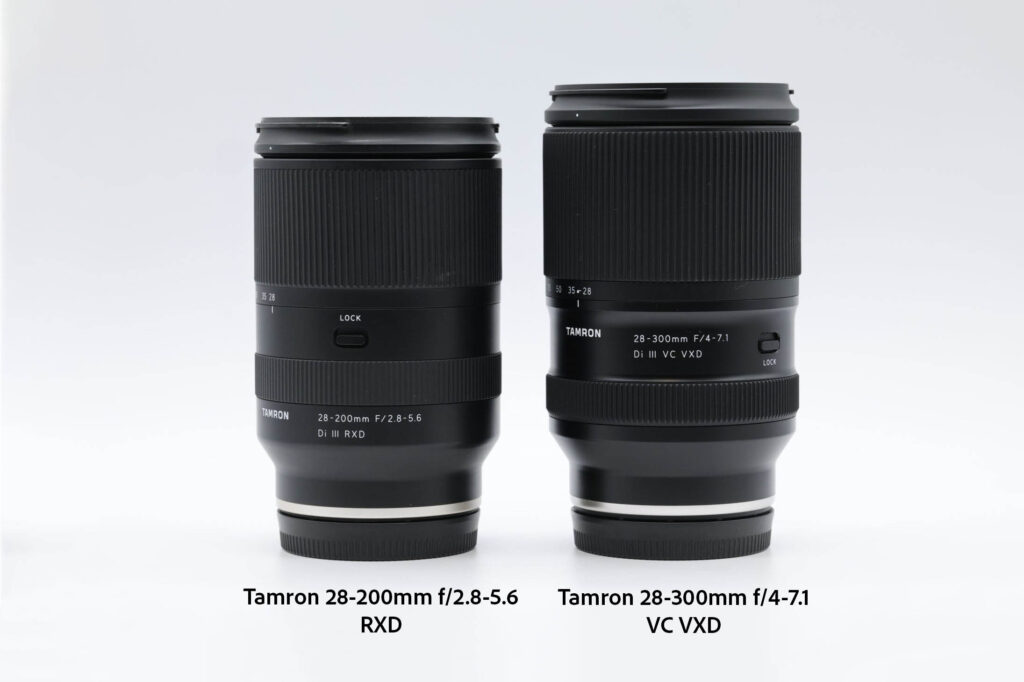
If there is one thing Tamron knows how to do, it’s a super zoom. They have a long history of excellent superzooms that push the boundaries of what was previously possible, dating back to the DSLR days.
At 610 grams and 12.6cm in its retracted state, the size and weight is competitive with all other image stabilized super zooms. BUT, this is the only one that reaches 300mm. All others tap out at either 240mm or 200mm.
This Tamron is roughly the same size, but thinner, than the Canon 24-240mm f/4-f/6.3 IS. It is longer, but thinner, than the Sony 24-240mm f/3.5-f/6.3 OSS. And it is quite a bit smaller and over a 100 grams lighter than the Nikon 28-400mm f/4-f/8 VR.
Overall, its… well, it’s a super zoom. It balances well on the likes of the Sony a7IV, but it can get front-heavy and unwieldy on the Sony a7c series.
It’s not a small lens, but that’s not what a super zoom is supposed to be. A super zooms’ job is to stay on camera as much as possible and minimize lens changes in the field.
Personally, I think it’s impressive that Tamron managed to squeeze a 300mm reach and image stabilization in a 600 gram lens. A lens that is still within the bounds of what can reasonably be called an everyday lens. It’s only about 40 grams more than the Tamron 28-200mm, which does not have image stabilization, for example.
In terms of optics, this lens delivers a mixed but generally impressive performance given its ambitious 10.7× zoom ratio. At 28mm, images show some softness toward the frame edges when shot wide open, but stopping down to f/8 brings a significant improvement. The center remains sharp across much of the range, even at longer focal lengths, and though the corners never quite reach the same level of crispness, especially at 200–300mm, I would say that’s a good trade-off to get a lens with this level of versatility.
Lots of people will complain about the aperture being only f/4-7.1, but, let’s face it, do you really expect to use a super zoom in low light? It’s just not the lens to reach for in low light. A 35mm f/1.8, 50mm f/1.8 and 85mm f/1.8 will all work great in low light. But, can that set-up reach 300mm? How many times do you want to be changing lenses in the park? Pick the right tool for the job.
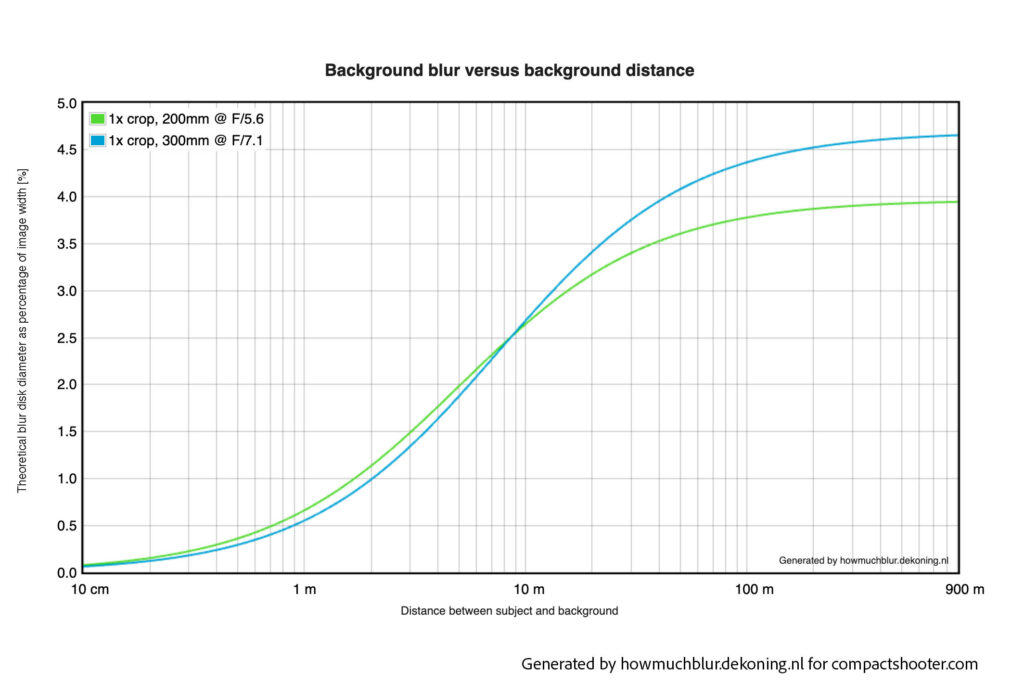
If you’re worried about being able to blur the background, you should know that 300mm at f/7.1 will actually get you slightly more background blur than 200mm at f/5.6 at certain distances, but they will otherwise look the same.
The Tamron 28-300mm is a great option for daylight shooters who want maximum zoom versatility in a travel friendly package.
The range is really quite something, it’s great for outdoor events or kids sports events. Being able to go from 28mm to 300mm in a full frame camera is incredibly fun. When taking only this lens to one of my kids’ events, looking at all my photos at the end of the day, it’s hard to believe they were all taken with just one lens. This lens isn’t just a convenient zoom, it’s a fun and convenient zoom.
Pair this with a bright prime of your choice, maybe the best 35mm for almost everybody? And you’ve got an excellent do it all two-lens combo at under 1000 grams.
Tamron 28-300mm specs:
Weight: 610 grams
Dimensions (Φ diameter x length): Φ77mm x 126mm
Filter size: 67mm
Check current street price: Amazon
Tamron 35-150mm f/2-2.8 VXD
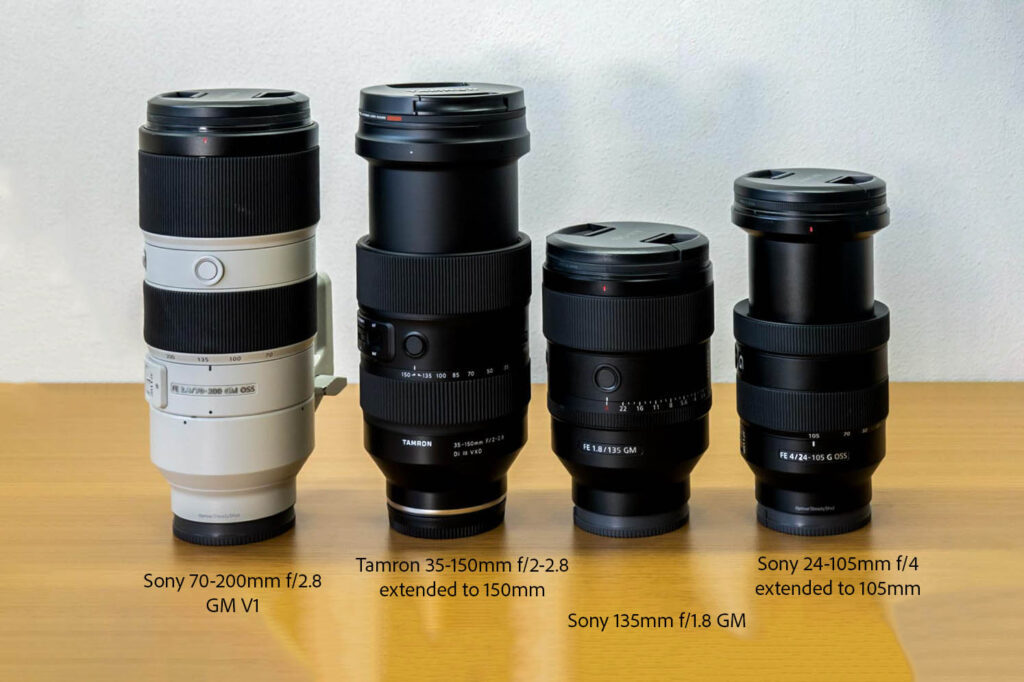
The lens that broke the internet. Although Tamron had previously done a 35-150mm lens for DSLR cameras before, that was a considerably less exciting f/2.8-f/4 lens.
This mirrorless design is more than just a reboot, it’s quite a bit more ambitious. With a 21-element, 15-group design, Tamron did not settle for just a constant f/2.8, nope, Tamron decided to do one better and gave us a full stop more at the 35mm end.
When I first picked up this lens, I knew this was not a convenient zoom lens. It was heavy. Seriously heavy. But could I walk around with a 35mm f/2 prime and two other zooms, or a couple more primes hanging around my neck? No. But, I could carry just this one lens. If you think about it that way, it doesn’t feel that heavy.
Seriously, think of the Sony FE 35mm f/1.8, the Zeiss 55mm f/1.8 prime and the Tamron 70-180mm f/2.8 around your neck or in your bag? What is more convenient? What is more versatile for most situations?
This lens redefines how we think about versatility.
150mm is still long enough to work where a 70-200mm normally would:

Optically, the Tamron 35-150mm f/2-f/2.8 delivers exceptional results across nearly the entire zoom range. Central sharpness is already excellent wide open, and even at the corners, resolution remains strong, particularly when stopped down to f/5.6 or smaller.
Contrast is excellent. Chromatic aberration is virtually absent, and spherical and axial aberrations are well controlled. Distortion is minimal, some barrel distortion at the wide end and pincushion distortion towards 150mm, but easily corrected in post.
Vignetting, however, is quite pronounced at wider apertures, especially at 35mm f/2 and 150mm f/2.8, and remains the most visible optical flaw. Backlight resistance is good, with flare and ghosting largely suppressed, though contrast can suffer when shooting directly into strong light sources.
I am not the biggest fan of the bokeh rendering, although it is generally smooth and attractive, thanks to a nine-blade diaphragm, with only slight angularity appearing when stopped down. It’s one of those YMMV things.
If you’re prepared to overcome the single biggest hurdle – the weight – you’ll have a lot of fun with this lens. Especially for those who take photos of active children or pets, portraits, events, the peace of mind this lens provides of never missing a photo opportunity will be priceless. This is a lens that rewrites the way we think about zooms. It’s just a matter of asking yourself if the results and the convenience of one lens outweigh the… weight.

Above, Tamron 35-150mm at 35mm f/2.

Above, Tamron 35-150mm at 150mm, f/2.8.
Tamron 35-150mm Specs:
Weight: 1165 grams
Dimensions (Φ diameter x length): Φ89.2mm x 158mm
Filter size: 82mm
Check current street price: Amazon
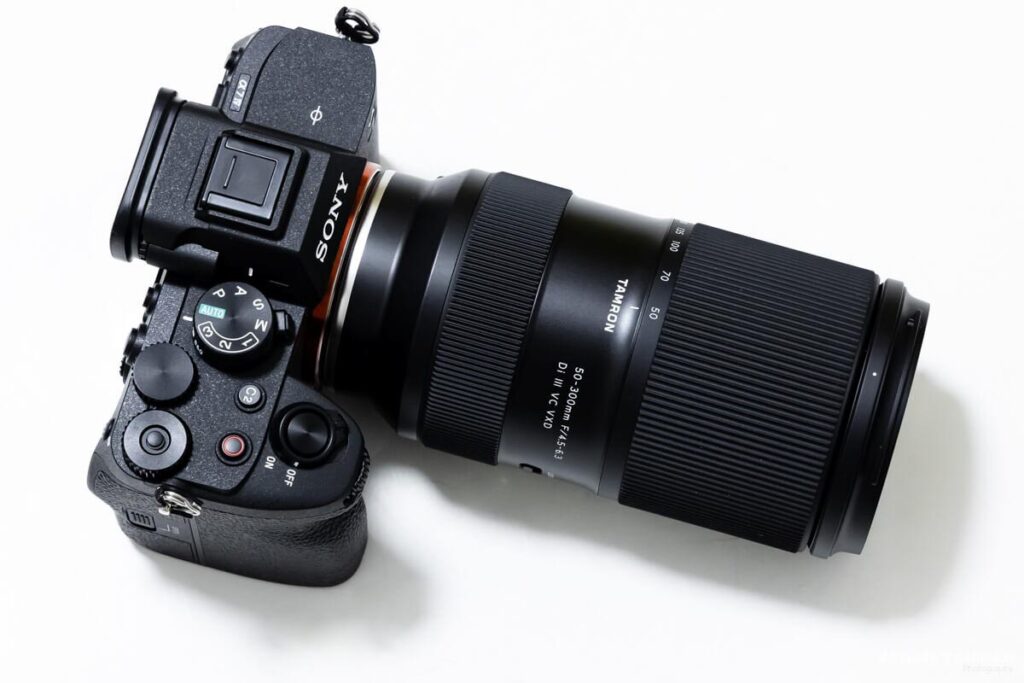
Tamron 50-300mm f/5-6.3 VC VXD
This is one of those lenses that don’t sound too exciting on paper, but is the complete opposite in actual, real world use. In fact, this is easily one of the best budget telephoto zooms for Sony E mount right now.
Generally sharp across the frame on the wider end (from 50-100mm). Still sharp in the center across the entire zoom range, but there is some loss of contrast towards the longer end, and the edges don’t quite match center sharpness.
Vignetting is probably the biggest weakness, it’s present in all focal lengths, whether at close focus or at infinity. At 300mm, even stopped down and focused at infinity, vignetting requires correction.
But, overall, there is nothing here that I would call a dealbreaker. The biggest question is probably in terms of value. This lens is almost double the price of the budget Tamron 70-300mm RXD. But, this lens has the newer VXD AF motors, always nice to have especially for telephoto lenses, has vibration correction (VC), a custom button, better minimum focus distance and more importantly, goes to 50mm. For me, that last bit makes the price difference more than worth it, but that’s one of those really big YMMV things. The way I see it, having the ability to go to 50mm saves me from a potential lens change in many instances.
The disadvantage of this lens compared to the Tamron 70-300mm (below) is the price and that its about 1/3 to 2/3 of a stop darker in some of the shared focal range.
Tamron 50-300mm aperture range:
50mm – f/4.5
70mm – f/5
100mm – f/5.6
180 – f/6.3
Annoyingly, Tamron doesn’t publish a CIPA rating for expected effectiveness of image stabilization (VC), but it appears to be at least 3 stops consistently on the long end. It does feel more effective at under 50-100mm, maybe up to 4 stops in that range.
At 40% less weight than the Tamron 50-400mm (below), this is one of the best travel or hiking telephoto lenses in Sony E mount right now, whether you shoot full frame or APS-C.
Tamron 50-300mm Specs:
Weight: 665 grams
Dimensions (Φ diameter x length): Φ78mm x 150mm
Filter size: 67mm
Check current street price: Amazon
Tamron 50-400mm f/4.5-6.3 VC VXD
You’ll see a lot of comparisons between this lens and the Tamron 50-300mm (above), but I don’t think these two lenses should be compared at all. The 50-300mm (above) is Tamron’s upgrade to the usual 70-300mm consumer zoom. While this lens, the Tamron 50-400mm is Tamron’s take on the usual 100-400mm telephoto.
By ambitiously taking this lens to 50mm, Tamron has doubled the 4x zoom coverage of a typical 100-400mm lens into an 8x coverage, all at the same size and weight as most first-party 100-400mm lenses.
And, this isn’t some nerfed down budget version either – all the expected quality of life improvements are here – there is a removable tripod collar (Arca compatible); image stabilization (VC); extensive weather sealing, a customizable button and even a custom switch.
The biggest knock here vs the Sony 100-400 GM is that the Tamron is not compatible with any teleconverters for Sony E mount. Because of licensing restrictions, it is extremely unlikely that any third party lenses will be compatible with any teleconverters for Sony E-mount even in the future.
Resolution is excellent throughout most of the range. Some edge softness at 50-100mm, and a slight resolution drop at 400mm, improved by stopping down two stops. But overall, this lens is excellent even on the 61MP bodies like the A7RV.
Tamron 50-400mm aperture range:
50mm – f/4.5
61mm – f/5
84mm – f/5.6
151mm – f/6.3
Overall, similar to the 50-300mm lens (above), this is a lens with no major optical issues. Distortion (noticeable at 50mm and 300mm) and vignetting (noticeable pincushion distortion throughout the entire range) are the biggest things, but are easily corrected in post.
The tripod foot is a separate purchase – it’s the Tamron A035TM. There are also several third-party options, such as the Haoge LMR-TL540.
Without the tripod foot, this lens weighs in at 1155 grams, similar to most 70-200mm f/2.8 lens. That’s pretty impressive. And it’s a black lens, for those of us who dislike looking like a sports journalist hauling around a white lens.
Flexibility is really the main theme here. Being able to shoot at 50mm without changing lenses, being able to shoot half-macro @ 1:2, at 50mm is also incredibly useful. It’s what I would call a ‘well-balanced’ lens, excellent value, with no real negatives. Definitely recommended.
Tamron 50-400mm Specs:
Weight: 1155 grams
Dimensions (Φ diameter x length): Φ88.5mm x 183.4mm
Filter size: 67mm
Check current street price: Amazon
Tamron 70-180mm f/2.8 VC VXD G2
Similar to the G2 version of the Tamron 28-75mm f/2.8, this lens is designed and manufactured in Japan.
The big updates over the first version are the addition of the faster VXD AF linear motors and image stabilization (VC).
This G2 version is slightly larger and heavier, but it keeps the same 67mm filter thread that is shared across most of Tamron’s lenses.
Despite the big weight reduction that the Sony 70-200mm f/2.8 GM II went through, this Tamron lens is still meaningfully lighter. The Tamron remains an externally zooming lens, while the Sony and the Sigma 70-200mm are both internally zooming, meaning their lens barrel does not extend when you zoom.
It gets a USB-C port for updating firmware and connecting with Tamron’s Lens Utility software. The big miss in build and handling is that Tamron didn’t add a switch for image stabilization and we don’t get an aperture ring which all 70-200mm competitors now have.
The VXD autofocus motor is a clear step-up from the RXD motor on the older lens. It is still not as good as Sony’s XD linear motors though. If we have a subject running full speed towards the camera, and we rate Sony’s XD linear motors with a hit-rate of 100% as a baseline, I would rate Tamron’x VXD motor at about 70-80% hit rate, while Sigma’s HLA motor would be closer to 60-70% hit rate.
At 70–100 mm, the lens is already razor-sharp wide open at f/2.8. The center and corners both look good, with only a tiny improvement shown by stopping down a little. From 135–180 mm, there’s a small drop in sharpness, but it evens out nicely by stopping down two stops.
Color and contrast are excellent. The lens handles chromatic aberration very well, both axial and lateral fringing are well controlled, even at wide apertures. Pretty good for a lens at this price point.
Distortion is automatically corrected in-camera, though Raw shooters will notice a bit of pincushion distortion at the telephoto end. Vignetting is visible across the zoom range at f/2.8 but is gone by f/4.
The bokeh is smooth and pleasant, though you can see a bit of onion-ring texture in bright highlights. It is vastly improved over the G1, in my opinion. Sigma still has smoother bokeh to my eyes, but the Tamron is close.
In backlit scenes, the lens handles flare and ghosting well. There’s still a little in extreme situations, but is mostly well controlled.
Overall, it’s the same story as the first version. Tamron has managed to create a true budget alternative to the Sony 70-200mm f/2.8 GM II. You’re getting 85%-90% of the performance at a much lower cost. But, this time, it feels less like a budget version. The addition of the VXD motors and image stabilization make it more competitive with the upgraded Mark II version of the Sony GM.
The addition of vibration correction (VC) also makes this lens a viable consideration for APS-C shooters with a body with no IBIS, such as the Sony a6400.
Just like the Tamron 28-75mm f/2.8 G2, this is one of the best value lenses in all of E-mount. From a price to performance perspective, I would rate this lens much higher than the Sigma 70-200mm f/2.8 DG DN. Highly, highly recommended.
Tamron 70-180mm G2 Specs:
Weight: 855 grams
Dimensions (Φ diameter x length): Φ83mm x 156.5mm
Filter size: 67mm
Check current street price: Amazon
Tamron 70-300mm f/4.5-6.3 RXD
Small-ish, relatively light, and affordable. That pretty much sums up Tamron’s affordable telephoto lens.
Anyone expecting a feature-rich design is going to be disappointed here. There is no image stabilization, no buttons or switches of any kind on the lens, it uses Tamron’s older RXD AF motors, MFD is at 1.5 meters. What we get is a no frills design, but it is also one of the smallest and lightest telephoto lenses for Sony E mount.
Currently, I feel that this lens earns its place because there isn’t really any competition. Not at this price point, and not anywhere near this point. The Sony 70-300mm f/3.5-5.6 OSS, for example, goes for a full $1100 more than this lens.
At 70mm, center sharpness is good even wide-open, with improved corners stopped down to f/8-f/11. As you zoom toward 200mm, performance remains even across the frame, though the corners soften slightly. At the 300mm end, center sharpness holds well, but edges lose some resolution; stopping down to f/8 or f/11 brings them back into line.
Chromatic aberration is well controlled, with only faint color fringing visible in high-contrast areas, when in-camera corrections are disabled. Vignetting is mild at wider apertures and largely disappears by f/8.
Turn off corrections and you will notice a touch of pincushion distortion at longer focal lengths, easily corrected in-camera or in post.
The bokeh is quite good. Blur appears soft overall, though out-of-focus highlights show faint onion-ring texture, which makes busy backgrounds look unattractive (e.g. foliage). But, if you take a little bit of care and avoid busy backgrounds, this won’t be a major issue for portraits and nature photography.
With that said, this lens is definitely built to this price point. It’s a competent lens for those who just want the option to reach to 200-300mm once in a while. This isn’t a lens that can be praised for “outstanding optical performance” or “outstanding features or AF”, but it’s a more than passable lens. Read that again. It’s not a bad lens. It does not fall into the ‘not recommended’ category. It’s a more than passable lens. It may even be considered a great value at this price point, depending on your needs and expectations. The reality is, even if Sony were to make a “budget” 70-300mm lens, it will never come near this price point.
If you only need a telephoto lens occasionally, or if you need a lightweight telephoto lens for social media content use, this is a great option.
Tamron 70-300mm Specs:
Weight: 545 grams
Dimensions (Φ diameter x length): Φ77mm x 148mm
Filter size: 67mm
Check current street price: Amazon
Tamron 150-500mm f/5.6-7.1 VC VXD
Tamron’s equivalent to the Sony 200-600mm f/5.6-6.3 G lens, except at $900 less.
Probably one of Tamron’s most eagerly awaited lenses prior to launch. This is Tamron’s birding and wildlife lens, aiming to provide all the bells and whistles of first party 200-600mm lenses at consumer level pricing.
It comes in at well under the 2115 grams of the Sony and in its collapsed state is much smaller in the bag than the Sony which is an internally zooming lens.
One big plus over the 200-600mm is the close focus ability of the lens making it a great lens for photographing butterflies and flowers. This lens has an MFD of 0.6 meters or 23.6 inches at 150mm and 1.8 meters or 70.9 inches at 500mm, giving you a 1:3.1 magnification ratio at 500mm.
Arca compatible tripod foot is included in the box. This lens is not compatible with any teleconverters for Sony E mount.
Tamron 150-500mm Specs:
Weight: 1880 grams ; 1725 grams without tripod foot
Dimensions (Φ diameter x length): Φ93mm x 209.6mm
Filter size: 82mm
Check current street price: Amazon
Full Frame Primes
Released way back in 2019, the first three primes all use the same body, with minute differences in weight. All three use the same 67mm filter thread that almost all Tamron lenses use, and all are capable of 1:2 macro.
However, there’s one thing worth pointing out: the first three lenses below don’t use a modern stepping or linear AF motor, but an older-style DC motor instead. This design isn’t ideal for mirrorless cameras that rely on live view focusing, and the response can feel a bit sluggish. There’s also noticeable focus breathing – where the field of view changes as you focus – which can further slow down autofocus performance, especially at close distances.
Tamron 20mm f/2.8 OSD
Weight: 220 grams
Dimensions (Φ diameter x length): Φ73mm x 64mm
Filter size: 67mm
Check current street price: Amazon
Tamron 24mm f/2.8 OSD
Weight: 215 grams
Dimensions (Φ diameter x length): Φ73mm x 64mm
Filter size: 67mm
Check current street price: Amazon
Tamron 35mm f/2.8 OSD
Weight: 210 grams
Dimensions (Φ diameter x length): Φ73mm x 64mm
Filter size: 67mm
Check current street price: Amazon
Tamron 90mm f/2.8 Macro VXD
Tamron has a long history of making excellent macro lenses, and this one continues that tradition. It’s sharp, fast, and fun to use.
This lens has full weather sealing, so you can use it outdoors without worrying too much about dust or light rain.
The autofocus system is one of the best things about this lens. It uses Tamron’s VXD motor, which makes focusing extremely fast and very quiet. Autofocus is accurate, even when shooting close-ups, and it also performs really well when recording videos. Many macro lenses focus slowly because they have to move through a wide range of distances, but this one feels quick and confident. If you prefer manual focus for macro work, you can customize how the focus ring behaves to suit your own shooting style.
Macro lenses are generally extremely sharp, and this lens is no exception. Not just in the center, but all the way to the edges. Even when zooming in on the details, everything looks crisp. The background blur, or bokeh, is smooth and natural, which helps your subject stand out. This makes it a great lens not only for macro shots, product photography etc.. but it can also double as portrait lens.
Colors and contrast look great, too. Chromatic aberrations are almost completely gone. There’s very little distortion, though you might notice a small bit of barrel distortion if you shoot flat subjects like paper or walls. It’s very minor and easy to fix in post.
The lens handles light well, with minimal flare or ghosting even when shooting toward bright light sources.
If there’s one small downside, it’s that there’s no switch on the lens to change between autofocus and manual focus. You have to do that from the camera menu. Some people might find that inconvenient, especially when working quickly in the field. But aside from that, there’s not much to complain about.
Overall, the Tamron 90mm f/2.8 Di III Macro VXD is one of the best macro lenses you can buy for Sony E-mount. It’s sharp, fast, well-built, and easy to use, all at a very good price.
Tamron 90mm Macro Specs:
Weight: 630 grams
Dimensions (Φ diameter x length): Φ79.2mm x 126.5mm
Filter size: 67mm
Check current street price: Amazon
APS-C Zooms
Tamron 11-20mm f/2.8 RXD
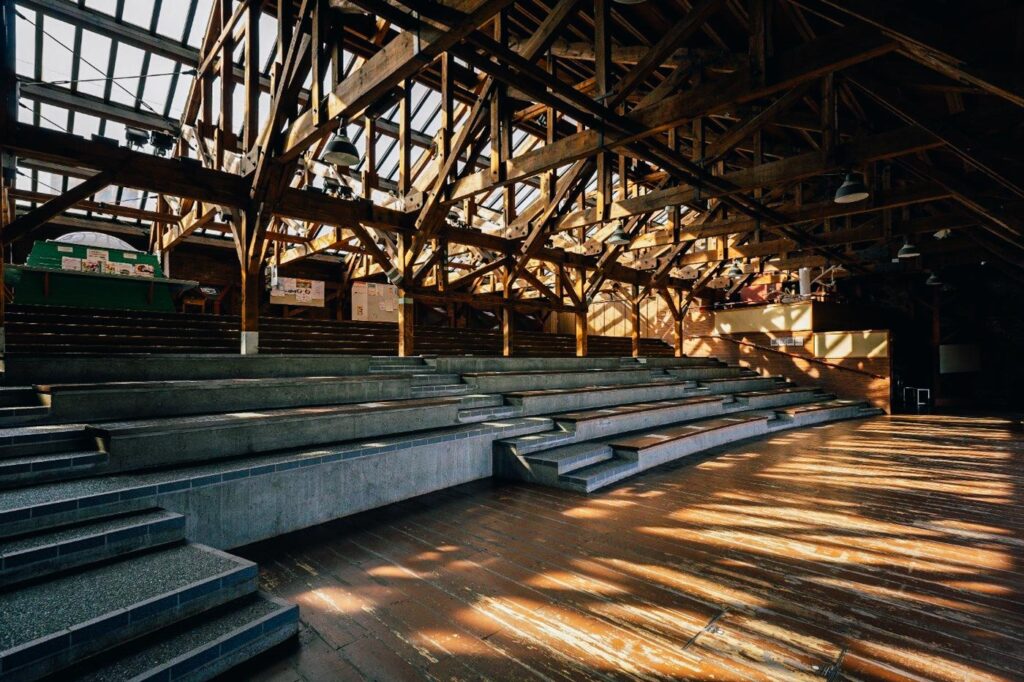
Prior to the release of this lens, Sony users who wanted an ultra-wide angle (UWA) zoom only had one main choice: the first generation Sony 10-18mm f/4 OSS.
For a short time, this was the only choice if you wanted a fast aperture UWA zoom for Sony.
Today, the Gen 1 Sony lens has been replaced by the current gen Sony 10-20mm f/4 G PZ, and Sigma has also released the tiny Sigma 10-18mm f/2.8 Contemporary lens.
Weighing just 335 grams and measuring 86mm long, this lens is the largest of the current UWA options for Sony APS-C, but it still balances nicely even on small cameras like the Sony a6400 or Sony ZV-E10.
It’s weather-sealed and the front element has a fluorine coating to resist fingerprints and dirt. Like other Tamron lenses for Sony, it uses a 67mm filter thread, making it easy to share filters between lenses such as the Tamron 17-70mm f/2.8 (above).
It’s the largest of all the UWA zoom options for Sony APS-C at this time, but it is still a relatively small lens.
Inside, the lens uses 12 elements in 10 groups, including several special glass types to control distortion and color fringing. Autofocus is handled by Tamron’s older RXD stepping motor. The use of the older AF motor is less of an issue in real-world use for an UWA vs a lens with longer reach. In use, it locks on quickly and stays quiet enough for recording without picking up motor noise. The lens can also focus quite close, achieving up to 0.25x magnification at the wide end, though you’ll need to watch out for shadows because of the short working distance.
It’s sharp across the frame even at f/2.8, especially at 11mm where center sharpness is excellent. The edges stay strong, and stopping down a bit improves corners further. Chromatic aberration and color fringing are well-controlled, even with in-camera corrections turned off. Barrel distortion is visible if you disable lens profiles, but it’s easily corrected in post.
Bokeh isn’t a major focus for an ultra-wide zoom, but the fast f/2.8 aperture still allows for some background blur when shooting close-ups. The lens handles backlight well, though some flare and ghosting can appear at smaller apertures, which is one of its weak spots.
If you’re looking to maximize coverage, this is a lens that pairs well with Tamron’s 17-70mm f/2.8, giving you full coverage from 11mm to 70mm at a constant aperture with a combined weight of under a kilo.
For an APS-C UWA, I still prefer the Sigma 10-18mm f/2.8 over this Tamron, if only because of size and weight and the slightly wider field of view. But, overall, this is an excellent choice for an UWA for Sony APS-C.
Tamron 11-20mm Specs:
Weight: 335 grams
Dimensions (Φ diameter x length): Φ73mm x 86.2mm
Filter size: 67mm
Check current street price: Amazon
Tamron 17-70mm f/2.8 VC RXD
Released in 2020 as Tamron’s first constant f/2.8 zoom for APS-C cameras, this lens has proven to be very popular since then. Before this lens, many zooms for APS-C started slower, like f/3.5 or f/4. With a bright aperture throughout the range, and an incredibly useful range, which covers most things people shoot: landscapes, portraits, everyday scenes, street etc.. this has proven to be one of Tamron’s best sellers.
In terms of build and design, the lens is mostly made of strong plastic but feels solid. It has weather seals to resist dust and water, and the front element has a fluorine coating to keep off fingerprints and moisture. The lens uses Tamron’s preferred 67 mm filter thread, which matches many other Tamron lenses. It’s a complex design with 16 optical elements in 12 groups, including special elements that help reduce distortions and color fringing. The lens extends by about 3 cm when you zoom from wide to telephoto.
Weighing about 525 grams and measuring 119.3 mm in length, it’s not a small lens in my book, it’s roughly the same size as the Sony 24-105mm f/4 OSS. On a small camera body like a Sony a6400 or ZV-E10, it is front heavy, but not entirely unmanageable for all-day use. It feels better on bodies with a bigger grip, like the Sony a6700.
Below, you can see it compared to another popular walk-around lens, the Sigma 18-50mm f/2.8 Contemporary Lens.
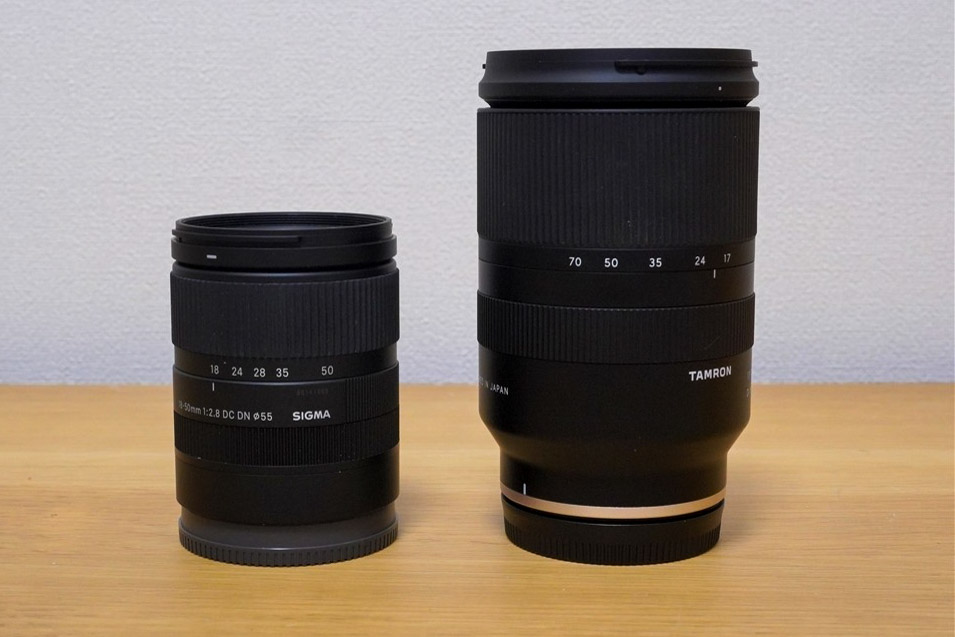
Annoyingly, there is no AF/MF switch on the lens, so you must toggle focus modes via the camera menu. Autofocus is handled by Tamron’s RXD motor. In good light, AF is fast, quiet, and accurate, and it works well with features like Eye AF. In lower light or on older cameras, the lens may hunt or struggle a little. The minimum focusing distance is quite good: as close as 19 cm at the wide end, giving a maximum magnification of around 0.21x. That means you can get fairly close to your subjects, though the lens’s shadow might creep into your shot at very close distances.
Resolution and sharpness are good to excellent. The lens does very well, especially at the center. At 17 mm, the center is sharp even at f/2.8. The edges are good, but improve when you stop down a bit. From 24mm up to 50mm, sharpness in the center remains strong wide-opn, but the edges soften more, stopping down helps. At 70 mm, edge sharpness is weaker wide open, and the center is acceptable, but not stellar until you stop down to f/4 or f/5.6.
Distortion is noticeable – barrel distortion at 17 mm, and pincushion at telephoto – but it is largely corrected automatically in-camera using lens profiles, or in post. Vignetting is strongest at 17 mm and f/2.8, mild at f/4, gone by f/8. Chromatic aberration is well controlled, and in many normal shooting situations you won’t see much color fringing. If you disable lens corrections, some purple fringing or color shifts in high-contrast edges will appear, but stopping down reduces these.
For video shooters, there is almost no focus breathing. Bokeh is okay, in line with the G1 versions of the 28-75mm f/2.8 and 70-180mm f/2.8 for full frame, meaning, it’s not as good as the G2 versions of those lenses. Still, I would not hesitate to use this ens for portraits and shots where the subject needs separation from the background.
Using the lens in real life, it feels like a 24-105mm f/4 would on full frame. It’s a real workhorse and it’s flexible: you can shoot wide landscapes at 17 mm, then zoom to portrait length at 70 mm without changing lenses. The constant f/2.8 means you don’t have to worry about losing light as you zoom. The stabilization helps at moderate shutter speeds. It’s a great option for travel, for events, for everyday use. Especially on cameras without stabilization like the a6400, the built-in VC is a big plus.
Below, you can see just how much reach you can get, with one shot at 17mm and the following shot at 70mm.


The lens is larger than the Sigma 18-50mm f/2.8, so it feels less discreet. The lack of switches on the barrel is a minor annoyance because you must use camera menus. Also, though autofocus is generally good, it can’t quite match Sony’s own linear motors in low light or for very fast-moving subjects. This lens uses Tamron’s older RXD motors and Tamron’s new VXD AF motors are also better for fast-moving subjects.
Overall, this is an excellent all-around lens. It offers a wide zoom range, constant brightness, stabilization, solid sharpness, good close-up ability, and video-friendly traits like minimal focus breathing. For many photographers, this lens can replace two or three lenses. At this price point, it strikes a brilliant balance between performance and versatility, with size perhaps being the major roadblock for most people. But, if the size doesn’t bother you, it is one of the most compelling lenses you can get for APS-C.
Tamron 17-70mm Specs:
Weight: 525 grams
Dimensions (Φ diameter x length): Φ74.6mm x 119.3mm
Filter size: 67mm
Check current street price: Amazon
Tamron 18-300mm f/3.5-6.3 VC VXD
One of the most versatile zoom lenses ever made for APS-C mirrorless cameras. It’s the first lens of its kind to offer a 16.6x zoom range for Sony E mount, covering everything from wide-angle landscapes to distant telephoto shots in a single, relatively small-ish lens. It’s the definition of an “all-in-one” travel lens.
With a weight of 620 grams, that’s almost exactly the same as the telephoto-only Sony 70-350mm OSS lens (625 grams).
It was one of the first Tamron lenses to use their VXD linear AF motor. This system is fast, quiet, and accurate, in my opinion still the best third-party manufacturer AF right now. It’s not as good as Sony’s linear AF, especially for tracking subjects moving across different planes of motion, but, for third party glass, it is currently the best there is.
Being a superzoom, its claim to fame obviously has to be its versatility. At the wide end (18mm), it can focus as close as 15cm, giving a half-macro magnification of 0.5x, unusually high for a zoom, but Tamron has shown that they’re good at that. At 300mm, it still manages a respectable 0.25x magnification, making it great for detail shots, flowers, or even small wildlife. This close-up ability, combined with a fairly soft background blur and pleasant bokeh, makes the lens surprisingly creative for casual macro-style shooting.
Below, you can see what an incredible range 18-300mm (equivalent to 27-450mm) can give you:
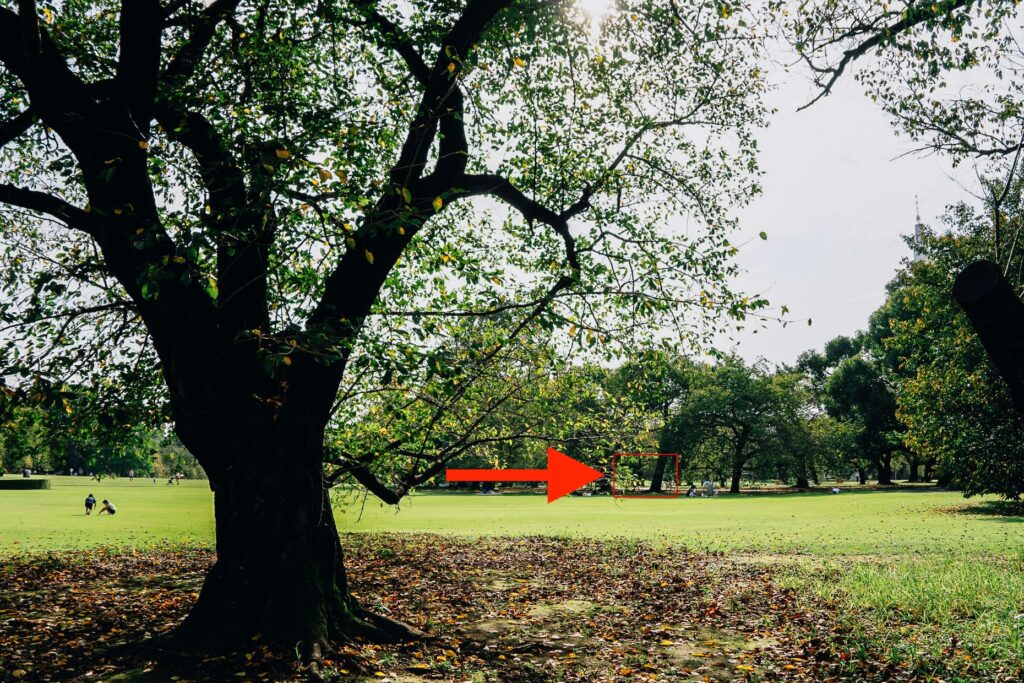

Optical performance is impressive for such a long zoom range. From 18mm up to about 200mm, sharpness in the center is excellent, with only a small drop in quality at the extreme edges. At 300mm, resolution dips slightly, especially toward the corners, but remains very usable. Stopping down to around f/8 improves clarity. Distortion is visible – barrel distortion at 18mm and pincushion at the telephoto end – but it’s relatively mild, and in-camera corrections or post-correction can fix it easily. Vignetting and chromatic aberration are mild and well-controlled, with only a touch of color fringing visible when wide open. The lens’s coatings are good at reducing flare, though some ghosting and light streaks can appear when shooting directly into bright light.
The TLDR for optical quality is: If it’s been awhile since you’ve used a superzoom lens, then you should know that these modern designs are nothing like the superzooms from the DSLR era. The difference in optical quality is night and day.
The built-in image stabilization (VC) is effective. You can see the frame snap into place in the viewfinder if you switch it off and on. In real-world use, sharp handheld results are possible at shutter speeds as slow as 1/8 second at 300mm, though results are more consistent at around 1/25 second. YMMV. Take it easy on the caffeine and you’ll be fine.
In actual use, despite the slower aperture, the Tamron 18–300mm feels like a lens that can do nearly everything. It’s perfect for travel, outdoor walks, family events, or as a one-lens solution for creators who don’t want to carry a full kit. It’s not a professional lens for critical image quality, but for everyday shooting, it delivers impressive results. The center sharpness, color, and contrast are all excellent, and the lens can handle everything from architecture to wildlife with ease.
There are no unexpected trade-offs. Autofocus slows down in low light because there just isn’t enough light hitting the sensor; the corners can be a bit soft at 200-300mm, and distortion is noticeable without correction. The lens lacks external controls like an AF/MF switch or way to turn image stabilization off.
When it first came out, it was the only game in town. But, now, Sigma has their own 16-300mm superzoom in the mix. The Sigma obviously goes wider, which is what you want in a super zoom. The more range = the more you don’t feel the need to change lenses, which is what a superzoom is all about. The Sigma also has a higher rating for image stabilization at the long end (6 stops) vs 4.5 stops on the Tamron. But, the Tamron claws some of that back with its brighter aperture. The Tamron is at f/5.6 from roughly 90mm to 155mm, and f/6.3 from 156mm to 300mm. The Sigma is already at f/6.3 by ~90mm. Basically, the Tamron is 1/3 stop brighter than the Sigma from ~90mm to ~155mm and again at 300mm.
Ultimately, this is a near-perfect travel companion. It combines reach, close-up ability, and surprisingly strong optics in a single lens that weighs less than most telephoto zooms. Highly recommended.
Tamron 18-300mm Specs:
Weight: 620 grams
Dimensions (Φ diameter x length): Φ75.5mm x 125.6mm
Filter size: 67mm
Check current street price: Amazon
APS-C Prime Lenses
None. As of this date, Tamron has not released an APS-C prime lens for Sony E-mount or any mount.
Complete list of Sigma APS-C Lenses for Sony E-mount
Pingback: The Complete Guide to Sigma Lenses for Sony E-mount (APS-C) - Compact Shooter
Pingback: The Complete List of Sigma Full Frame Lenses for Sony E Mount (FE) - Compact Shooter
Pingback: Complete list of Viltrox lenses for Sony APS-C - Compact Shooter