This is a complete guide to all current production Sigma full frame lenses for Sony E mount (FE).
We also have a separate guide to all Sigma lenses for Sony APS-C.
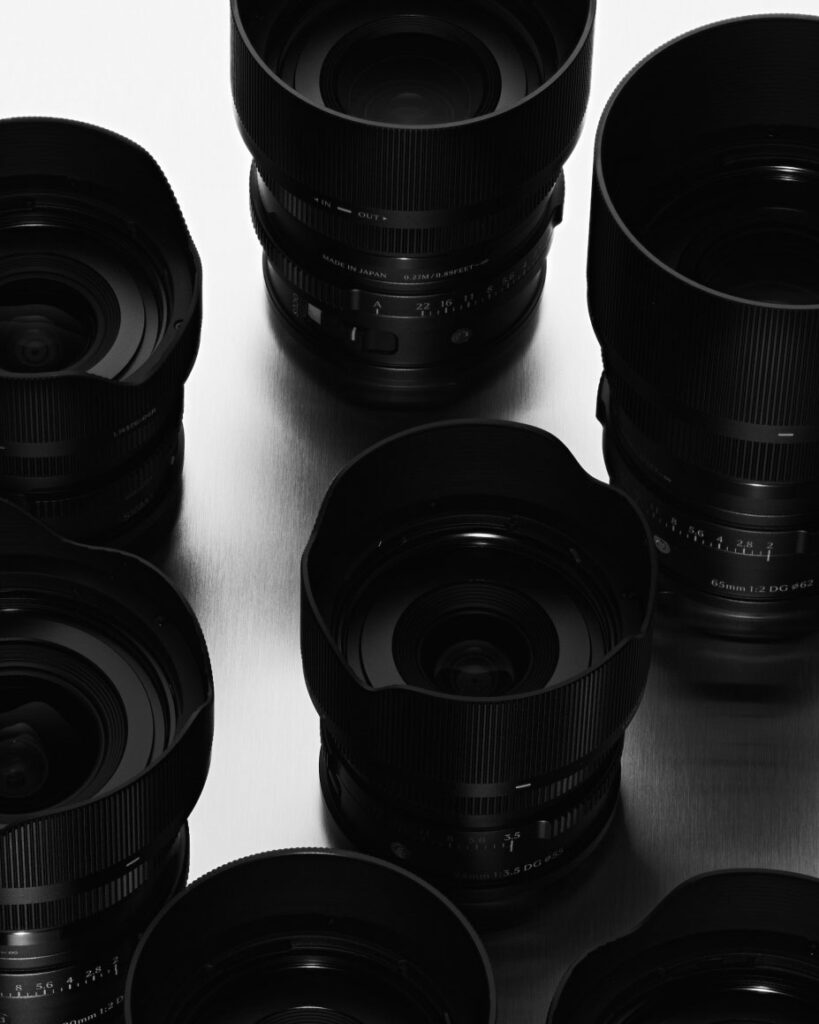
Sigma has become one of the most important third-party lens makers for Sony’s E-mount system, offering an extensive lineup that covers everything from compact primes to high-end zooms and fast primes.
RELATED: Complete List of Tamron Lenses for Sony E-Mount (Full Frame and APS-C)
Unlike in the early DSLR days when third-party lenses were often seen as budget alternatives, Sigma’s modern lens lineup, which they have divided into the Art, Contemporary, and Sports series, has elevated the brand’s reputation to near first-party levels.
When Sony first launched the mirrorless full frame E-mount in 2013, most of the initial lenses that Sigma released were just old DSLR designs remounted into E-mount. Basically, Sigma just stuck a built-in E-mount converter to their DSLR lenses.
Fast forward to today, all those lenses have been discontinued and Sigma’s current lineup are all lenses designed specifically for mirrorless cameras, meaning they are able to take full advantage of Sony’s short flange distance, high-resolution sensors, and fast hybrid autofocus systems including eye autofocus and face detect.
Art Series vs Contemporary Series vs Sports Series: What’s the difference?
Art Series:
Sigma’s Art Series represents Sigma’s best of the best, focusing on optical excellence and high resolution, and relying mostly on optical instead of in-camera or post-corrections. These are lenses built for image quality above all else. They typically feature wide maximum apertures and premium glass elements, and they have the size and weight to show for it. Art lenses are aimed at photographers who want the best possible image quality, even if it means carrying a heavier lens.
Contemporary Series:
The Contemporary Series, focuses on portability, multi-functionality, and affordability. Most of my favorite Sigma lenses are Contemporary lenses. These lenses are designed to deliver solid image quality in smaller, lighter packages, making them ideal for travel, street, and casual photography. They often share similar optical formulas or performance levels with Art lenses but use more compact designs and lighter materials to keep size and cost down.
While the Art line tries to avoid “do-it-all” designs in favor of lenses built for specific, specialized purposes, the Contemporary line takes the opposite approach – embracing versatility and all-around usability for everyday shooting.
Sports Series:
The Sports Series caters to action and sports, wildlife and nature, and other specialized photographers (aircraft etc), prioritizing long focal lengths, image stabilization and robust weather-sealed construction.
Limitations of Third Party Lenses for Sony E-mount
There are still a few downsides to using third-party lenses like Sigma’s on Sony cameras, mainly due to software restrictions imposed by Sony. The most notable is the limitation on burst shooting speeds with certain high-end models. For example, even though the Sony a1 and a9 series can shoot up to 30 frames per second, or an incredible 120 fps in the case of the a9 III, third-party lenses are capped at 15 frames per second. This restriction is not due to the lens’ optical performance or autofocus speed, but rather Sony’s decision to limit full-speed communication and tracking capabilities to its own lenses.
In practice, this limitation only matters for photographers using the Sony a1 or a9 series, since the a7 line tops out at 15 fps or below anyway. For most shooters, it’s a non-issue. It’s also worth noting that even within Sony’s lineup, not all Sony lenses can achieve the maximum frame rates of these cameras, as performance still varies depending on the lens’ design and autofocus motor.
Another key limitation affects video creators. Third-party lenses cannot make use of Sony’s Dynamic Active Stabilization mode. This feature attempts to intelligently combine in-body image stabilization (IBIS) with optical stabilization and a small (~1.3x) crop to produce smoother footage. While third-party lenses can still utilize Active Stabilization – a less aggressive version of stabilization resulting in a ~1.1x crop, tests consistently show that Sony’s own lenses deliver noticeably steadier video when active stabilization is engaged. This may make first-party lenses the better choice for handheld video work. But, it is probably important to note that most third party lenses with electronic contacts will save gyro data to your video files, allowing stabilization of video footage in software such as Sony’s Catalyst Browse. You can even record gyro data if you use a vintage lens (no electronic contacts) with a lens adapter with electronic contacts.
Another feature that is reserved for Sony’s lenses is the in-camera focus breathing correction. This feature is a software function within modern Sony cameras that electronically crops a portion of the image to counteract the change in angle of view caused by focus breathing, thereby “eliminating” focus breathing. If you opt for Sigma’s Art line, you will find that most of them have very minimal focus breathing.
Despite those limitations – which may not matter to you – Sigma remains a popular choice simply because Sigma lenses tend to deliver equal image quality to Sony lenses including Sony G Master glass, at a noticeably lower price.
In other instances, Sigma fills gaps in Sony’s lineup with lenses that Sony doesn’t offer, such as the ultra-fast 35mm f/1.2 DG DN Art or compact primes like the Sigma 90mm f/2.8 Contemporary “I-series” lens, which appeal to photographers who prefer smaller, beautifully machined metal lenses that balance well on lightweight bodies like the Sony a7c.
Related:
15 of the best lenses for the Sony a7c Series
Smallest full frame lenses for Sony
Aside from filling gaps and providing alternatives to Sony lenses, Sigma continues to innovate, designing lenses that push the envelope beyond what was previously thought possible, with a few ‘world’s first’ lenses – such as the Sigma 28-45mm f/1.8, Sigma 135mm f/1.4 and even the Sigma 28-105mm f/2.8 lens.
All Sigma Full Frame Zoom Lenses
Important Note: The zoom ring on Sigma lenses turns in the opposite direction from Sony lenses. So, if you’re used to how Sony zooms work, it might feel a bit backwards at first when zooming in or out with a Sigma lens. Sigma lenses rotate counter-clockwise to zoom, whereas Sony lenses rotate clock-wise to zoom.
Art Series Zoom Lenses
Sigma’s Art series aims to deliver flagship-level optical performance at a more accessible price, offering photographers much of the “G Master” quality, without the G Master cost. In some instances, Sigma even sets the pace. The Sigma 14-24mm f/2.8 was released a full year before the Sony 12-24mm f/2.8 GM, for example. More recently, the Sigma 28-45mm f/1.8 and the Sigma 28-105mm f/2.8 have no equivalent in Sony’s own line-up.
Sigma 14-24mm f/2.8 DG DN Art Lens

A landscape and milky way photographers dream lens. This was Sigma’s first full frame lens to be designed from the ground up for mirrorless cameras, and not simply a DSLR design ported over to a mirrorless mount.
Optically, the 14–24mm DG DN is a standout. Sharpness is high even wide open at 14mm, and the corners hold up impressively well across the zoom range. The lens resolves enough detail for 40–60MP sensors without breaking a sweat. Chromatic aberration and distortion are both minimal once in-camera corrections are applied, and flare resistance is strong thanks to effective coatings.
Coma is well-controlled too, one reason astrophotographers consistently praise it. Stopped down to f/8 or f/11, it delivers sunstars that are clean and symmetrical.
Despite the bulbous front element, the lens manages to avoid obnoxious flares and colored ghosts. It can’t take front filters, which is par for the course for lenses of this type, but, Sigma thoughtfully adds a rear filter holder. All for half the price of the Sony 12-24mm f/2.8 GM.
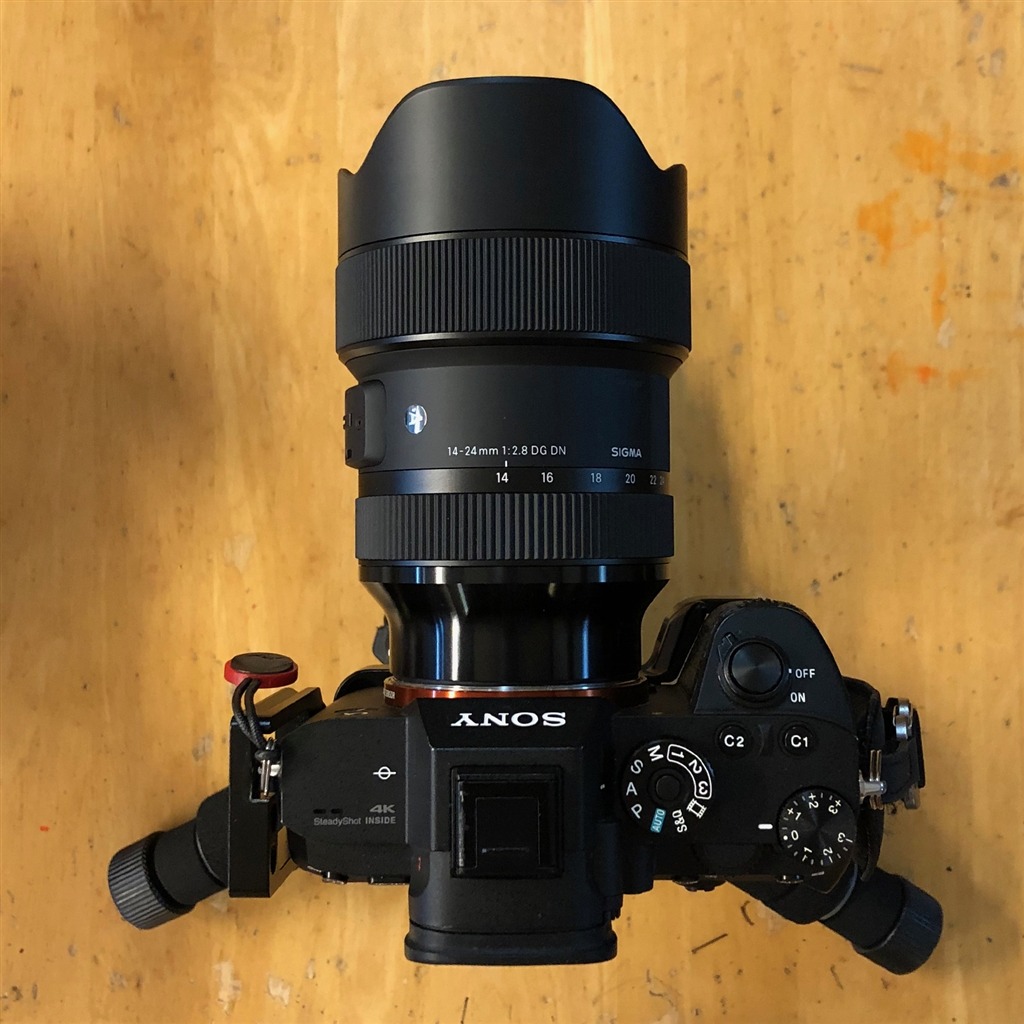
Specs:
Weight: 795 grams
Dimensions (Lxφ): 133mm x φ85mm / 5.2 inches x φ3.3 inches
Filter Size: No front filter threads ; has a rear filter holder for holding sheet-type (gel) filters (template for cutting filters is included)
Check current price: Sigma 14-24mm f/2.8 on Amazon
Sigma 24-70mm f/2.8 DG DN Mark II Art Lens
Sigma’s 24–70mm f/2.8 DG DN II Art is exactly what the first version should have been: smaller, faster, and more refined without losing the Art-series look and feel. It now handles properly on compact mirrorless bodies, optical performance remains excellent even wide-open, AF is greatly improved with their new HLA linear motors (upgraded from the old stepper motors). Build quality is first-rate, and the addition of an aperture ring and closer minimum focus distance makes it more versatile in the field and competitive with the Sony 24-70mm f/2.8 GM Mark II.
Wide open, sharpness is high across most of the frame, with excellent microcontrast and color neutrality. Center performance is superb; corners clean up nicely by f/4. Chromatic aberration and distortion are well controlled, and flare resistance is noticeably better than the original model. There’s some vignetting at 24mm f/2.8, but it’s mild and easily corrected.
Bokeh is smoother and more consistent than before, with better transitions and less “nervous” texture. Background blur is especially attractive at 70mm. At the same time, sharpness is improved over the first gen version.
Below, we see how much Sigma was able to cut down on size, as it now matches the Sony 24-70mm f/2.8 GM II.
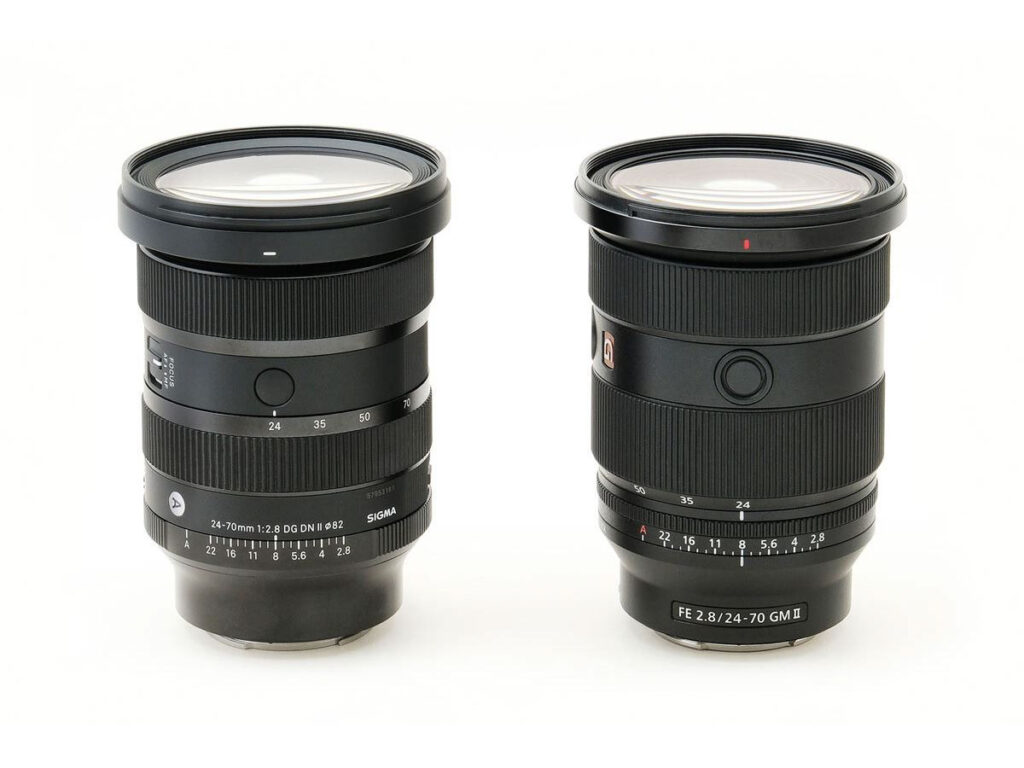
If you want the absolute best performance and best AF-C tracking performance, the Sony GM II still holds the edge. But for most photographers, this Sigma gives you 95% of the Sony GM II for about 70% of the price. In other words, it’s the practical choice for anyone looking for value for money, without skimping on optical performance.
An excellent value. Highly recommended.
Specs:
Weight: 735 grams
Dimensions (Lxφ): 122.2mm x φ87.8mm / 4.8 inches x φ3.5 inches
Filter Size: 82mm
Check current price: Sigma 24-70mm f/2.8 II on Amazon
Sigma 28-45mm f/1.8 DG DN Art Lens

A true “bag of primes” zoom?
Coming in at almost a kilo, this is a serious piece of kit. But, if it can eliminate 2 or 3 primes from your bag, are you even going to notice that weight?
Sigma’s 28–45mm f/1.8 DG DN Art is an unusual lens, and that’s putting it mildly. It’s the world’s first full-frame constant f/1.8 zoom, and while that headline alone will attract attention, what really makes it interesting is how it behaves in practice. After spending time with it, it’s clear this is less about chasing specs and more about proving what’s possible when you merge prime-level quality with (some of) the flexibility of a zoom.
The zoom is internal, which helps keep the balance consistent when flying on a gimbal.
Despite the unusual specs, make no mistake, this is a photographers lens. It’s built like a professional tool, not a showcase piece. It’s like someone on the design team at Sigma said, “Hey, we’re going to make a lens that will push boundaries, but, we’re not just showing off, we also want people to actually use it like a normal lens.”
And, yes, it does perform like a bag of primes. Wide open at f/1.8, it’s already impressively sharp at the center, with only mild softening at the edges. Stop down a bit and it reaches excellent uniform sharpness across the frame. Contrast is high, microcontrast is strong, and the rendering is clean and neutral.
Bokeh is one of the lens’s strongest traits. Foreground and background blur blend naturally, without harsh transitions or nervous edges. The 11-blade diaphragm keeps highlights round and smooth even when stopped down slightly. You can tell Sigma deliberately designed this lens for a natural, cinematic look, and not for test charts.
Flare resistance is excellent, though with the large front element, you’ll still see some veiling flare if you don’t take care.
For most of us, this is not a travel lens. At around a kilogram and roughly the size of a 24–70mm f/2.8, you’ll feel it in your bag. But for what it does, it’s remarkably compact. To match this level of performance with primes, you’d be carrying at least three lenses, say a 28mm, 35mm, and 50mm, and together they’d weigh more, take up more space, and slow you down with lens changes.
Sigma’s logic here is sound: start at a “wide enough” 28mm and go to a “normal” 45mm, but, if you need more reach, crop in. On a high res body like the Sony A7RV or A1, cropping to 1.5x = 67.5mm equivalent still gives you plenty of resolution and an effective f/2.7 depth of field. It’s not a replacement for a 70mm prime, but for getting the same look as a 24-70mm f/2.8? It’s good enough for most real-world work.

Above, Sigma 28-45mm f/1.8 DG DN at 45mm, f/1.8.
It’s not cheap, but it’s cheaper than it should be. You’d easily spend twice as much buying three primes that match its optical quality. The Sony 24–70mm f/2.8 GM II and Sigma’s own 24–70mm f/2.8 Art are more flexible, but neither matches the light gathering at f/1.8 or subject separation this lens delivers.
The main competition, oddly enough, comes from your own expectations. The limited zoom range doesn’t look exciting on paper, and, it is a big boy. Many will dismiss it because of those reasons. But once you start shooting, it becomes clear how effective this focal range is. For a lot of photographers, we live in this range. Sure, it’s nowhere as useful as the range that a 24-70mm covers, but, what is covered here is the ‘everyday’ range: wide enough for context, long enough for isolation, and f/1.8 is bright enough for almost anything.
It’s a limited lens, yes, but it’s within a good creative limit. Sigma knows this won’t sell in huge numbers, but it’s the kind of lens that makes Sigma, well.. Sigma. It shows what a relatively small lens-maker can do when it’s not constrained by convention.
Verdict: Not small, not cheap, not for everyone. But for the right photographer, this might be the smartest “prime lens replacement” yet made.
Specs:
Weight: 950 grams
Dimensions (Lxφ): 153.4mm x φ87.8 / 6 inches x φ3.5 inches
Filter Size: 82mm
Check current price: Sigma 28-45mm f/1.8 Art on Amazon
Sigma 28-105mm f/2.8 DG DN Art Lens
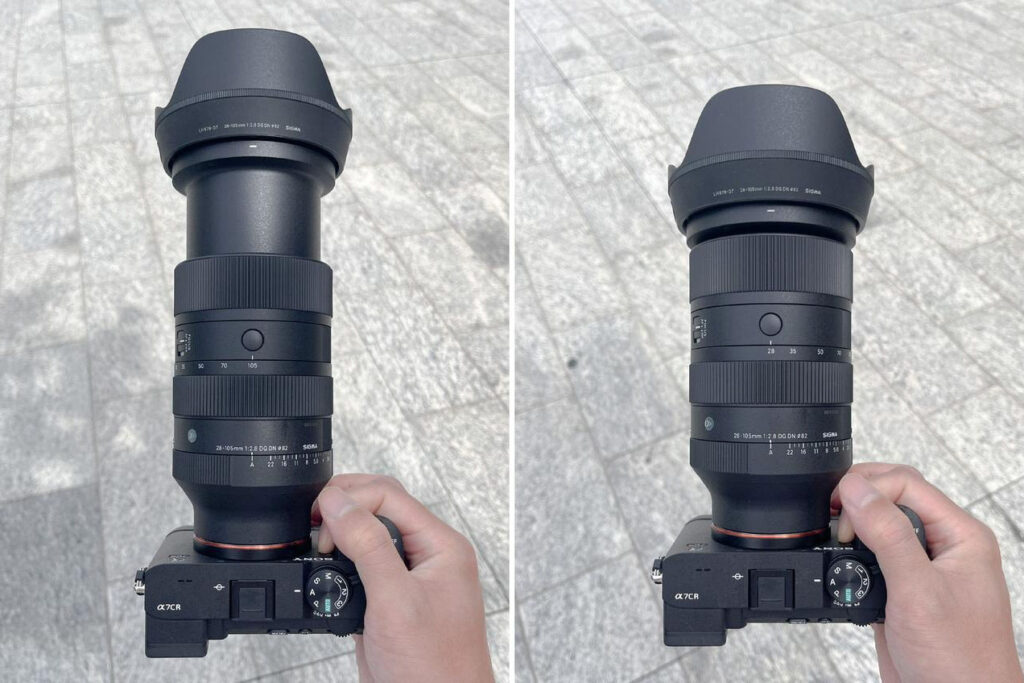
Is this the start of a new generation of standard zooms?
24-105mm or even 24-120mm lenses are not new, there’s a ton of them across various systems. But, they are all f/4 lenses. A 28-105mm f/2.8 is a unicorn. Canon did it first with the Canon RF 24-105mm f/2.8 Z lens, but that was viewed as a real investment, not only because of the $3299 that Canon was asking for it, but also because it weighs 1.3kg and is the same size as a 70-200mm f/2.8 lens.
Sigma took a different approach with this lens. For one, it starts at 28mm, which helps cut down its size. And it does, this lens is significantly more portable than the Canon. Weight wise, it’s heavier than a 24-70mm f/2.8 standard zoom and lighter than the Tamron 35-150mm f/2-f/2.8. Still substantial, but, within the realm of possibility of someone carrying it for travel.
Similar to the Sigma 28-45mm f/1.8, this lens may prompt some photographers to ask, “What’s the point?” if they don’t have a clear image of what you’re using it for.
But for those who know exactly what they want – a fast, flexible lens that balances reach, speed, and portability – it fills a unique niche.
And, in the right hands, it can deliver some stunning results.
Specs:
Weight: 990 grams
Dimensions (Lxφ): 159.9mm x φ87.8mm / 6.2 inches x φ3.5 inches
Filter Size: 82mm
Check current price: Sigma 28-105mm f/2.8 on Amazon
Contemporary Series Zoom Lenses
Sigma 16-28mm f/2.8 DG DN Contemporary Lens
This has sort of flown under the radar, mostly because it was late to the party.
Sony has had their 16-35mm f/2.8 and f/4 lenses for a while now and Tamron had a 17-28mm f/2.8 as part of its trio. Both Sony and Tamron lenses have now been updated to Mark II versions.
RELATED: Complete list of Tamron Lenses for Sony E-mount (Full Frame and APS-C)
While some photographers would prefer a 16–35mm range, that typically means a larger, heavier, and pricier lens. Sigma’s decision to limit the zoom range keeps things compact and affordable, exactly what the Contemporary series is all about.
Here it is next to the Sigma 28-70mm f/2.8 DG DN Contemporary. Together, they weigh under 1,000 grams, deliver a constant f/2.8 aperture from 16mm all the way to 70mm, and do so without draining your bank account. For photographers who value portability without sacrificing performance, these are two of the most practical full-frame zoom combinations available.
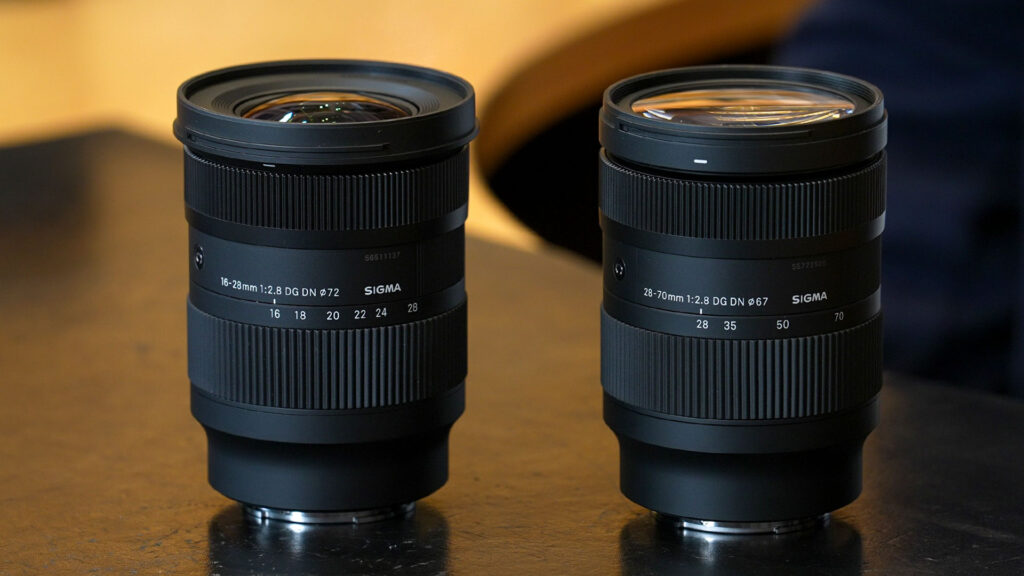
Specs:
Weight: 450 grams
Dimensions (Lxφ): 102.6 x φ77.2mm / 4 inches x φ3 inches
Filter Size: 72mm
Check current price: Sigma 16-28mm f/2.8 on Amazon
Sigma 20-200mm f/3.5-6.3 DG DN Contemporary Lens
A first of its kind. This is the first ultra zoom that starts at 20mm, instead of the usual 24mm or 28mm. This is the lens to reach for if you need a versatile lens that covers everything from ultra-wide angle to telephoto without ever needing to swap lenses. Despite the ambitious range, this lens remains compact and lightweight enough for travel, making this a top choice for the ultimate one-lens travel solution.
That said, it is a 10x superzoom, so expect the usual compromises. The 20mm end isn’t anywhere as strong as what you’d get from dedicated ultra-wide lenses, much less a prime, but performance throughout the entire range remains solid, and, considering that there are no other ultra zooms that start this wide, I would argue that the overall performance is actually beyond most expectations.
Considering that this lens can potentially replace three separate zooms in your bag, while also offering impressive close-focusing ability (1:2 magnification from 28mm-85mm), shows that versatility is its raison d’être.
As you can see in the comparison below, the Sigma 20-200mm is the same size as other full frame ultra zooms that reach 200m, despite being the only one that starts at an impressive 20mm. The Sigma is second from the left.

Specs:
Weight: 540 grams
Dimensions (Lxφ): 117.5mm x φ77.2mm / 4.6 inches x φ3 inches
Filter Size: 72mm
Check current price: Sigma 20-200mm on Amazon
Sigma 28-70mm f/2.8 DG DN Contemporary Lens
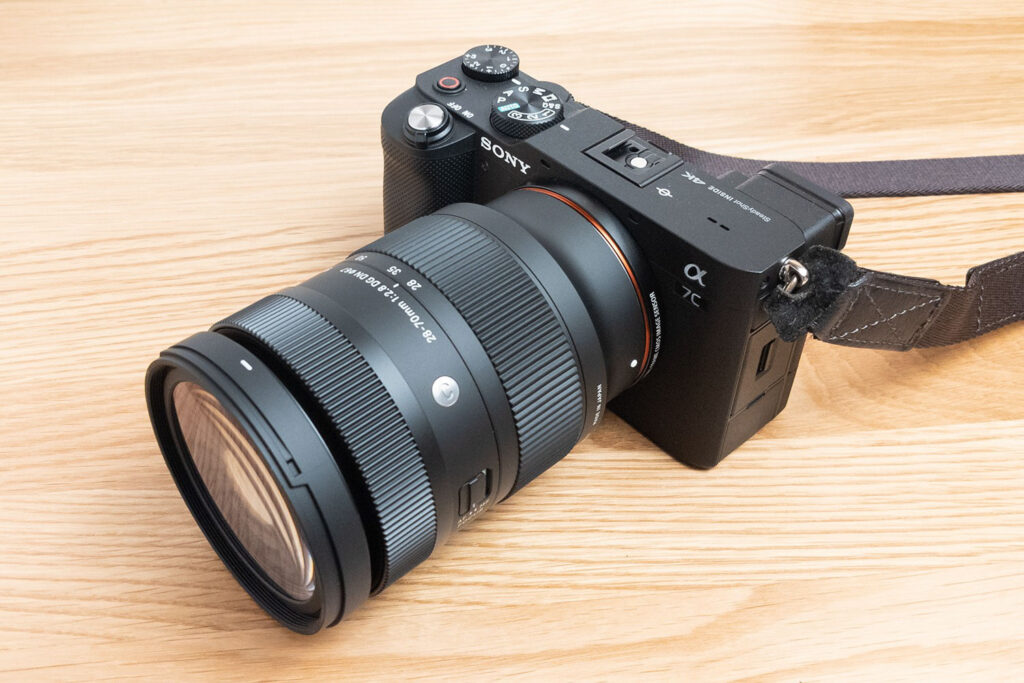
The Sigma 28-70mm f/2.8 was a surprising addition to the Contemporary line, and one that further confuses the log-jammed mid-range zoom choice for Sony full frame. For some, the 28mm wide end isn’t wide enough, and that may be enough to be a deal breaker. For some, the trade-off of having a substantially smaller and lighter lens is worth giving up some of the wide-end.
While good optically, it is clear that the Sigma 24-70mm f/2.8 II Art is a clear step up vs this lens, but at the cost of 56% more weight.
I mean, we’re talking under 500 grams for a constant f/2.8 standard zoom here. That’s some engineering by Sigma right there. I can’t emphasize this enough. This is a constant f/2.8 standard zoom that balances well on the Sony a7c series! It’s almost unheard of.
This is an excellent choice for someone looking for a standard zoom faster than f/4, but still wants to keep things small and travel-friendly. Pair this with a Sony a7c II and you’ve got a compact and serious one-lens solution that totals under 1kg. I mean, that’s pretty incredible.
Below, you can see its size compared to two of the more popular travel lenses for Sony, from two schools of thought on what a travel lens should be. One from those who like carrying super zooms, and one from those who like carrying a small, fast prime: the Tamron 28-200mm and the Sony FE 35mm f/1.8
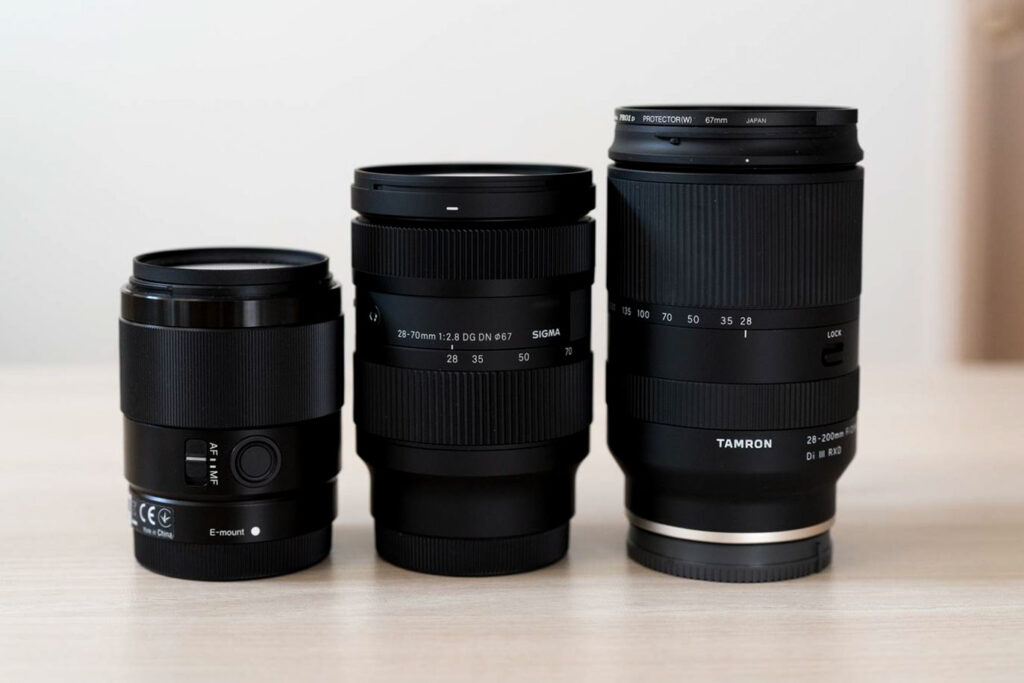
Specs:
Weight: 470 grams
Dimensions (Lxφ): 103.5mm x φ72.2mm / 4.1 inches x φ2.8 inches
Filter Size: 67mm
Check current price: Sony 28-70mm f/2.8 on Amazon
Sigma 100-400mm f/5-6.3 DG DN OS Contemporary Lens
A viable option for casual photography. Great for landscapes and other stationary subjects.
Unfortunately, hit rate for action/sports or birds in flight isn’t great. The older stepping AF motor in this lens just can’t keep up with fast moving subjects. Image stabilization works well; good resolution even wide-open.
Physically, it’s obviously a long lens, as is a given in a 100-400mm lens, but it’s well balanced. This lens is actually slimmer than the Sony FE 70-300mm, which makes it easier to operate.
Tripod collar sold separately: Sigma TS-111. It is compatible with Arca-type platforms and clamps.
There is a teleconverter being sold, but it is NOT compatible with the Sony E mount version. It only works for the Leica L-mount version of this lens.
Specs:
Weight: 1,140 grams
Dimensions (Lxφ): 199.2mm x φ86.0mm / 7.8 inches x φ3.4 inches
Filter Size: 67mm
Check current price: Sony 100-400mm DG DN on Amazon
Sports Series Zoom Lenses
Sigma 70-200mm f/2.8 DG DN OS Sports Lens
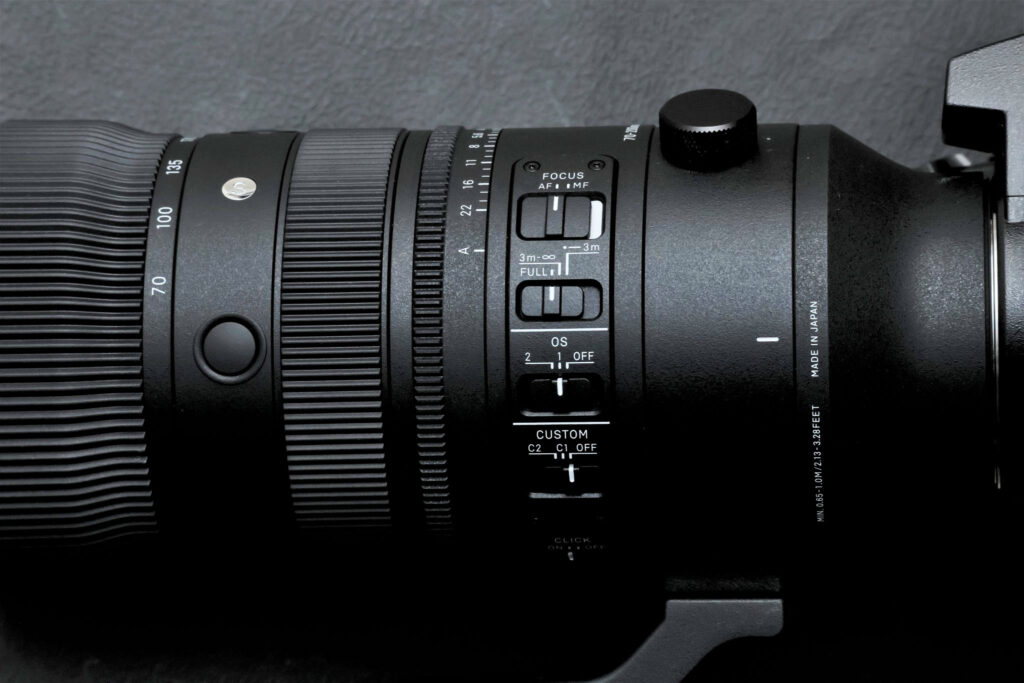
A lens that many people had given up waiting on. Sigma announced this lens only after Sony had already released a Mark II of it’s 70-200mm f/2.8 GM and after Tamron had announced a mark 2 of its own in the Tamron 70-180mm f/2.8 G2. This, perhaps contributes to the less than expected popularity of this lens.
Otherwise, Sigma pulled out all the stops here. Dual HLA motors (this is their new linear AF motors), an aperture ring (!), pleasing bokeh rendering, low axial and lateral CA, and pro-level build quality, although the zoom ring placement towards the front of the lens takes some getting used to.
Image stabilization (OS) is listed as “up to 7.5 stops,” but it’s important to note that it’s 7.5 stops at the 70mm end and 5.5 stops at the 200mm end, which is still pretty good.
Dedicated sports and action shooters will prefer the Sony 70-200mm GM’s better AF, but the Sigma undercuts it in price considerably, so you will have to weigh your options here.
Note: The Sony E-mount version does not have a USB port for using the Sigma USB Dock UD-11. The dock is only for use on the L-mount version of this lens, allowing the user to tweak certain settings such as the range of the focus limiter function.
Ditto for teleconverters. 1.4 and 2x TC’s are compatible only with the L-mount version of this lens. No teleconverters are compatible for the Sony E mount version.
Specs:
Weight: 1,335 grams
Dimensions (Lxφ): 207.0mm x φ90.6mm / 8.1 inches x φ3.6 inches
Filter Size: 77mm
Check current price: Sigma 70-200mm f/2.8 on Amazon
Sigma 60-600mm f/4.5-6.3 DG DN OS Sports Lens
A 10x telephoto zoom lens! This is the designed-for-mirrorless version of the old, designed-for-DSLRs Sigma 60-600mm, which was the successor to the best selling Sigma 50-500mm f/4.5-6.3, more popularly known as the “Bigma”.
If you don’t mind the weight, this is a lens that doesn’t have any competition. The Sony 200-600mm or other similar zooms just can’t match the versatility of being able to go wide to 60mm. The Tamron 50-400mm f/4.5-6.3 might be worth a look for some photographers. But, the reality is, they’re just two different lenses. 400mm just isn’t the same as 600mm. The Tamron is significantly more portable, and cheaper, so there is that to consider.
Like all Sigma telephoto lenses for Sony, it is not compatible with any teleconverters.
Specs:
Weight: 2,485 grams 💪💪
Dimensions (Lxφ): 281.2mm x φ119.4mm / 11.1 inches x φ4.7 inches
Filter Size: 105mm
Check current price: Sigma 60-600mm OS on Amazon
Sigma 150-600mm f/5-6.3 DG DN OS Sports Lens
Specs:
Weight: 2,100 grams 💪💪
Dimensions (Lxφ): 265.6mm x φ109.4mm / 10.5 inches x φ4.3 inches
Filter Size: 95mm
Check current price: Sigma 150-600mm OS on Amazon
Sigma 300-600mm f4 DG OS Sports Lens
Specs:
Weight: 3,970 grams 💪💪💪
Dimensions (Lxφ): 469.9mm x φ167.0mm / 18.5 inches x φ6.6 inches
Filter Size: 40.5mm (Rear drop-in filters)
Check current price: Sigma 300-600mm on B&H
All Sigma Prime Lenses for Full Frame
Art Series Prime Lenses
A large part of Sigma’s success in transitioning from “budget third party” to “premium lens manufacturer” can be attributed to their Art Series. Dating back to the DSLR era, with their f/1.4 Art lenses for Canon EF and Nikon F, to their current line-up for mirrorless below, the Art Series now serves as Sigma’s halo product line, representing GM-like optical quality, at a fraction of the cost.
Sigma 14mm f/1.8 DG Art Lens
This is the world’s first rectilinear 14mm full-frame lens with an f/1.4 aperture, making it a unique and in-demand lens, especially for astrophotography.
Although some retailers incorrectly list this lens as discontinued, that is not the case. Sigma recently announced that they are moving to a made-to-order system for this lens. For example, orders will be accepted from September to October of the current year, then orders will ship in March of the following year.
Sigma 14mm f/1.8 Specs:
Weight: 1160 grams
Dimensions (Lxφ): 149.9mm x φ101.4mm / 5.9 inches x φ4.0 inches
Filter Size: No front filters. Rear filter holder for clip-on filters.
Check current price: Made to order only. Contact your local Sigma dealer. Usually about ~ $1800-1900.
Sigma 15mm f/1.4 DG DN Diagonal Fish Eye Art Lens
Sigma 15mm f/1.4 Specs:
Weight: 1,360 grams
Dimensions (Lxφ): 159.9mm x 104.0mm / 6.3 inches x φ4.1 inches
Filter Size: Rear filters only (sheet-type (gel) filters) (template for cutting filters included)
Check current price: Sigma 15mm Fish Eye at B&H
Sigma 20mm f/1.4 DG DN Art Lens
Includes an aperture ring lock switch and a manual focus lock switch, useful for astrophotography.
Supports both front and rear filters.
Curved lip at the front of the lens allows for a lens heater to be slipped onto the lens to help combat internal condensation.
Sigma 20mm f/1.4 Specs:
Weight: 630 grams
Dimensions (Lxφ): 113.2mm x φ87.8mm / 4.5 inches x φ3.5 inches
Filter Size: 82mm
Check current price: Sigma 20mm f/1.4 on Amazon
Sigma 24mm f/1.4 DG DN Art Lens
Almost as small as the legendary Sony 24mm f/1.4 GM.
Sigma’s 24mm f/1.4 DG DN Art sits in an increasingly crowded wide-angle prime field, but it earns its place easily. For photographers who need a fast, sharp, and dependable 24mm for both stills and astrophotography, this is one of the most complete options available for the money.
At roughly 510 g, it’s heavier than the Sony GM, but the balance on full-frame bodies like the a7 IV is still great. Slightly unweildy on the A7C, but workable.
Similar to the 20mm f/1.4, above, this lens also features an aperture lock and manual focus lock. For astrophotography, the focus lock switch proves genuinely useful, keeping manual focus steady during long exposures.
Sagittal coma flare control is as good as the more expensive Sony 24mm f/1.4 GM. Vignetting is also similar.
Slightly narrower FOV than the Sony 24mm f/1.4 GM. Less focus breathing than Sony 20mm f/1.8 G and Sony 24mm GM. BUT, the Sony’s are compatible with Sony’s in-camera focus breathing compensation.
Overall, it’s a lens that feels complete. It’s optically impressive, handles beautifully, and avoids the common pitfalls of fast wide-angles: distortion, coma, and excessive weight.
Sigma 24mm f/1.4 Specs:
Weight: 510 grams
Dimensions (Lxφ): 97.5mm x φ75.7mm / 3.8 inches x φ3.0 inches
Filter Size: 72mm
Check current price: Sigma 24mm f/1.4 on Amazon
Sigma 35mm f/1.2 DG DN II Art Lens
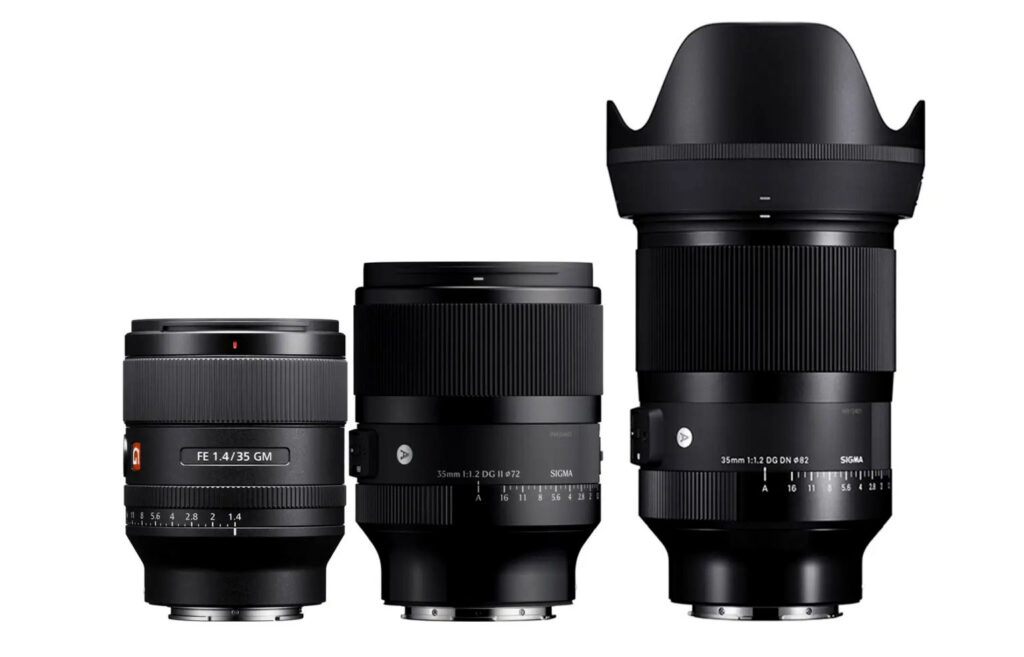
This Mark II version was released recently, and I haven’t had the chance to shoot with one yet. Above, you can see the substantial size reduction they were able to get vs the Mark I version (right).
Sigma 35mm f/1.2 II Specs:
Weight: 745 grams
Dimensions (Lxφ): 113.4mm x φ81.0mm / 4.5 inches x φ3.2 inches
Filter Size: 72mm
Check current price: Sigma 35mm f/1.2 Mark II on Amazon
Sigma 35mm f/1.4 DG DN Lens
You’re going to find a lot of reviews complaining that Sigma didn’t make this as light as the Sony 35mm f/1.4 GM (524 grams), but, the reality is, with the only other exception being the Samyang 35mm f/1.4 P FE (470 grams), all other 35mm AF lenses for Sony that are f/1.4 or brighter are the same weight or are heavier than this lens.
As is usual from Sigma, this 35mm offers excellent value as it comes in at half the price of the Sony 35mm GM.
Compared to the GM, there is a noticeable drop in resolution at the edges and corners when taking close-up shots, but this is not a problem in usual shooting distances. Resolution at infinity focus is excellent. Bokeh is relatively smooth and pleasing. There is some pincushion distortion, but other than that, there are no major drawbacks. This is a lens that is easy to recommend.
Sigma 50mm f/1.4 Specs:
Weight: 660 grams
Dimensions (Lxφ): 111.5mm x φ78.2mm / 4.4 inches x φ3.1 inches
Filter Size: 72mm
Check current price: Sigma 50mm f/1.4 on Amazon
Sigma 50mm f/1.2 DG DN Art Lens
When rumors of this lens first came out, there was a lot of apprehension, because the prior Sigma 50mm f/1.4 (below) was quite a bit larger than the Sony 50mm f/1.4 GM. There was some fear that this Sigma f/1.2 would be closer to the size of the Nikon 50mm f/1.2 than the Sony 50mm f/1.2 GM.
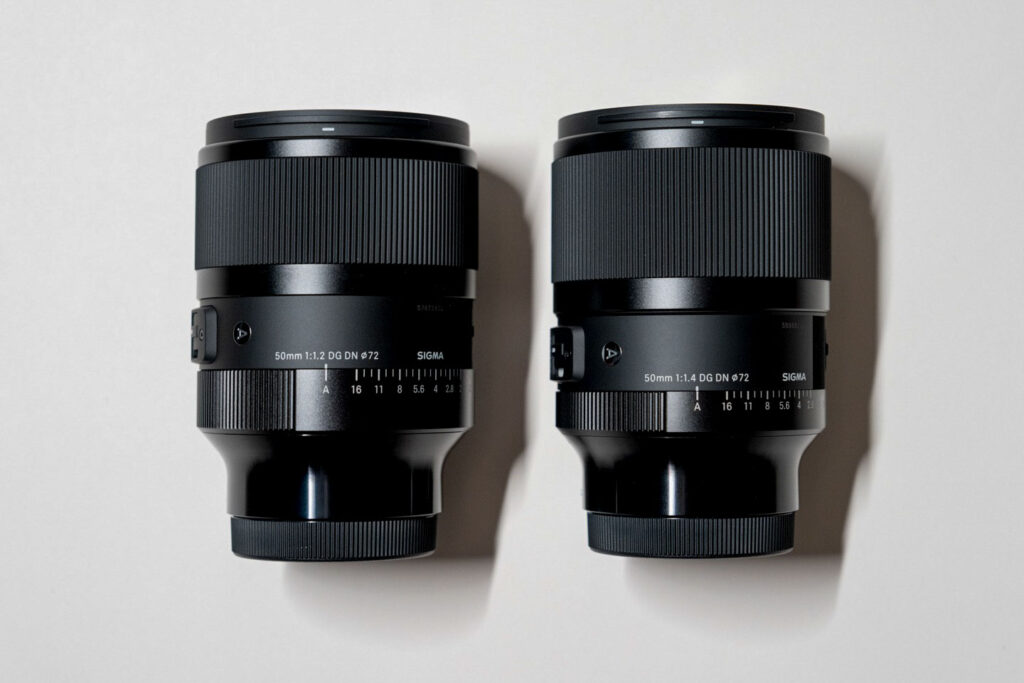
But, fear not, unlike the Sigma 50mm f/1.4 (below), this lens competes with Sony favorably, size-wise. This lens is roughly the same size as the Sony 50mm f/1.2 GM. The Sigma’s barrel is slightly thinner and lighter than the Sony, but the Sony is slightly shorter in physical length.
This lens is roughly the same size as the Sigma 50mm f/1.4 (below), the main difference being that the Sigma 50mm f/1.4 (below) is lighter.
Following the ‘controversial’ Sigma 50mm f/1.4 (I talk more about the f/1.4 lens below), this 50mm f/1.2 shows that Sigma listens to feedback. In many ways, this lens showcases Sigma at its best.
The biggest difference here is in tracking AF. The Sony 50mm f/1.2 GM is able to hit a near 100% hit-rate for subjects moving across different planes of focus even at f/1.2. Sigma’s hit rate is closer to 70%, even in good light. But, if you mostly shoot static subjects or slow-moving subjects, the Sigma will perform just fine, for more than $500 less.
For video shooters, there is the fact that focus breathing compensation only supports Sony lenses. But, focus breathing on the Sigma is minimal to begin with, and you do lose some of your frame when you turn on breathing compensation on the Sony (on a camera with that function).
At f/1.2, contrast and fine detail are already excellent, and the rendering remains consistent through the aperture range. Background blur is smooth and unobtrusive. Leaning towards neutral. Less dramatic than a “character” lens. Sigma clearly prioritized even performance and minimal aberrations. Stopping down improves corner sharpness slightly, but what’s impressive is, you don’t have to.
Like the GM, this lens delivers a convincing three-dimensional look that gives subjects a sense of depth and separation. If you’re stepping back into fast primes after years of relying on zooms, you are going to be surprised at how much f/1.2 lenses have improved over the years.
For shooters who simply want f/1.2 for its look, this is the most accessible way to get there with almost no compromise.
Considering that the Sony 50mm f/1.2 GM currently goes for more than twice the price, this Sigma is an incredible value. A lens worthy of the “Art” designation. Highly, highly, highly recommended.
Below, you can see the Sigma 50mm f/1.2 on the left, and the Sigma 50mm f/1.4 on the right. As you can see, they are roughly the same size, with the 50mm f/1.4 being a few millimetres longer.
Sigma 50mm f/1.2 Specs:
Weight: 740 grams
Dimensions (Lxφ): 110.8mm x φ81.0mm / 4.4 inches x φ3.2 inches
Filter Size: 72mm
Check current price: Sigma 50mm f/1.2 on Amazon
Sigma 50mm f/1.4 DG DN Art Lens
At launch, the Sigma 50mm f/1.4 DG DN drew some criticism for its size and weight, especially when compared to Sony’s 50mm f/1.4 GM, which debuted around the same time. The Sigma is over half an inch longer and more than 100 grams heavier, making it closer in bulk to Sony’s 50mm f/1.2 GM than to its direct rival.
The contrast in size is even more pronounced against the much smaller and lighter Samyang 50mm f/1.4 II.
A year later, when Sigma released the 50mm f/1.2 DG DN (above), it seemed to take that feedback seriously, because the newer, f/1.2 lens is actually a touch shorter than this f/1.4 version.
At the time of its launch, however, the Sigma 50mm f/1.4 DG DN found itself in a tricky spot: buyers unconcerned with price had little reason to choose it over Sony’s excellent 50mm f/1.2 GM, while some budget-conscious shooters were drawn to the Samyang.
It is more expensive vs the Samyang 50mm f/1.4 II, but there isn’t a clear cut winner, depending on your needs. Center sharpness wide-open goes to Samyang. Corner sharpness wide-open goes to Sigma. Stopped down, overall edge-to-edge sharpness goes to Sigma. Pincushion distortion is worse on the Sigma, but it also has less chromatic aberration.
Sigma’s new HLA AF motor is better than Samyang for video and AF-C, but Sony’s XD linear motors are still noticeably better for tracking AF though. At launch, this was only the second Sigma to use their new HLA AF motors.
A lot of the criticism of this lens is a result of poor timing because it was released after the Sony 50mm f/1.4 and the Samyang 50mm f/1.4 II. But, overall, this lens still follows the usual Sigma formula: Excellent optical quality for much less than the Sony-branded counterpart.
But, I have to admit that as someone who puts a lot of premium on size and weight, I wouldn’t rate this in the same value-for-money range as the Sigma 50mm f/1.2 (above).
Sigma 50mm f/1.4 Specs:
Weight: 660 grams
Dimensions (Lxφ): 111.5mm x φ78.2mm / 4.4 inches x φ3.1 inches
Filter Size: 72mm
Check current price: Sigma 50mm f/1.4 on Amazon
Sigma 85mm f/1.4 DG DN Art Lens
There are now almost two dozen? 85mm lenses to choose from for Sony E-mount. Of those – and excluding the first version of lenses which have been upgraded to a version 2 – there are six 85mm lenses with apertures brighter than f/1.8. The Sony 85mm f/1.4 GM II, the Samyang 85mm f/1.4 II, the Viltrox 85mm f/1.4 Pro, the Sirui 85mm f/1.4 Aurora, the Meike 85mm f/1.4 and this Sigma.
More than half a decade since it was released, and despite the absolute plethora of choice of 85mm’s in Sony E mount, this lens remains to be one of Sigma’s best selling lenses. I would go so far as to say that, for the money, this is the best 85mm lens on the market right now.
I don’t know what Sigma’s secret sauce is here, but this lens shouldn’t be able to do what it does, at this size and at this price point.
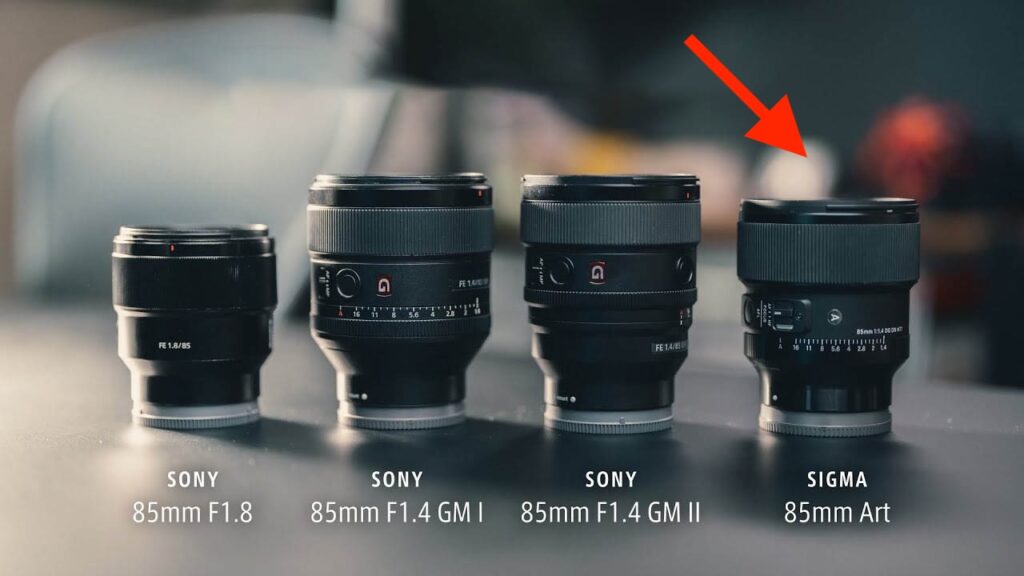
Bokeh is pleasing, it is the star of the show without taking the spotlight away from your subject, if you know what I mean. There is practically no chromatic aberration. It is tack sharp wide-open, and improves when stopping down, which makes it useful beyond portraits.
But, despite the sharpness, it renders skin beautifully. Color rendition is accurate and neutral, but again, despite that, skin tones are pleasing not lifeless. Micro-contrast is likewise excellent, but, it doesn’t lead to a harsh rendering. This lens feels like a study in contradictions: razor-sharp, but, able to render smooth and flattering skin tones.
Build quality is among the best, if not the best among all third party 85mm lenses, whether f/1.8 or f/1.4. Weather sealing gaskets, aperture ring, everything you need is here.

The Sigma 85mm f/1.4 DG DN has very few weaknesses, the biggest being in tracking AF when compared to the Sony 85mm f/1.4 GM II.
But, IMO, this isn’t really the lens for fast action. If you need a portrait lens to have 100% hit-rate for a burst of shots of a someone running at full speed towards you, your only choice is the Sony 85mm f/1.4 GM II at double the price.
Pincushion distortion and some vignetting is present if you turn off all corrections, but why would you want to?
There’s no shortage of great 85mm lenses for Sony. Most of them are excellent, and truthfully, you could capture similar images with almost any of them. There isn’t anything this Sigma can shoot that most other 85mm lenses can’t, but I think it’s a masterpiece.
It delivers G Master–level image quality at roughly half the price, with a modern design and pro-grade build that solve most of the usual issues.
You can spend hours watching YouTube comparisons or pixel peeping, but trust me, you’ll end up buying this lens anyway. It’s an easy 9.9 out of 10, or even a 9 out of 9, depending on what you shoot.
Highly, highly, highly recommended.
Sigma 85mm f/1.4 Specs:
Weight: 625 grams
Dimensions (Lxφ): 96.1mm x φ82.8mm / 3.8 inches x φ3.3 inches
Filter Size: 77mm
Check current price: Sigma 85mm f/1.4 on Amazon
Sigma 105mm f/2.8 DG DN Macro Art Lens
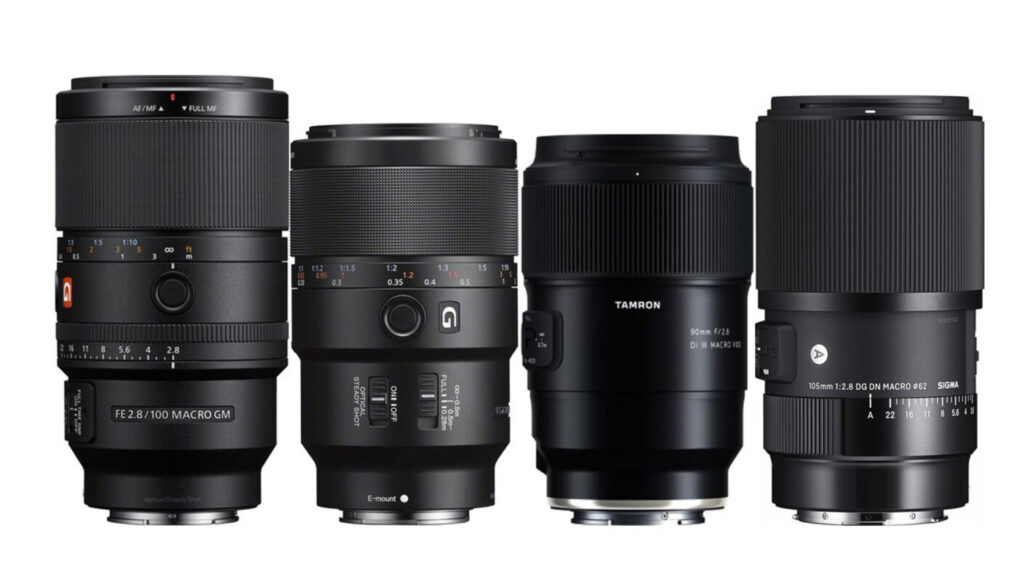
Sharpness is excellent from wide open and remains even across the frame from macro to infinity, this is something not all macros manage. Both axial and lateral chromatic aberrations are very well corrected, and distortion is minimal. Bokeh is smooth and restrained, with neither harsh outlining nor a “smudged” look.
While the Sigma 105mm f/2.8 can certainly double as a portrait lens, it borders on being too sharp for people shots unless you dial the sharpness back in post. Some have complained about slow autofocus, but… this is a macro lens, that’s typical. Sigma does include a focus limiter to help manage that.
Compared with Sony’s newer 100mm f/2.8 GM Macro, the Sigma is actually a touch more compact, but the Sigma is heavier.
Those who need the very best autofocus tracking, such as underwater macro shooters who want minimal setup fuss and want to keep things as ‘point-and-shoot’ as possible, will likely be better served by the Sony.
The Sony 100mm GM, however, costs about twice as much, and most of that premium goes toward quality of life improvements, not necessarily better optics: built-in optical stabilization, a clever push-pull focus ring with a distance scale and hard stops, and, perhaps most importantly, compatibility with Sony’s 1.4x and 2.0x teleconverters, extending magnification up to 2x or 2.8x, respectively. Whether those extras are worth it depends on what or how you shoot.
Sigma 105mm Specs:
Weight: 710 grams
Dimensions (Lxφ): 135.6mm x φ74mm / 5.3 inches x φ2.9 inches
Filter Size: 62mm
Check current price: Sigma 105mm Macro on Amazon
Sigma 135mm f/1.4 DG Art Lens
The portrait lens to end all portrait lenses? The bokeh monster? The best portrait lens ever? There is no end to the superlatives attached to this lens.
Sigma’s replacement for the discontinued Sigma 105mm f/1.4 and Sigma 135mm f/1.8 HSM is finally here.
And yes, as expected it has a massive front element. 17 elements in 13 groups (4 FLD, 2 aspherical elements). It is smaller and lighter than the Sigma 105mm f/1.4 it replaces, but, make no mistake, this lens isn’t subtle. It’s not physically long, and it doesn’t scream telephoto! But, it has a lot of girth. It’s big, heavy, and it looks serious. At 1.4 kilograms and with a 105mm filter thread (same as the 105mm f/1.4), this isn’t a lens you toss into a bag “just in case.”
Like the 105mm it succeeds, it still comes with its own tripod collar and foot. It’s Arca-swiss compatible and the collar is fully removable if you don’t want to use it. It also comes with a humongous lens hood.
Autofocus performance is handled by what Sigma calls its “second generation” of HLA (High-response Linear Actuator) AF motor. Although I’m not exactly sure how it compares to the first gen. But, AF is fast, quiet, and accurate, even with the large optical group this design requires.
Wide open, center sharpness is already excellent, with contrast and resolution peaking by f/2 to f/5.6. Corners are slightly soft at f/1.4 but sharpen nicely by f/2.8. Even on a 60-megapixel sensor, it holds up impressively. Chromatic aberration is very well controlled, both axial and lateral, and there is only mild pincushion distortion that’s easily corrected. Vignetting is moderate wide open but largely gone by f/2.
Then there’s the bokeh, which is the whole point of this lens. Background blur is creamy and natural, with none of the onion-ring or busy texture artifacts seen in lesser designs. Foreground blur remains smooth even in challenging compositions. The transition from focus to defocus is exceptionally graceful, giving subjects a clear sense of separation. This is what Sigma was aiming for, and it shows. Flare and ghosting are minimal, thanks to modern coatings and that honking big lens hood that could double as a flower pot.
Minimum focus distance is around 1.1 meters, or 3.6 feet which is noticeably worse than the Sony FE 135mm f/1.8’s 0.7 meters or 2.3 feet. Focus breathing is also clearly present, and Sigma lenses don’t benefit from focus breathing compensation in Sony cameras.
One interesting secondary use case is turning on crop mode on a high res body like the A7RV or Sony A1, or putting this lens putting an APS-C camera on this lens. You’ve basically got your own version of the Sigma 200mm f/2 Sports lens on here as well.
Sigma 135mm Specs:
Weight: 1420 grams
Dimensions (Lxφ): 137.5mm x φ111.7mm / 5.4 inches x φ4.4 inches
Filter Size: 105mm
Check current price: Sigma 135mm f/1.4 on Amazon
Contemporary Series Prime Lenses
Sigma’s Contemporary series can be further divided into two lines:
The compact f/2 line (20mm, 24mm, 35mm, 50mm, and 65mm), and the even more compact and lightweight line (f2.8 and above) – the 17mm f/4, 24mm f/3.5, 45mm f/2.8 and 90mm f/2.8.
Sigma 17mm f/4 DG DN Contemporary Lens
One of the smallest ultra wide lenses for Sony full frame. This is Sigma at its best. While they show that they can compete with the big boys with lenses like the Sigma 50mm f/1.2 and 85mm f/1.4 Art lenses, they also come up with lenses like this.
Tiny, ultralight, excellent close-up performance, beautifully built. It’s one of those lenses that some people will simply not understand – only f/4? Why make a prime that is only f/4? I’d rather carry a zoom, blah blah blah.
Those of us who get it, of course, are just happy that Sigma makes lenses that go against the grain.
In my opinion, this may be the best looking out of the entire Sigma “I series” of lenses. Because it’s so tiny, the barrel doesn’t have the glossy decorative ring found in most other I series lenses.
Optical flaws are within expectations for a compact, lightweight ultra-wide lens. Some correction is needed for distortion and vignetting, but nothing out of the ordinary. The only real letdown is the lack of defined sunstars when stopped down.
The price is a little on the high side, if you don’t put a premium on size and weight like I do.
For Sony E-mount users, the main alternative is the Samyang AF 18mm f/2.8 (sometimes branded as Rokinon). It’s smaller, lighter, and one stop brighter, and offers great value for money. However, its build quality can’t match the Sigma’s, the Samyang has a lot more plastic, and it simply doesn’t feel as premium.
Also see: The smallest Sony full frame lenses
Sigma 17mm Specs:
Weight: 220 grams
Dimensions (Lxφ): 50.8mm x φ64.0mm / 2.0 inches x φ2.5 inches
Filter Size: 55mm
Check current price: Sigma 17mm f/4 on Amazon
Sigma 20mm f/2 DG DN Contemporary Lens
Sigma’s alternative to the popular Sony 20mm f/1.8 G lens.
Even wide open at f/2, images are detailed and contrasty, though there is a fair amount of vignetting between f/2 and f/4. Distortion is present as well, barrel distortion in particular shows up clearly in raw files before correction, and can still be visible in JPEGs after correction.
I don’t personally do astrophotography, but I feel that the vignetting in this lens will limit its appeal, since any correction to vignetting will degrade image further. Astro photographers may be better served by the Sigma 20mm f/1.4 (see above, in the ART lenses section).
For non-milky way photographers, the vignetting may be a feature, adding character to images.

Color rendition leans slightly cool, giving a more neutral, modern look compared to Sony’s warmer tones. That may make it harder to match up with other lenses, but it’s all personal preference. If you’re a fan of Zeiss lenses for example, you may prefer this cooler balance, YMMV.
It’s roughly the same weight as the Sony 20mm f/1.8, but it’s slightly smaller which may make it a better fit for some gimbals.
Sigma 20mm Specs:
Weight: 370 grams
Dimensions (Lxφ): 74.4mm x φ70mm / 2.9 inches x φ2.8 inches
Filter Size: 62mm
Check current price: Sigma 20mm f/1.4 on Amazon
Sigma 24mm f/2 DG DN Contemporary Lens
One of the top choices for anyone looking for a compact 24mm lens option for Sony full frame.
As good as the 24mm f/1.4 GM is, and despite it being the smallest 24mm f/1.4 lens for any system right now, it’s still not what most would call a small lens. The GM is small for what it is, but for most of us, it doesn’t qualify as a small lens.
For a lot of photographers looking for a small everyday carry lens, it comes down to this Sigma 24mm f/2 or the Sigma 24mm f/3.5 (below).
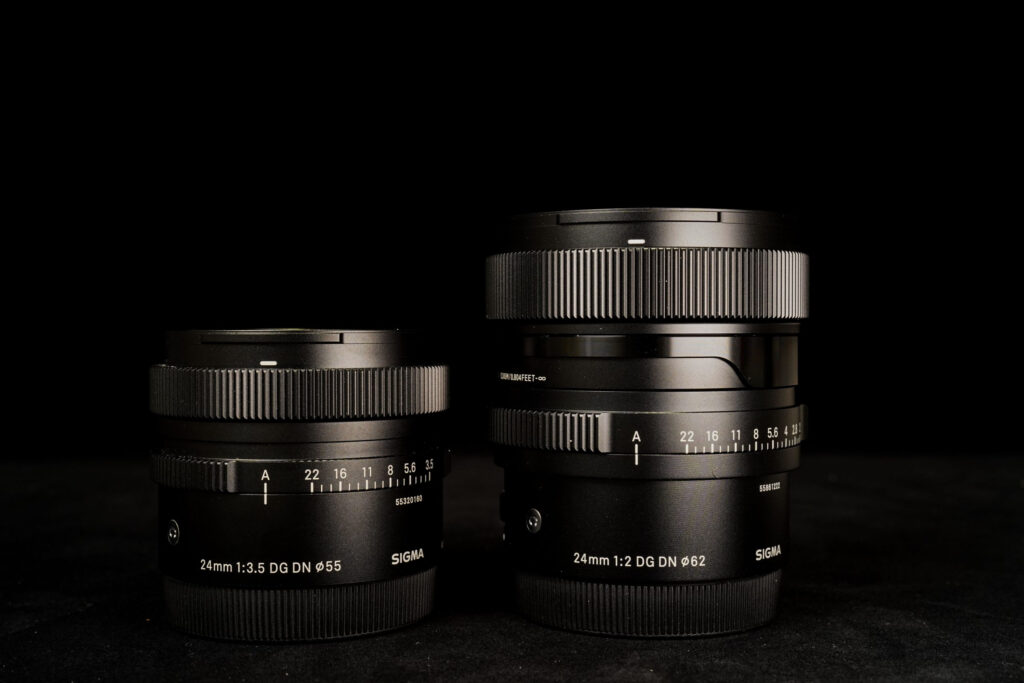
Should I go for brightness or more portability? The 24mm f/3.5 is of course lighter, smaller, and can focus much closer. But, can the loss of almost 2 stops vs this f/2 lens justify the portability?
Some photographers like using a compact 24mm lens as a “35mm” on an APS-C body or in crop mode on their full frame bodies. In this use case, this f/2 lens would likely work much better than the Sigma f/3.5.
Sigma 24mm f/2 Specs:
Weight: 360 grams
Dimensions (Lxφ): 74mm x φ70mm / 2.9 inches x φ2.8 inches
Filter Size: 62mm
Check current price: Sigma 24mm f/2 Contemporary on Amazon
Sigma 24mm f/3.5 DG DN Contemporary I Series Lens
A personal favorite.
This was the lens that introduced me to the “I series”. One of the smallest lenses for Sony full frame. If you like small, tactile lenses, if you put a lot of premum on “hand feel” – I can tell you right now, this lens is a joy to use.
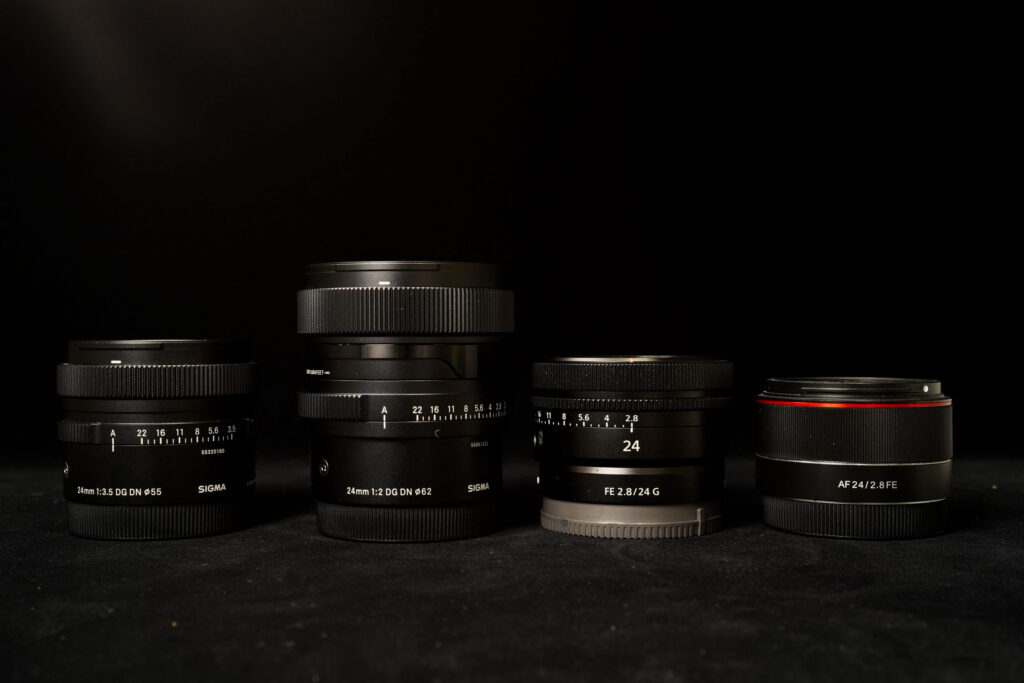
Pair this with a Sony a7c, and it’s crazy that you’re able to get a full frame set-up that is this small and is less than 800 grams. If that doesn’t make you smile, then you probably don’t like small set-ups as much as we do.
This tiny little lens really impressed me from the first time I used it. It’s compact and light, but the all-metal build feels solid and premium in the hand.
Autofocus is quick and snappy, and the image quality is way better than I expected for something this small. It’s sharp even wide open – right to the corners – which honestly surprised me since I wasn’t expecting much.
The bokeh looks great too, especially when shooting up close, with smooth and creamy background blur. Which again shows that, sometimes, it’s not just the quantity of blur that matters, the quality of the blur matters, too. Here is a lens that is slower than some zoom lenses, yet it is able to produce better quality blur than almost any zoom in this range.
Chromatic aberration and coma are well controlled, so there’s no real need to stop down to clean things up.
The biggest downsides are vignetting, and a weird pincushion distortion, which is weird to find in a wide angle lens. Post-corrections take care of them easily, but purists will be better served by the much larger Sigma 24mm f/1.4 in the “Art” series (scroll up).
IF you’re like me, who values small and high performing lenses, and aren’t bothered by “only” having f/3.5, this lens is highly, highly recommended.
Sigma 24mm f/3.5 specs:
Weight: 230 grams
Dimensions (Lxφ): 50.8mm x φ64mm / 2.0 inches x φ2.5 inches
Filter Size: 55mm
Check current price: Sigma 24mm f/3.5 on Amazon
Sigma 35mm f/2 DG DN Contemporary Lens
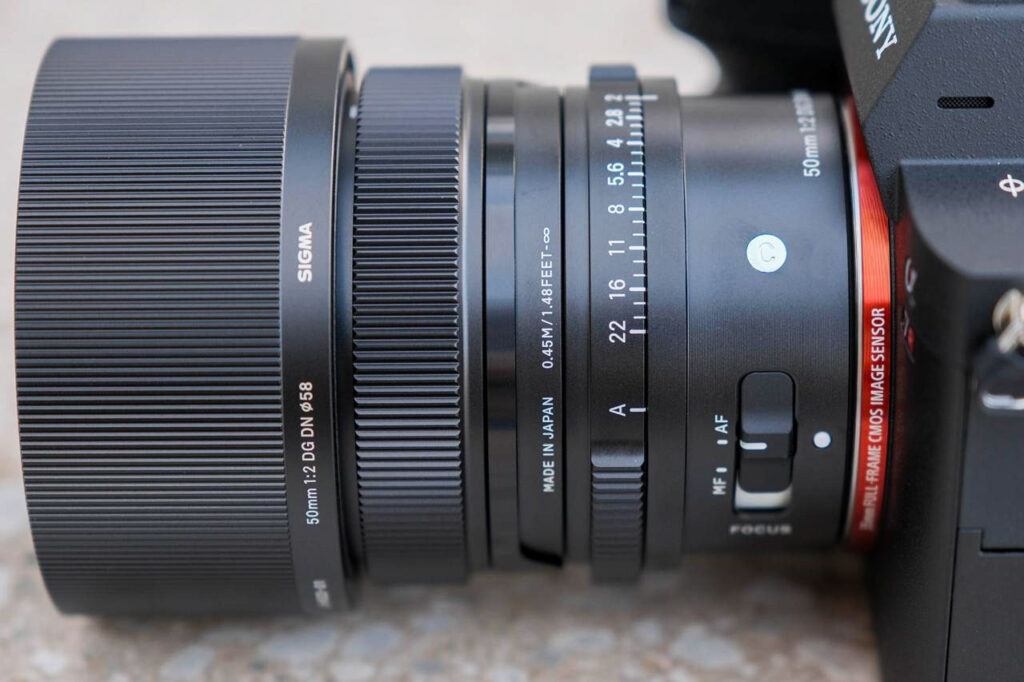
Sigma’s answer to the Sony FE 35mm f/1.8, a lens I call the best 35mm lens for most Sony shooters.
In my review, I described the Sony FE 35mm f/1.8 as a well-balanced lens – a lens that makes smart compromises and delivers an almost perfect 35mm experience for the price.
The Sigma 35mm f/2 sits in roughly the same price bracket but takes a different approach. It has its own strengths, particularly in build quality and handling. The all-metal construction feels premium, and the tactile controls, especially the nicely damped aperture ring, give it that satisfying, mechanical feel that’s missing on the Sony.
Where the Sigma falls short, though, is in autofocus performance. While the Sony doesn’t use their latest XD linear motors, its older linear AF system still works more seamlessly with Sony’s AF-C and real-time tracking.
If you mostly shoot static subjects, this won’t be an issue. But since 35mm is one of the most popular “do-it-all” focal lengths, most people will likely use it for things like kids, pets, travel, or street photography, all situations where Sony’s real-time tracking gives it a clear advantage.
The Sony also wins in close focusing. It can get noticeably closer to your subject, which is great for food shots, detail photos, or kids clowning around in front of the camera.
All that said, the Sigma still stands out for its design and shooting experience. It feels fantastic in hand, solid, compact, and beautifully made, and will appeal to anyone who values that tactile connection between photographer and lens.
Also available in a beautiful silver version – but unfortunately, the silver version is only available in Leica L mount at this time.
Sigma 35mm Specs:
Weight: 325 grams
Dimensions (Lxφ): 67.4mm x φ70mm / 2.7 inches x φ2.8 inches
Filter Size: 58mm
Check current price: Sigma 35mm f/2 Contemporary on Amazon
Sigma 45mm f/2.8 DG DN Contemporary Lens
One of the most misunderstood lenses out right now.
Like the Sigma 24mm f/3.5, there are probably a lot of raised eyebrows here. An f/2.8 prime that costs the same as a zoom? What’s the point?
It’s worth starting by reading Sigma’s explanation about this lens, where the designers explain the philosophy and decisions behind its creation. It gives us some insight into why this lens is so unique.
In short, Sigma prioritized smooth, beautiful bokeh in a compact, everyday-sized lens. To achieve that, a few design compromises had to be made: a modest f/2.8 maximum aperture, a slightly soft rendering especially at close focus, and, because of the deliberate decision to under-correct for spherical aberrations, this results in inconsistent performance when using continuous autofocus (AF-C).
This isn’t a lens for everyone, and many shooters might not immediately appreciate the distinctive “look” it produces. That’s why understanding the design intent is so important, because it helps you see this lens for what it is, not what it isn’t.
Once you understand those parameters and can appreciate its unique rendering style, you’ll realize this is a truly special lens, one with a character and aesthetic that few others can match. And, just like the Sigma 24mm f/3.5 above, it’s a great addition to anyone building a kit focused on size and portability.
Sigma 45mm Specs:
Weight: 235 grams
Dimensions (Lxφ): 48.2mm x φ64.0mm / 1.9 inches x φ2.5 inches
Filter Size: 55mm
Check current price: Sigma 45mm f/2.8 on Amazon
Sigma 50mm f/2 DG DN Contemporary Lens
Same build as all the I Series Contemporary lenses – compact, stylish, all-metal lens that feels great on smaller full-frame bodies like the Sony A7C II. Excellent aperture ring that is a joy to use, but can’t be declicked for video use.
Optically, it delivers sharp results wide open, with smooth, clean bokeh and well-controlled distortion and chromatic aberration.
It’s especially good at mid to long distances, though sharpness drops off toward the corners when shooting close up. Stopping down to f/2.8 or f/4 improves the corners nicely.
The lens has a bit of character, not overly clinical, which some shooters will appreciate. The bokeh is smooth and soft, with a hint of residual aberration that gives a bit of “flavor” to close-up shots.
Autofocus is quiet and accurate, but not particularly fast with moving subjects. Focus breathing is also noticeable. Like all Contemporary series primes, the aperture ring still lacks a de-click option. Still, handling is excellent, and the weather-sealing gasket on the mount is always nice to have.
Compared to the legendary Sony Zeiss 55mm f/1.8, the two lenses differ in personality: the Sony is punchier and more contrasty, the Sigma a touch more neutral with smoother transitions.
At its price, it’s not cheap for a 50mm f/2 lens, but it feels well made and performs consistently. Among 50mm primes for Sony E-mount, it’s one of the most balanced options. Sharp, compact, and with just enough personality to stand out.
Sigma 50mm Specs:
Weight: 345 grams
Dimensions (Lxφ): 70.0mm x φ70.0mm / 2.8 inches x φ2.8 inches
Filter Size: 58mm
Check current price: Sigma 50mm f/2 on Amazon
Sigma 65mm f/2 DG DN Contemporary Lens
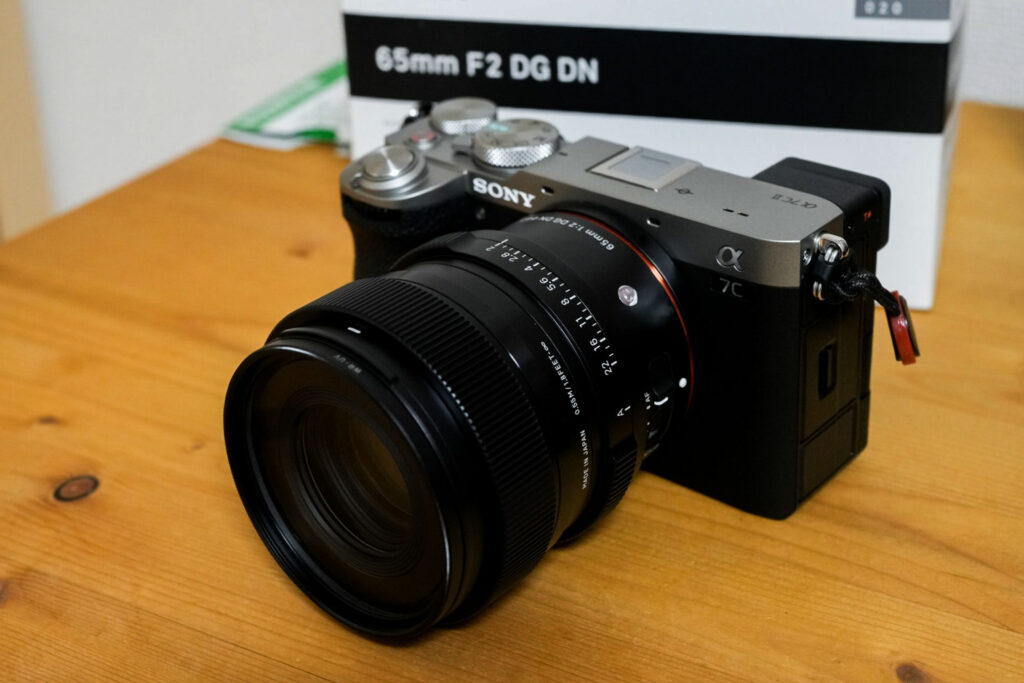
This was one of the first I Series lenses that was released, and it’s gained a lot of fans over the years.
With an unusual 65mm focal length, this lens occupies a curious middle ground – somewhere between the common 50mm and 85mm options – making it a “tweener” lens of sorts. It’s not inexpensive for an f/2 lens, but, as is now usual in the rest of the line, the build is exceptional, easily rivaling more expensive glass.
Optically, the 65mm f/2 performs at a very high level. Sharpness is excellent across most of the frame even wide open, with minimal vignetting and strong control of chromatic aberration. Bokeh is smooth and natural, helped by the slightly longer-than-normal focal length. Stopping down improves corner performance, but most users will be satisfied at f/2. There’s a bit of onion-ring texture in highlights, and the lens doesn’t focus particularly close (55cm minimum, 1:6.8 magnification), so it’s not ideal for near subjects or detail work.
Autofocus is accurate, but not particularly quick, making it less than ideal for action or fast-moving subjects. Manual focus feels precise with a heavier-than-usual resistance, which I prefer in an AF lens.
At 405g, it’s heavier than its compact size suggests. Mounted on a small body like the Sony A7C II, it feels dense but balanced. Compared to Sigma’s 50mm f/2, the 65mm loses a bit of portability, but gains compression and smoother background rendering. It’s a lens that invites slower, more deliberate shooting: portraits, details, and travel scenes where you want a natural yet slightly tighter perspective.
Functionally, it’s straightforward: sealing on the gasket, but nothing beyond that; a nicely dampened aperture ring, but it isn’t de-clickable. Still, the tactile feel and minimalist aesthetic make it a joy to use. In many ways, it’s a photographer’s lens more than a spec-sheet one.
So who’s it for? If you already own a 50mm or 85mm, the 65mm can feel redundant. But if you want something different, maybe more compression than a 50mm, less bulk than an 85mm, it hits a sweet spot. Image quality is close to Sigma’s Art series, I’m surprised that it isn’t one. But the smaller form factor and a rendering that has just enough character to stand apart from the more clinical lenses in its class, probably makes it a better fit for the Contemporary line.
The 65mm f/2 is easy to recommend It’s a beautifully built, optically strong, slightly eccentric prime. Not the fastest, not the cheapest, and not the most versatile, but among Sigma’s I Series lenses, it could be the most satisfying to shoot with.
Sigma 65mm Specs:
Weight: 405 grams
Dimensions (Lxφ): 76.7mm x φ72mm / 3.0 inches x φ2.8 inches
Filter Size: 62mm
Check current price: Sigma 65mm f/2 on Amazon
Sigma 90mm f/2.8 DG DN Contemporary Lens
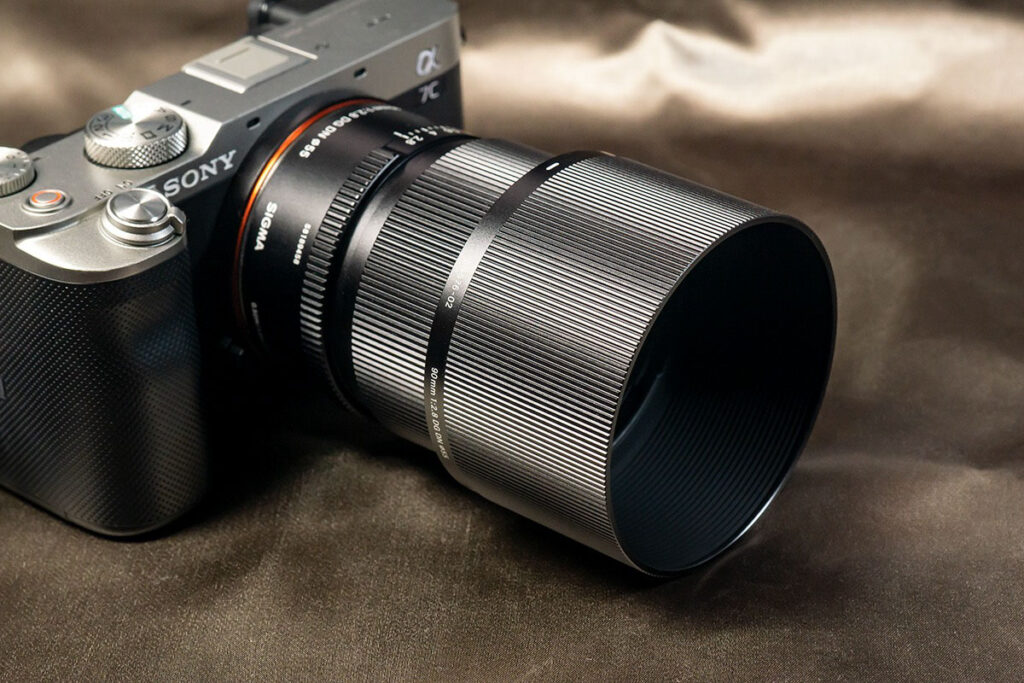
The Sigma 90mm f/2.8 DG DN is one of those lenses that doesn’t look like much on paper, “only” an f/2.8, mid-telephoto, no “Art” badge, but in practice, it’s a small gem that punches well above expectations. Like the rest of the I-series lineup, it feels solid, beautifully made, and proportionally just right on compact full-frame bodies such as the Sony A7C II. At 295g, it’s lighter than it looks and smaller than you think a 90mm should be.
Optically, the 90mm performs very well. The center is sharp wide open, and stopping down to f/4–f/5.6 brings crispness across the frame. Bokeh is smooth and pleasing, more natural than clinical, the Sigma way. Obviously it won’t be as good at isolating as faster f/1.8 or f/1.4 primes, but it is enough. The focal length helps: 90mm provides a slightly more compressed perspective than 85mm, making portraits and detail shots look clean and refined. There’s some vignetting and field curvature at f/2.8, but both improve by f/4. Distortion and chromatic aberrations are minimal and easy to correct in-camera.
The minimum focus distance is a useful 50cm, allowing for tight framing and semi-close compositions. It’s not a macro lens, but you can get closer than most 85mm f/1.8 options. Autofocus is smooth, quiet, and accurate in AF-C, though AF-S can feel a touch hesitant. The manual focus ring is well-damped with good precision, and the aperture ring clicks in third-stop increments, though, like the rest of the I Series so far, you can’t de-click it.
The downsides? Corners never quite reach the same perfection as the center, and field curvature can make the plane of focus tricky at wider apertures, though it probably helps in making central subjects pop. Background bokeh can vignette slightly, and fringing is visible at very close distances. There’s also mild pincushion distortion and light falloff, both of which are fixable. In short, it’s not optically flawless, but the performance is consistent and the rendering has character.
This lens is one of the very few full-frame telephoto lenses that you can carry all day without noticing. It doesn’t overwhelm a small camera, doesn’t intimidate your subjects, and doesn’t make you think twice about packing it for travel. If you’re used to the bulk of an 85mm f/1.4, this feels liberating.
For portraits, travel, or even detail-oriented street work, it’s an excellent companion. If you need maximum subject separation or shoot in low light, the Sigma 85mm f/1.4 DG DN Art is clearly better, but it’s also far larger, heavier, and more expensive.
Among Sigma’s I Series lenses, this is arguably the sleeper hit. It’s not flashy, not especially fast, but it delivers clean results, excellent color, and a tactile shooting experience that is rare in AF lenses today and does so in a size and that is smaller than your typical mid-telephoto lens.
Sigma 90mm Specs:
Weight: 295 grams
Dimensions (Lxφ): 61.7mm x φ64mm / 2.4 inches x φ2.5 inches
Filter Size: 55mm
Check current price: Sigma 90mm f/2.8 on Amazon
Sports Series Prime Lenses
Sigma 200mm f/2 DG OS Sports Lens
Sigma 200mm Specs:
Weight: 1800 grams
Dimensions (Lxφ): 203.0mm x φ118.9mm x / 8.0 inches x φ4.7 inches
Filter Size: 105mm
Check current price: Sigma 200m f/2 on Amazon
Sigma 500mm f/5.6 DG DN OS Sports Lens
Sigma 500mm Specs:
Weight: 1365 grams
Dimensions (Lxφ): 236.6mm x φ107.6mm / 9.3 inches x φ4.2 inches
Filter Size: 95mm
Check current price: Sigma 500mm on Amazon
Re-mounted DSLR Lenses (Full Frame)
These are DSLR designs. Sigma basically took the Canon EF-mount versions of these lenses and built-in an EF to E mount adapter on them. As a result, they still have DSLR-era AF system (HSM) and are even bigger (longer) than their DSLR versions because of the added mount adapter.
I don’t really recommend that anyone get them anymore, unless you have a good reason. e.g. you want an AF lens with a built-in distance scale or you want a lens solely for manual focus pulls during filming.
99.9% of people are better off getting any of the “built-for-mirrorless” lenses elsewhere on this list.
Sigma 70mm f/2.8 DG Macro Art Lens
Sigma 105mm f/1.4 DG HSM Art Lens
RELATED:
Smallest Lenses for Sony Full Frame
15 of the Best Lenses for the Sony a7c
Complete list of Sigma lenses for Sony APS-C
Complete list of Tamron Lenses for Sony E-Mount (Full Frame and APS-C)
Pingback: The Complete Guide to Sigma Lenses for Sony E-mount (APS-C) - Compact Shooter
Pingback: The Complete List of Tamron Lenses for Sony E Mount - Compact Shooter