Here’s our guide to every Sigma lens made for Sony’s APS-C E-mount. If you’re putting together a kit or rethinking your lineup of lenses for cameras like the Sony a6400, Sony ZV-E10, or Sony a6700, you’re in the right place.
We have a separate guide for all Sigma full frame lenses here: The complete list of all Sigma Full Frame lenses for Sony E-mount (FE).
All Sigma APS-C Zoom Lenses
Important note: The zoom ring on Sigma lenses turns in the opposite direction from Sony lenses. So, if you’re used to how Sony zooms work, it might feel a bit backwards at first when zooming in or out with a Sigma lens.
Sigma 10-18mm f/2.8 DC DN Contemporary Lens
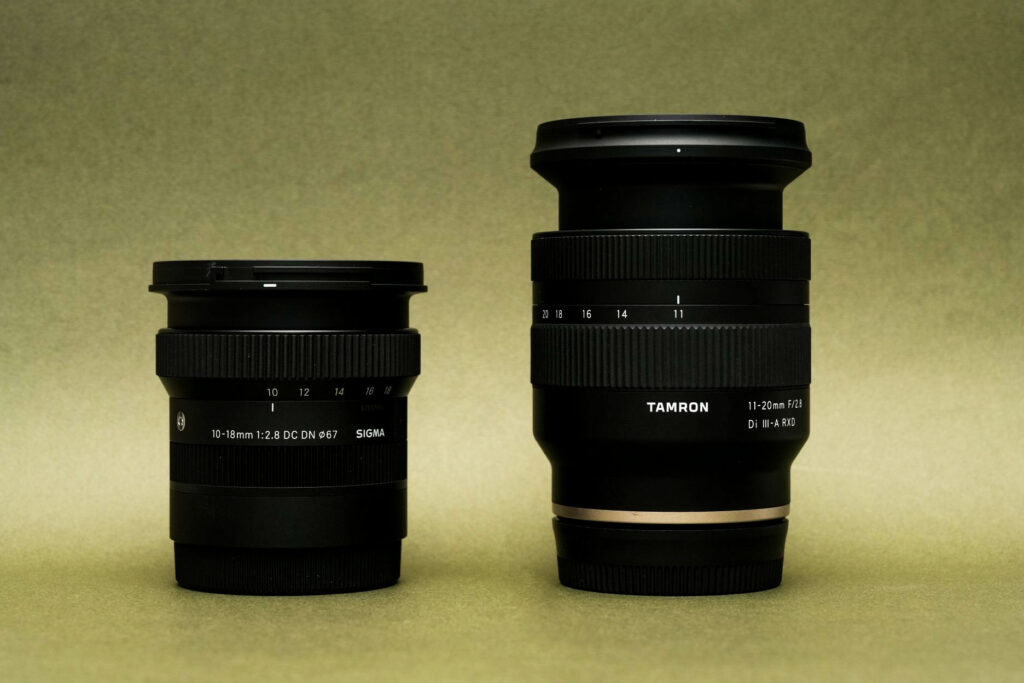
The smallest and lightest ultra-wide f/2.8 zoom you can buy today. It’s significantly smaller than its closest competitor, the Tamron 11-20mm f/2.8 RXD. It’s slightly bigger than the Sony 10-20mm f/4. But, the Sony is only f/4. This Sigma is also smaller than the Samyang 12mm f/2.0 AF prime lens.
It’s one of those rare lenses that seems to exist because someone at Sigma simply decided, why not?
Build and Handling
Let’s start with size and handling, because that’s the whole point of this lens. At just 255g and 64mm long, it fits in the palm of your hand and it feels almost toy-like at first, especially compared to something like Sigma’s own 14–24mm f/2.8 DG DN Art, which weighs over a kilogram. The difference in portability is enormous, this is a lens you can toss in the corner of a bag and forget about until you need it.
The build is plastic but solid, with a good tactile feel. The zoom ring has a smooth, damped motion, and the lens extends slightly when you’re at the widest end, not when you zoom in. The hood mounts via a push-in design rather than a traditional bayonet, unusual, and it feels fiddly at first, but it works fine once you get used to it.
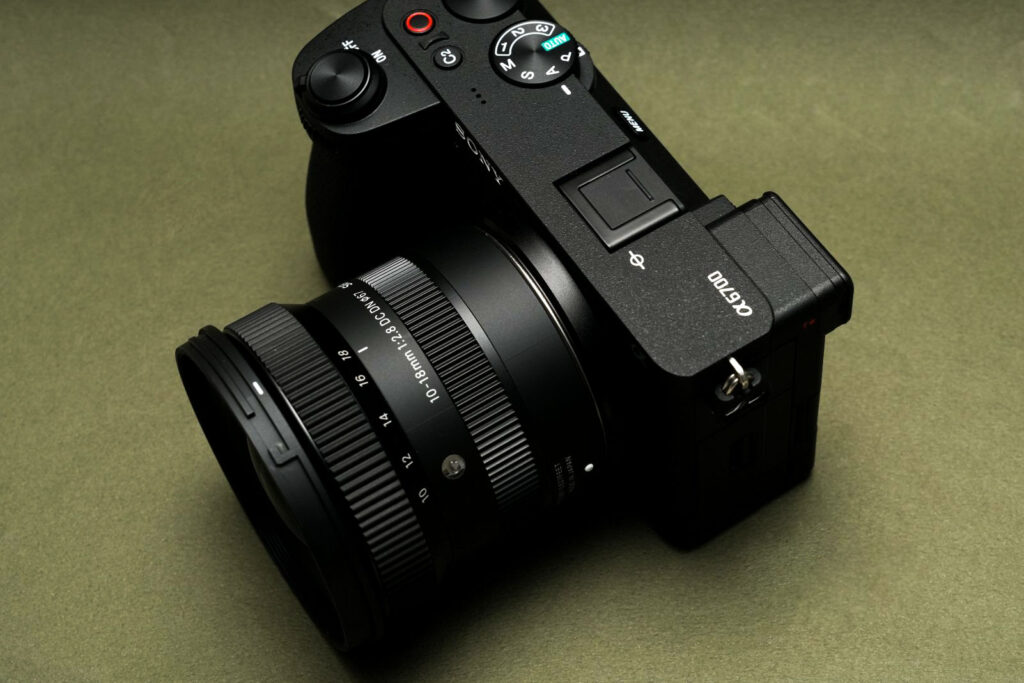
The lens lacks an aperture ring, image stabilization, or custom switches of any kind. This is the same design philosophy that Sigma has chosen with most if its APS-C lens line-up, so far. The Tamron 11-20mm f/2.8 follows the same formula. One advantage the Tamron gets over the Sigma is some weather sealing, as the Sigma has none, not even a gasket in the mount.
Optical Performance
For something this small, performance is very good. Central sharpness is strong even wide open, and the edges and corners sharpen up noticeably by f/5.6. Compared directly with the Tamron, Sony 10-12mm f/4 G and the older Sony 10-18mm f/4, the Sigma 10–18mm holds its own in practical use. The Sigma is the weakest in the corners, but, at normal viewing sizes, the difference in corner resolution is minor; you’ll only see it when pixel-peeping side by side.
Across the frame, at the wide end, image quality softens slightly at 10mm and f/2.8, which is expected for an ultra-wide zoom. By 14–18mm, results improve, and overall sharpness becomes quite consistent. Color and contrast are excellent – very ‘Sigma-like’ – with good saturation and minimal chromatic aberration. Some flare can appear with direct light sources, but it’s manageable, and ghosting is well-controlled. Distortion and vignetting are corrected in-camera, so for most users shooting JPEGs or working in modern raw converters, these are non-issues.
Bokeh isn’t something you normally care all that much about in an ultra-wide, but at closer distances, the fast aperture does allow some subject separation. Photographing my children hamming it up for the camera or objects up close shows a gentle, pleasant blur when focused near minimum distance, which is a plus for the Sigma for environmental portraits or lifestyle work compared to the f/4 on the Sony 10-20mm G.
It’s not optically perfect, and I did not expect it to be. An ultra-wide zoom this small has to have some compromises. But, it’s good enough in all the ways that matter. More importantly, it’s practical. Having an ultra-wide that goes from 15-28mm-equivalent in a size like this has literally changed my shooting habits. Not only do I actually bring it along for family travel or casual shooting days where an ultra-wide would have stayed home, but it has also encouraged me to be more “risky” with my other lenses choices, because I know I have my favored 24-28mm focal range covered by an f/2.8 lens.
Alternatives
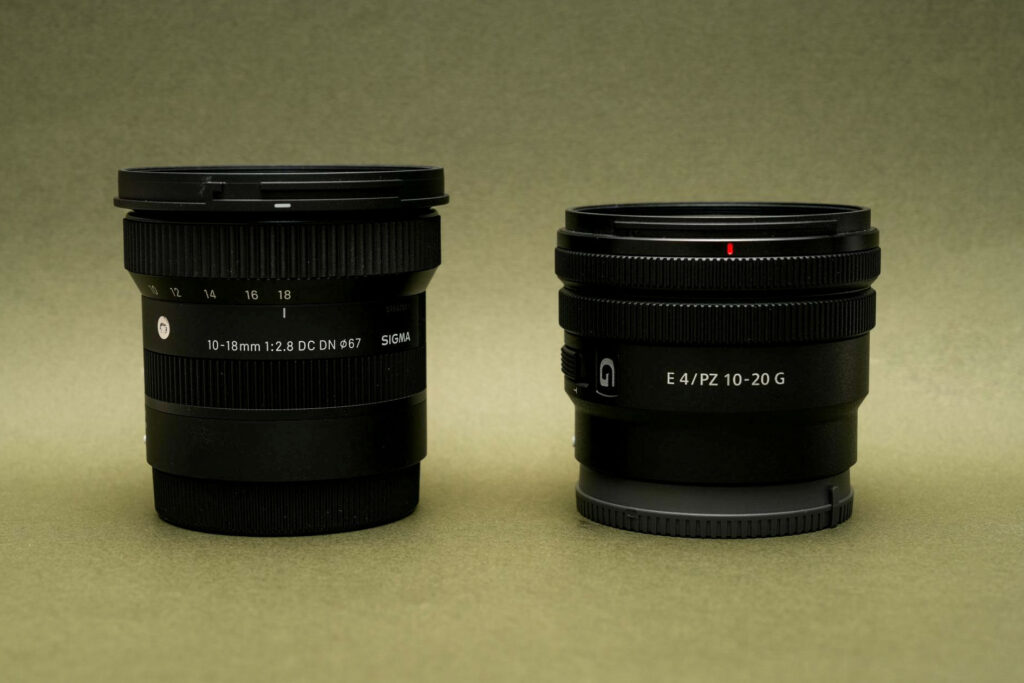
Above, you can see that the Sigma is roughly the same size as the Sony 10-20mm f/4 G. The Sigma has the advantage of being a full stop brighter, while the Sony has the advantage of being able to zoom an extra bit longer. The Sony is also internally zooming, meaning it doesn’t extend at all when zooming. This is an advantage when filming on an electronic gimbal, since the balance won’t shift too much.
However, the Sony uses a “power zoom” rather than a traditional mechanical zoom. This can result in a somewhat disconnected feel during zooming and also means the lens lacks visible focal length markings on the barrel.
Vs the Tamron 11-20mm, the Sigma’s size and wider field of view wins out for me. I can always crop or move forward a bit to get closer with the Sigma, but if I run out of space, I can’t really do much about getting a wider field of view on the Tamron.
RELATED: The Complete List of Tamron Lenses for Sony E-Mount (Full Frame and APS-C)
Verdict
It’s not without compromise: no weather sealing, no aperture ring, only reaches to 18mm (28mm-equivalent field of view) and there is some edge softness wide open. But in return, you get a genuinely portable f/2.8 ultra-wide that makes APS-C systems feel complete again. For landscape, travel, vlogging, it’s the lens that justifies carrying a crop-sensor kit.
If you’ve been waiting for a reason to ditch your heavy full-frame UWA zoom, this is it. Someone finally made an ultra-wide you’ll actually want to take with you.
In professional or documentary contexts, like photographing children in classrooms or events, the Sigma 10–18mm proved more than capable. Its close focus and wide field of view let me capture immersive, dynamic scenes, and its f/2.8 aperture can be a life-saver in low light. Once you use it in the real world, you will realize that the size makes it amazingly convenient, and the relatively poorer corners rarely matter outside of test charts.
Pair this with the Sigma 18-50mm f/2.8 below, and with a Sony a6400 (405 grams), you’ve got a two-lens kit that is ready for anything for under 1kg in a small pouch or bag!
Sigma 10-18mm Specs:
Weight: 255 grams
Dimensions (Lxφ): 64.0mm x φ72.2mm / 2.5 inches x φ2.8 inches
Filter Size: 67mm
Check current street price: Sigma 10-18mm f/2.8 on Amazon
Sigma 18-50mm f/2.8 DC DN Contemporary Lens
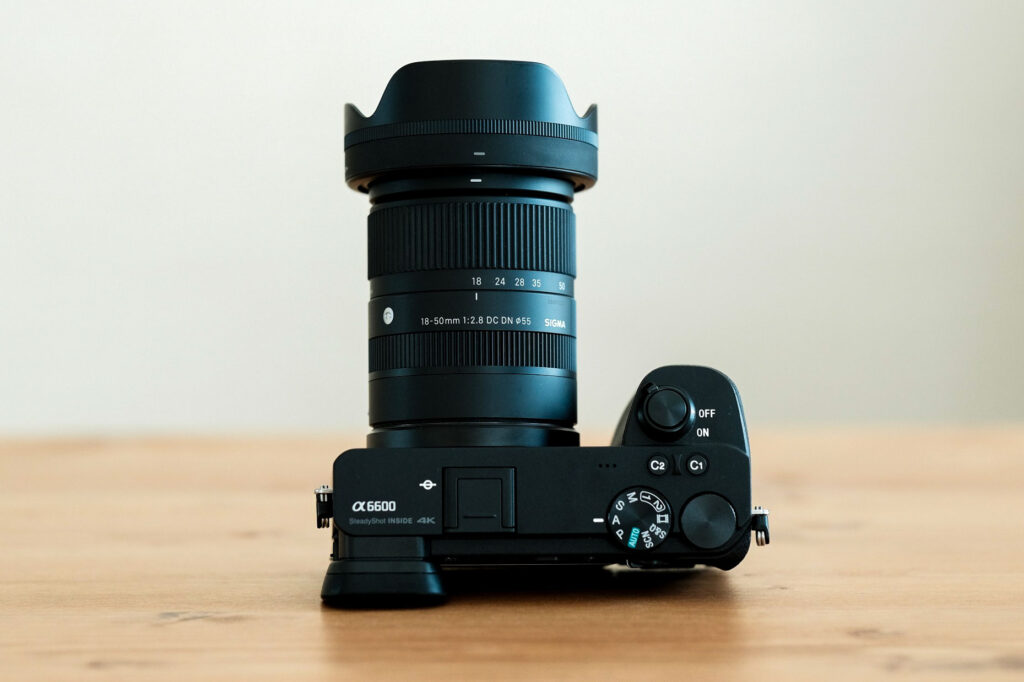
This lens has become something of a runaway success in the APS-C world. It isn’t flashy, it doesn’t carry Sigma’s “Art series” badge of more premium lenses, but it’s a lens that checks all the boxes for APS-C shooters.
Build and Handling
Let’s start with what’s immediately obvious: this lens is tiny. Mounted on an a6400, a6700, or ZV-E10, it looks and feels like a kit lens. Yet, it delivers the constant f/2.8 aperture you’d normally associate with pro-level glass. The build is typical Sigma Contemporary series: mostly composite plastic, but it doesn’t feel cheap. It’s feels soild, with tight tolerances and smooth operation. The zoom ring is well-dampened, with a short throw (less than 90 degrees), which makes zooming fast and natural.
The only real quirk is the zoom direction, which is reversed if you’re coming from Sony lenses. Some may find this jarring at first, but, for myself, despite mixing and matching with Sony lenses, I got used to it after a few days. The lens has no switches or buttons, no AF/MF toggle, no custom button, no image stabilization.
I know Sigma loves consistency in their design language, and it looks like they’ve decided that their APS-C zoom line won’t have aperture rings or any customizable buttons. It feels like a missed opportunity to me. In 2026 and beyond, photographers are looking to get a bit more quality of life improvements in their gear, and while I don’t expect image stabilization (which Sigma calls optical stabilization (OS)) in this lens, I had hoped for at least an aperture ring or a focus hold button.
On balance, the lens feels great in hand. It pairs perfectly even with the ZV-E10, Sony a6100 or a6400, which are among the smallest APS-C cameras out right now. Even all day use won’t strain your wrists, since it won’t doesn’t make these set-ups front heavy at all. Unlike the Sony 16-55mm f/2.8, which could benefit from a larger Sony APS-C body, similar to the Fuji X-S20 or the Fuji X-H series, this lens has no problems with the small grips found on some Sony APS-C bodies.
Optical Performance
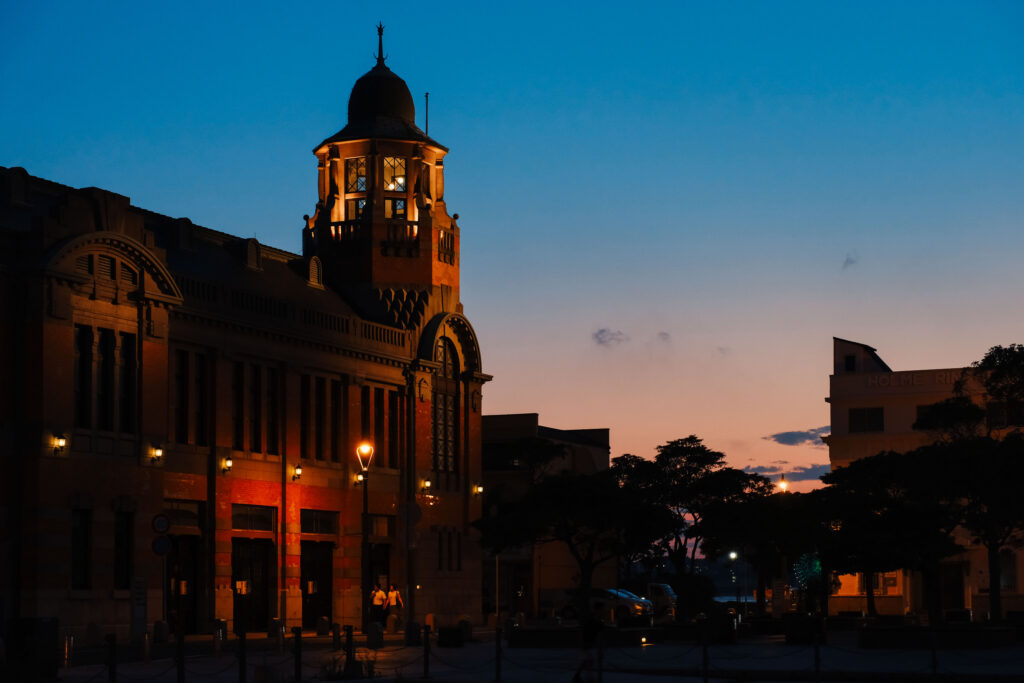
For a small zoom, performance is surprisingly robust. Sharpness in the center is excellent wide open, and the edges are more than respectable. Stopping down to f/4 or f/5.6 evens things out across the frame. At f/8, there is absolutely nothing to complaint about. At 18mm, there’s some mild softness in the corners and visible vignetting, but nothing I would call unexpected in an ultra-compact f/2.8 zoom. Distortion is present, a touch of barrel distortion at the wide end transitioning to pincushion by 50mm, but these are easily corrected in post.
Color and contrast are typical Sigma: rich, neutral, and consistent. Compared to Sony’s E 16-55mm f/2.8 G, the Sigma is a touch less contrasty but delivers a more natural color tone that I prefer, especially for people shots.
Bokeh is generally smooth for a zoom in this range, especially at closer distances. Background blur can get a bit nervous in busy scenes, and there’s some cyan fringing (axial chromatic aberration) visible around high-contrast edges. It’s noticeable when shooting wide open, particularly with in specular highlights and fine textures like fur or grass. That said, I feel that it’s a fair tradeoff considering how compact the optical design is.
Flare and ghosting are well controlled. The coatings do a good job maintaining contrast when shooting into light sources. In real world use, I rarely ran into a situations where flare was a problem.

Autofocus and other features
AF-C tracking is quick enough for casual action, kids, pets, street scenes. There’s a slight hesitation in AF-S mode before locking focus, but that’s typical for Sony, you really want to be in AF-C and use tracking most of the time.
Focus breathing is minimal, which makes this a strong option for video shooters, especially given its small size and quiet operation.
The close focusing distance is impressive, just 12cm at the wide end and about 30cm at the tele end. You won’t really be using the MFD that much, since your subject will practically be touching the front glass. But, close focus in a zoom is always useful. I know it’s great when my daughter makes funny faces thinking she’s too close for the camera to focus.
Alternatives
Compared to the Tamron 17–70mm f/2.8, the Sigma is much smaller, lighter, and easier to balance on APS-C bodies. The Tamron delivers better edge sharpness and smoother bokeh, but it is much bigger and front-heavy by comparison. The Sigma’s real advantage is that it doesn’t compromise portability.
Against Sony’s 16–55mm f/2.8 G, the Sigma gives up a little edge and corner sharpness and flare control but costs far less and weighs half as much. There is no question the Sony is the technically superior optic, and being able to go to 16mm (24mm equivalent) can sometimes be the difference between getting the perspective you want. But, you will have to weigh that vs the size and price savings that the Sigma provides.
Verdict
The Sigma 18–50mm f/2.8 DC DN Contemporary is exactly what Sony’s APS-C line needs: a small, sharp, and fast standard zoom that matches the compact bodies of the a6xxx and ZV series. It’s not meant to be overly impressove in lab charts or spec sheets, it’s meant to live on your camera and deliver results you need.
You give up some things: a little bit of range in the wide end and perhaps a little edge sharpness in certain situations. But in return, you get a constant f/2,8 zoom that’s balanced, and genuinely portable.
If you’re building a lightweight APS-C kit for travel, daily shooting, or hybrid work, this is easily the best recommendations to build your kit around.
Specs:
Weight: 290 grams
Dimensions (Lxφ): 76.5mm x φ61.6mm / 3.0 inches x φ2.4 inches
Filter Size: 55mm
Check current street price: Sigma 18-50mm on Amazon
Sigma 17-40mm f/1.8 DC DN Art Lens
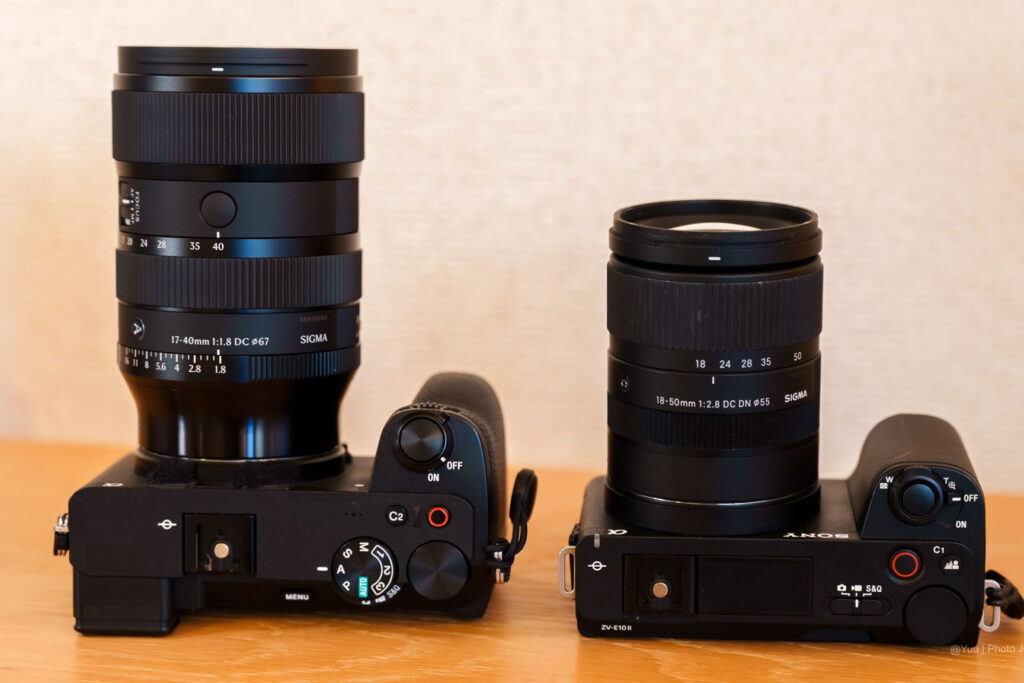
The update to the legendary 18-35mm f/1.8 lens for crop sensor DSLR’s is finally here. And, boy oh boy, is it a beauty!
The DSLR era 18–35mm f/1.8 HSM earned a near-cult following among photographers and filmmakers. This new version takes the same basic concept: a constant f/1.8 aperture across the zoom range, and builds it from the ground up for mirrorless.
Build and Handling
The 17-40mm is roughly the same size as the previous 18-35mm f/1.8 in Canon EF mount. Of course, if you added an adapter to use the older lens on a Sony body, then overall size would become even bigger still.
The 17-40mm is long but relatively slim, with weight distributed well enough that it balances nicely on small APS-C bodies like the a6700, a6400 and ZV-E10. The fit and finish are top-notch with a general feeling of precision. In typical Sigma Art fashion, there’s nothing “budget” about how it feels or operates.
The zoom and focus rings both have excellent resistance. One big difference vs its predecessor is that manual focus is no longer linear and it no longer has the useful distance scale of the old 18-35mm lens. This lens does support the option to set the focus ring to nonlinear/linear focus on select L-mount cameras (Lumix, Leica, Sigma cameras), but there is no such option in Sony cameras.
On the Sony version, Sigma has added a de-clickable aperture ring, and a lock to prevent accidental movement. The Canon RF version does not have an aperture ring, only a free-wheeling control ring, similar to the rings on Canon RF lenses. You can set it to control aperture on the RF version, but it’s unmarked, and you won’t get the option to make it clicky or to lock it to one aperture to prevent accidental changes.
Same as the 18-35mm, it’s an internal zoom design, meaning the barrel does not extend while zooming. That’s not only good for balance, but also for video use with gimbals and matte boxes.
Optical Performance
Wide open, it delivers high center sharpness across the range, with corners that are already usable at f/1.8 and clean up further by f/2.8. At the telephoto end, sharpness is consistent across the frame, and resolution remains strong up to f/11.
Bokeh is, as you’d expect from a fast zoom,. At 18mm, the depth of field is not especially shallow, but the transitions are smooth and the specular highlights mostly round with soft edges. Stopping down improves vignetting and eliminates the slight cat’s-eye shape near the frame edges. At 35mm and beyond, you can achieve a genuine pop that you normally won’t be able to get from APS-C zooms.
Chromatic aberration is mostly well-controlled, though some longitudinal (axial) color fringing does show up around high-contrast transitions at f/1.8. It’s minor and easily cleaned up in post, but videographers working in high-contrast lighting might notice a bit of color shift in bokeh edges. Lateral CA is minimal and largely correctable in-camera.
Uncharacteristic for an Art lens, the 17-40mm needs to rely on corrections for extensive barrel distortion at 17mm. Post-correction dpes eliminate the issue altogether. There is some milder pincushion distortion at about 30mm, also easily correctible. It’s a non-issue for me, I am not a purist. I have no issues with lenses requiring software corrections. It is just surprising that Sigma marketed this lens under its Art series, despite the more extensive use of software correction for distortion vs your typical Art lens.
Flare resistance is another strong point. Even with point light sources in frame, ghosting and contrast well controlled. In backlit scenes, overall contrast remains pretty good.
Sunstars are a nice surprise. By f/2.8, the lens produces clean, symmetrical sunstars with sharp, defined rays.
Autofocus
This is one of the first Sigma APS-C lenses using Sigma’s new HLA (High-response Linear Actuator) AF motor. Similar to the stepper motor in its other lenses, it is both fast and quiet. Compared to the old HSM AF on the 18-35mm f/1.8, it’s a night-and-day difference.
Despite the complex optical formula, (17 elements in 11 groups) with 4 SLD elements and 4 aspherical elements, the linear motors are more than up to the task. There is no sluggishness here.
Tracking AF (AF-C) isn’t as good as the Sony 16-55mm f/2.8, especially for subjects moving through different planes of focus. e.g. someone running straight towards the camera, with hit-rate about 60-70%, compared to 99% on the Sony lens.
Alternatives
Compared to the lens it replaces: the older Sigma 18–35mm f/1.8 HSM. This new version is lighter, sharper, faster to focus, and better corrected. It adds an aperture ring and eliminates the extending barrel. It’s generally a moot point, as the Sigma 18-35mm was never released in Sony E mount. The majority of people picked up the Canon EF-S version and used the Sigma MC-11 EF-to-E mount adapter.
Compared to Sony’s 16-55mm f/2.8, the Sigma is 1 and 1/3 stops brighter, sharper wide open, and in my opinion, built to higher tolerances. Though of course, it’s not really an apples to apples comparison. The Sony has a significantly better zoom range, but is more than a full stop slower. The Sony has more consistent edge sharpness, but the Sigma’s advantage in light gathering and all the other advantages that the f/1.8 aperture brings in depth of field control can’t be ignored.
Tamron’s 17–70mm f/2.8 might be another lens that may be up for comparison, but same as the Sony 16-55mm, it’s just a completely different kind of lens, more all-purpose, less specialized. Size-wise though, they are very similar. But, no one is going to call the Tamron “a bag of primes” and no one is going to call the Sigma 17-40mm a versatile travel zoom.
Verdict
The focal range, equivalent to 27–52mm on full frame, is somewhat limiting compared to a 24-70mm f/2.8 on full frame. If you’re shooting events, environmental portraits, or video, it still remains a very practical range. For travel or landscapes, most people would probably pair it with something wider.
The constant f/1.8 aperture fundamentally changes what’s possible on APS-C, giving us an extra tool for creative control and low-light performance that f/2.8 zoom lenses can’t match.
It’s not a small lens, I’ve heard it described as “too much to just toss in a bag,” and I agree with that. If you prioritize compactness above all, Sigma’s 18–50mm f/2.8 DC DN remains the better travel option in this range. But, if you don’t care for that, the 18–35mm f/1.8 brings image quality and flexibility that no other APS-C zoom currently matches. The only way to get something similar would be to step up to full frame with an f/2.8 full frame zoom.
Specs:
Weight: 530 grams
Dimensions (Lxφ): 117.9mm x φ72.9mm / 4.6 inches x φ2.9 inches
Filter Size: 67mm
Check current street price: Sigma 17-40mm f/1.8 on B&H
Sigma 16-300mm f/3.5-6.7 DC DN OS Contemporary Lens
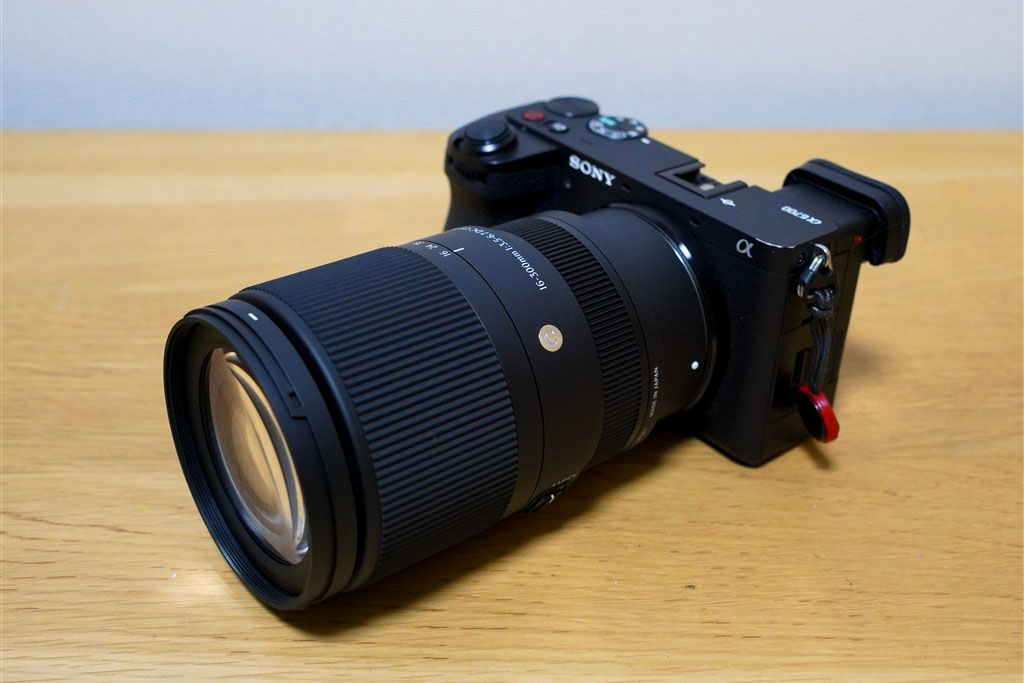
This is Sigma’s first all-in-one zoom for APS-C mirrorless, effectively covering a whopping 24-450mm equivalent range. It plays in the same space as Tamron’s popular 18-300mm, but goes slightly wider while keeping about the same size and weight.
Build and Handling
Build quality is excellent for a superzoom. The lens feels solid, with tight tolerances, no play in the extending barrel, and the zoom ring doesn’t wobble or creep.
The Sigma APS-C Contemporary formula is all here: no AF/MF switch and no optical stabilization switch, just a zoom lock. Both AF and stabilization are handled by the camera body, which, depending on how you shoot, could be a non-issue or an annoyance. The lens balances better than expected on cameras like the α6700, though it’s not light. For a lens that is meant for travel, it’s not small, but it is compact for the range it covers. It’s roughly the same size and weight as the Tamron 18-300mm, and slightly smaller than the Sony 70-350mm telephoto zoom.
There is a weather sealing gasket around the mount, and Sigma claims dust and splash proof construction everywhere else.
It’s roughly the same weight as the Tamron (620 grams), but it feels lighter to me. Maybe the Sigma has better balance, and doesn’t pull the weight to the front too much. Unfortunately, I don’t have them at the same time to compare. But, I do plan a better side-by-side comparison between the Sigma 16-300mm vs the Tamron 18-300mm in the future. Maybe.
RELATED: Complete list of Tamron Lenses for Sony E-Mount
Optical Performance
For an ultra zoom, performance is great. The wide end shows some corner softness, but the center sharpness is good throughout, and the telephoto end is better than expected from a 300mm zoom.
Color and contrast are natural, flare resistance is impressive, and overall rendering feels modern and crisp. Bokeh is smooth enough for a lens of this type, and close-up ability is excellent: this lens can shoot half-macro at 70mm, which adds versatility for flowers, details, or small objects.
Image stabilization performance is as advertised (officially, its OS is rated better than the Tamron’s VC) and helps make the slower aperture manageable for handheld shooting.

Above, Sigma 16-300mm at 300mm, f/7.1
Alternatives
The most obvious alternative is the Tamron 18-300mm f/3.5-6.3.
The extra 2mm at the wide-end is extremely useful in tight spaces. For some, the 18mm on the Tamron will already be a deal breaker. A super zoom’s main job is to spend as much time on your camera as possible and minimize lens changes, having 16mm vs 18mm can be the difference maker in this instance.
Both are capable of half-macro magnification, but, the Tamron does it at 18mm, while the Sigma does it at a more useful 70mm. The Sigma gives you a significantly better working distance for close-up shooting.
The Sigma is rated better for image stabilization, 6 stops at the wide-end and 4.5 stops at the telephoto end. The Tamron is rated at 4.5 stops across the range. Although, that can be negated somewhat by the differences in aperture. The Tamron is slightly brighter in certain parts of the focal range. The Tamron is at f/5.6 from roughly 90mm to 155mm, and f/6.3 from 156mm to 300mm. The Sigma is already at f/6.3 by ~90mm. The f/6.7 aperture is only at 300mm. Basically, the Tamron is 1/3 stop brighter than the Sigma from ~90mm to ~155mm and again at 300mm.
Verdict
Here’s why you buy this lens: you want one do-it-all zoom that covers wide landscapes, portraits, telephoto, and near-macro without changing lenses. It’s for travel, hiking, daytime family events, or days when you want to carry just one lens and still be ready for anything. Highly recommended.
Sigma 16-300mm Specs:
Weight: 615 grams
Dimensions (Lxφ): 123.4mm x φ73.8mm / 4.9 inches x φ2.9 inches
Filter Size: 67mm
Check current street price: Sigma 16-300mm on Amazon
All Sigma APS-C Prime Lenses
Sigma 12mm f/1.4 DC DN Contemporary Lens
Sigma’s 12mm f/1.4 DC DN is a surprising lens in several ways. It’s the first f/1.4 ultra-wide made specifically for APS-C mirrorless, and it manages that feat while staying compact, light, and priced well below what you’d expect for the optical performance it delivers. Released in late 2025, it rounds out Sigma’s growing line of fast primes for crop bodies.
Build and Handling
No surprises here, the 12mm follows the familiar APS-C Contemporary series styling: understated, functional, and modern. But, the big surprise is that we finally (!) get an aperture ring on a Sigma APS-C prime. The aperture ring moves in 1/3-stop clicks, and is well executed. I’ve read some say it is on the loose side, but it feels perfect to me. Unlike Sigma’s wide primes for full frame, there is no aperture lock option though, unless you want to stick it into “A” and control your aperture via the camera only. There is also no option to declick the aperture.
The outer barrel is high-grade polycarbonate. It’s fully sealed against dust and splashes, with a gasket at the mount and fluorine coating on the front element to protect from fingerprints and water droplets. A bayonet-type, flower-shaped hood is included, and it reverses for storage.
It’s a small lens, roughly the same size and weight as the Sony 15mm f/1.4. It’s in between the Sony 11mm f/1.8 and the Sigma 10-18mm f/2.8 in size. It is significantly smaller and lighter than what is perhaps its closest competitor – the Viltrox 13mm f/1.4.
RELATED: The Complete List of Viltrox Lenses for Sony APSC-C
Optical Performance
At f/1.4, the center is already sharp with good contrast. Corners appear a touch soft, but remain respectable. Stopping down to f/2 tightens the corners significantly, and by f/2.8 across the frame sharpness is already good. From f/4 to f/8, image quality is excellent across the board, and diffraction only starts to nibble at sharpness beyond f/11.
Chromatic aberration is minimal. You might see faint magenta or green fringing at f/1.4 in high-contrast edges, but it’s mild and easily corrected. Lateral CA is almost nonexistent. Distortion, on the other hand, follows the Contemporary series way of relying on in-camera or software correction. Uncorrected raw files show noticeable barrel distortion, but can be fixed easily in post.
Vignetting is about two stops at f/1.4, but it evens out by f/2 and is also easily corrected in post.
If you favor this focal length for portraits, you may actually like how it naturally draws attention to the center of the frame.
Coma is well-controlled for such a wide and bright lens. Star points stay relatively tight, and sagittal flaring is minimal.
Backlight performance is excellent. Flare and ghosting are practically nonexistent, even with the sun in the frame. Contrast remains strong, and there’s no major veiling. The 9-blade rounded diaphragm renders attractive 18-point starbursts at f/11.
Alternatives
Competitors include the Sony 11mm f/1.8, Sigma’s own 10-18mm f/2.8 zoom, and budget alternatives from Samyang and Yongnuo. The Sony focuses slightly faster and is even lighter, but it’s only f/1.8, giving the Sigma a two-thirds stop advantage. The Sigma zoom, meanwhile, offers flexibility but loses the depth-of-field control and low-light advantages of the 12mm.
Yongnuo’s 11mm f/1.8 undercuts it on price but can’t match Sigma’s edge-to-edge sharpness, flare resistance or AF performance. Samyang’s 12mm f/2 has been a popular low-cost choice, but it now feels dated beside the Sigma’s autofocus and center sharpness wide-open.
Verdict
Sigma’s 12mm f/1.4 DC DN is a milestone lens for Sigma’s APS-C prime line. It follows the same formula: large-aperture, near-professional level optics, even if it relies on software corrections, and genuine portability in a way few lenses do. But, what makes it interesting is that it’s the first APS-C prime from Sigma that breaks beyond the “staple” focal lengths that we expected them to release. This bodes will for the future of Sigma’s APS-C line. It shows that they’re willing to invest more into unique focal lengths beyond just covering the basics.
If you shoot interiors, real estate, landscapes, architecture, night skies, or video on a crop-sensor mirrorless body, this lens should be near the top of your list. Sigma has effectively delivered a full-frame-grade optic for crop users who care about both image quality and portability.
Highly recommended.
Specs:
Weight: 250 grams
Dimensions (Lxφ): 69.4mm x φ68.0mm / 2.7 inches x φ2.7 inches
Filter Size: 62mm
Check current street price: Sigma 12mm f/1.4 on Amazon
Sigma 16mm f/1.4 DC DN Contemporary Lens
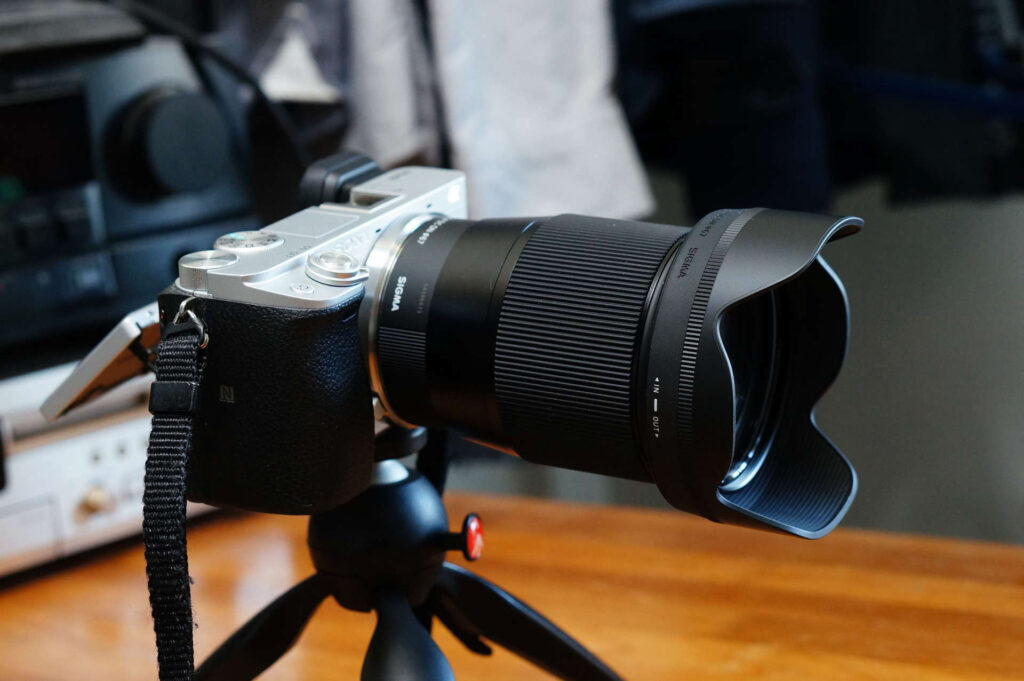
With a 24mm-equivalent field of view, similar to the main 1x camera on recent iPhones, this is an ideal everyday focal length. Though it’s the largest in Sigma’s f/1.4 APS-C lens series, it’s also arguably the most versatile, especially for those who gravitate toward a wider view.
This is one of the most popular lens for creators. It’s wide enough for tight indoor studio set-ups, but not too wide that it distorts everything, and the f/1.4 allows for some control over blurring the background.
Build and Handling
This is the biggest of Sigma’s APS-C prime lineup, but when it was released in 2017, it was an engineering marvel. Sigma managed to pack an f/1.4 aperture into a barrel that’s compact enough to suit small mirrorless bodies. The lens barrel is bare bones, but it does have a dust and splash-resistant design, a rubber gasket at the mount. Nothing wobbles. The focus ring is large, damped just right. There are no buttons or switches, but that also means less things that may break or let moisture in.
Autofocus is driven by a stepping motor, but it is still competitive almost a decade later. It’s fast, quiet, and precise. It works well, even for video, with smooth and silent focus transitions.
The 16mm focal length gives you a 24mm full-frame equivalent field of view. It’s a natural and flexible focal length that feels comfortable for both landscape and environmental portrait work. It’s wide enough to pull in a sense of space, but not so wide that perspective starts to look forced. There’s a reason Apple settled on this focal length for the 1x main camera on their phones.

Optical Performance
At f/1.4, it’s already sharp in the center with some edge softness. By f/2, contrast and microdetail click into place, the corners clean up well by f/4, and diffraction doesn’t become noticeable until f/11.
Out-of-focus areas are smooth, especially at closer distances, and while wide-angle lenses aren’t known for subject separation, the combination of f/1.4 and the 16mm perspective makes it possible to isolate a subject in a way most wide primes can’t. Bokeh balls are round in the center and only start to cat-eye near the edges.
Flare resistance is excellent. Even with the sun just inside the frame, contrast holds up remarkably well. Sigma’s coatings do their job, and ghosting is minimal. Chromatic aberration is modest at f/1.4, nearly gone by f/2, and lateral CA is virtually absent. There’s about two stops of vignetting wide open, typical for a fast wide prime. This drops to ~under one stop by f/2.8. Distortion is a mild barrel type and easily corrected in-camera or in post.
Coma performance is decent but not perfect. This isn’t the best choice for pinpoint astrophotography. Bright stars near the corners stretch slightly at f/1.4, but stopped down a bit, it is capable of nightscapes and city scenes.
Minimum focus distance is 25 cm, yielding a 0.10× magnification. It’s not a close-up lens by any stretch, but it gets close enough for casual detail work. Focus breathing is minor and predictable, which is good news for video shooters.

Verdict
There is a reason this lens is well loved. It excels for video, travel, street, and environmental portraits, and it’s one of those lenses that can live on your camera without ever feeling limiting. If you shoot landscapes, it’s sharp enough. If you shoot events, it’s bright enough. And if you shoot casually, it’s just fun.
There are a few compromises. There are no weather seals beyond the mount, no switches, and no built-in stabilization. Wide-open contrast is slightly reduced by axial chromatic aberration, and coma keeps it from being the first choice for astrophotography. But, beyond that, it’s a well balanced jack of almost all trades.
The Sigma 16mm f/1.4 DC DN Contemporary is a quietly excellent wide prime. It’s fast, sharp, pro-level optics, but priced like a hobbyist lens. Few lenses deliver this much quality, this wide, at f/1.4, for this little.
Specs:
Weight: 405 grams
Dimensions (Lxφ): 92.3mm x φ72.2mm / 3.6 inches x φ2.8 inches
Filter Size: 67mm
Check current street price: Sigma 16mm f/1.4 on Amazon
Sigma 23mm f/1.4 DC DN Contemporary Lens
Released in 2023, the Sigma 23mm f/1.4 arrived more than a decade after the Sony 24mm f/1.8 Zeiss Sonnar (2011), finally giving Sony APS-C shooters a true alternative in this popular focal length.
The 23mm focal length (roughly 35mm field of view equivalent) hits a sweet spot. It’s wide enough for context, tight enough for portraits, and natural for everyday shooting. It works indoors, outdoors, for travel, and for video. A “fast 35” is generally a crowd pleaser. You don’t need to keep backing up when shooting indoors, and yet, it’s long enough to give you please background blur.
Below, you can see the 23mm on the left, next to the original Sigma trio – the 16mm, 30mm and 56mm.

Build and Handling
The barrel combines metal and high-grade composite materials, with a rubberized focus ring and a metal mount. The design is clean, as usual, no switches, no aperture ring. Made in Japan, with tight tolerances and a mount gasket and basic dust and splash resistance.
The focus ring turns smoothly, with the right damping and a longer throw, which makes manual focusing more fun than usual in a fly-by-wire system.
At 330g, it’s small enough to balance comfortably even on lightweight bodies like the Sony ZV-E10.
Autofocus is quick and decisive. On most modern bodies, it snaps from near to far in roughly a third of a second and tracks cleanly with Eye AF. Focus breathing is present but moderate.
Optical performance
Central sharpness is excellent from wide open: crisp, detailed, with good contrast. The edges start out softer at f/1.4, improve noticeably by f/2, and by f/2.8 it’s effectively sharp across the frame. Peak resolution sits around f/4–f/5.6, and diffraction becomes visible beyond f/11.
Wide open, the lens does show some axial chromatic aberration, visible as a green/magenta fringe around bokeh highlights and contrast edges. It’s not extreme, but it’s there, and you’ll see it most clearly in high-contrast scenes or reflective subjects. Lateral chromatic aberration is well-corrected. Turn off corrections though and you’ll see it across the entire aperture range. It is not an issue in most real world shooting.
The bokeh is generally attractive, especially at portrait and medium distances. Smaller background highlights can show some chromatic tinting and a hint of busyness, especially at f/1.4. Foreground bokeh tends to magenta, background to cyan, typical of fast lenses with some axial CA. Overall, the bokeh looks natural, not clinical, and matches the rendering style of Sigma’s other APS-C primes.
Distortion is mild barrel type, around -2.7%, and easily corrected in-camera or via profiles. Vignetting measures about 1.8EV at f/1.4, dropping to negligible levels by f/2.8.
Coma is visible wide open, improving sharply by f/2, and mostly gone by f/2.8. Astigmatism and spherical aberration are low enough not to affect normal use. In practical terms: you can shoot at f/1.4 for subject separation, and you’ll get excellent technical performance once you stop down slightly.

Alternatives
Despite the popularity of this focal length, there is a surprising dearth of choices here for Sony E-mount.
You’ve got the Sony Zeiss 24mm f/1.8, a long time favorite, first released in 2011. It’s smaller and lighter, being only f/1.8. But, despite that, you’re still paying the Zeiss tax, as it still goes for around ~$200 more than the Sigma.
The Sigma is sharper across the board at all apertures, but the Sony wins in close focus, with an MFD of 16cm, allowing for 1:4 magnification vs the Sigma’s 25cm (1:7.3 magnification).
The Viltrox 25mm f/1.7 Air series is the other popular option in this range, although it is a longer 37.5mm-equivalent lens. Center sharpness compares favorably with the Sigma, although the Sigma is still better in the corners. It’s significantly smaller and lighter, being only f/1.7, but it doesn’t come close to the Sigma build quality. The Sigma also handles vignetting and flare resistance better. The Viltrox’s has an even longer close focus distance vs the Sigma. The huge advantage of the Viltrox is in price and perhaps value, depending on what your priorities are.

Verdict
Sigma’s DC DN primes have earned a reputation for delivering more than they cost. This 23mm keeps that record intact. It’s the logical middle sibling between the 16mm and 30mm f/1.4 models, finally providing a similar premium alternative to the Sony Zeiss 24mm f/1.8 in this popular focal length.
At around $600, I would argue that value isn’t quite as good as the other lenses in this series, since the 23mm f/1.4 is in the same price (and size) range as full frame 35mm lenses, but, if you’re strictly an APS-C shooter, it remains an excellent option.
There are sharper lenses, there are smaller lenses, and there are cheaper lenses, but, the Sigma has the f/1.4 advantage, and it remains a well-executed lens that does exactly what you expect.
The Sigma 23mm f/1.4 DC DN Contemporary is the kind of lens that makes Sigma’s APS-C prime lens line feel complete.
Specs:
Weight: 330 grams
Dimensions (Lxφ): 78.9mm x φ65.8mm / 3.1 inches x φ2.6 inches
Filter Size: 52mm
Check current street price: Sigma 23mm f/1.4 on Amazon
Sigma 30mm f/1.4 DC DN Contemporary Lens
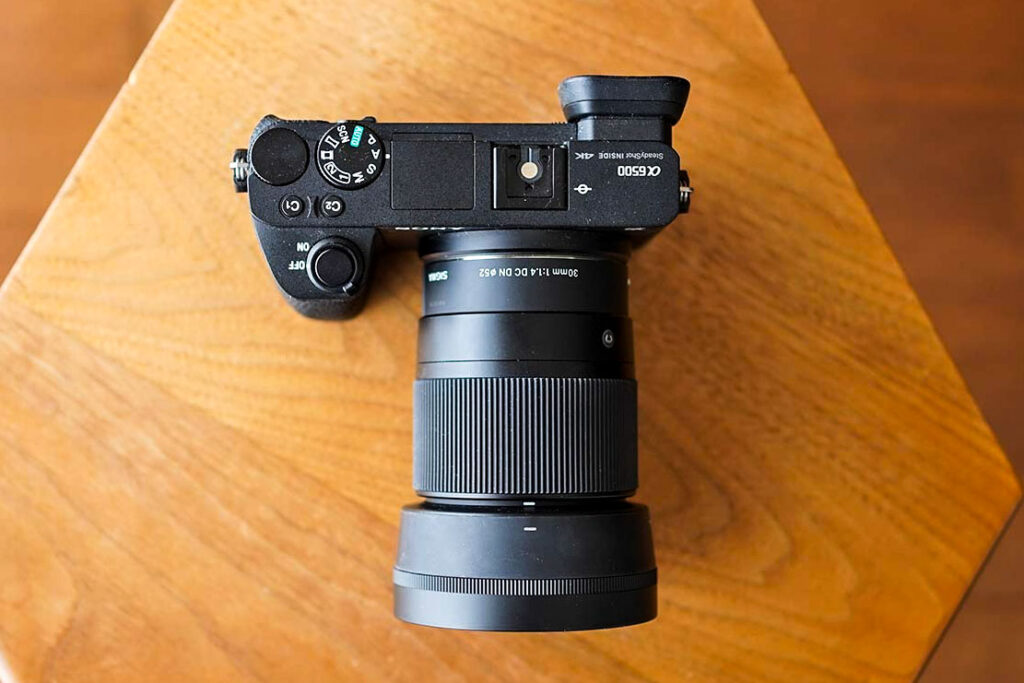
Released in 2016, this is the oldest lens in Sigma’s f/1.4 series of primes. The Sigma 30mm f/1.4 DC DN Contemporary has been one of Sigma’s cornerstone APS-C primes, a fast, sharp, and affordable normal lens that has aged remarkably well.
With a 45mm-equivalent field of view, it behaves similarly to the ‘nifty-fifty’ 50mm lens used in full frame cameras.
Build and Handling
Build quality is solid for the price: metal mount, clean lines, and a compact 265g body that balances nicely on smaller cameras. It’s not weather-sealed, but the fit and finish feel tight and premium. The by-wire focus ring is smooth and precise, with minimal lag. Autofocus is quick, quiet, and accurate, though not quite as instantaneous as Sony’s own 35mm f/1.8 OSS.
Optical Performance
The center is impressively sharp even at f/1.4, with corners improving steadily by f/2 and becoming very good by f/2.8. Contrast is strong, color is neutral, and overall rendering is pleasing, especially for people shots. Bokeh is smooth and rounded thanks to nine aperture blades, though axial chromatic aberration (LoCA) can add a touch of magenta and green fringing at wide apertures it’s mostly gone by f/2. Distortion is mild barrel type and easily corrected in post; lateral CA is well-controlled.
Alternatives
Compared with the equally popular and even older Sony 35mm f/1.8 OSS (2012), the Sigma is bigger, heavier and lacks stabilization, but it’s sharper across the frame and offers more subject separation thanks to its brighter aperture.
More recently, the Viltrox 35mm f/1.7 Air Series lens offers some serious competition. Viltrox has slightly better center sharpness and is significantly smaller and lighter.
Also see: The Complete List of Viltrox Lenses for Sony APSC-C
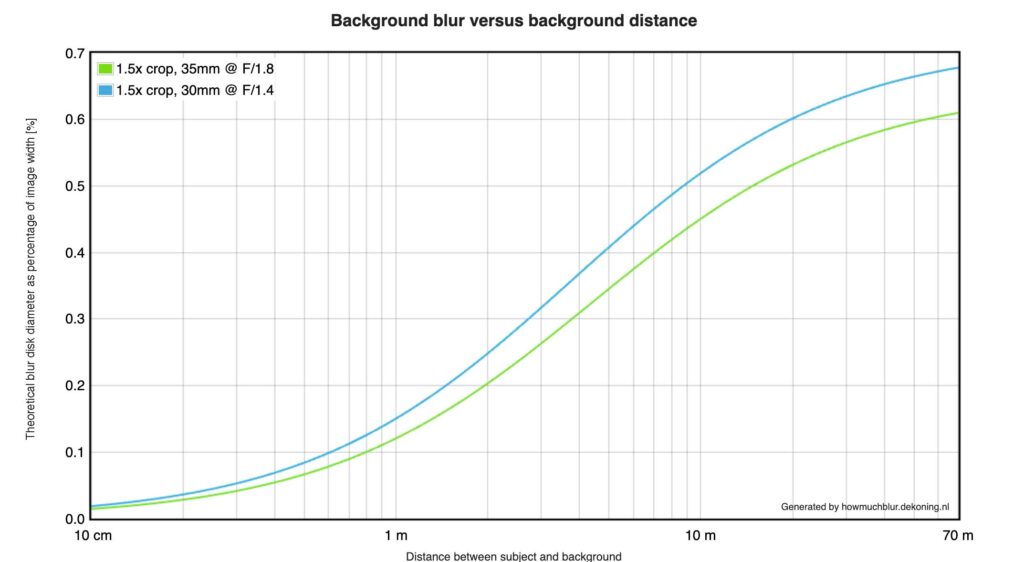
The big advantage of the Sigma remains it’s f/1.4 aperture, which helps in low light and with getting that extra background blur. As you can see in the chart below, the f/1.4 aperture on a 30mm lens trumps the longer focal length of an f/1.8 lens, in terms of ability to blur the background.
Verdict
The Sigma 30mm f/1.4 DC DN remains one of the best values in the Sony E-mount lineup. Fast, sharp, compact, and cheap enough to recommend without hesitation.
Specs:
Weight: 265 grams
Dimensions (Lxφ): 73.3mm x φ64.8mm / 2.9 inches x φ2.6 inches
Filter Size: 52mm
Check current street price: Sigma 30mm f/1.4 on Amazon
Sigma 56mm f/1.4 DC DN Contemporary Lens
A personal favorite.
The Sigma 56mm f/1.4 has been one of the top portrait primes for many APS-C systems over the years. With a field of view equivalent to 84mm on full frame, this fills that short-telephoto focal range that is perfect for portraits. Long enough to not distort features, but not too long that its impossible to use indoors.
Build and Handling
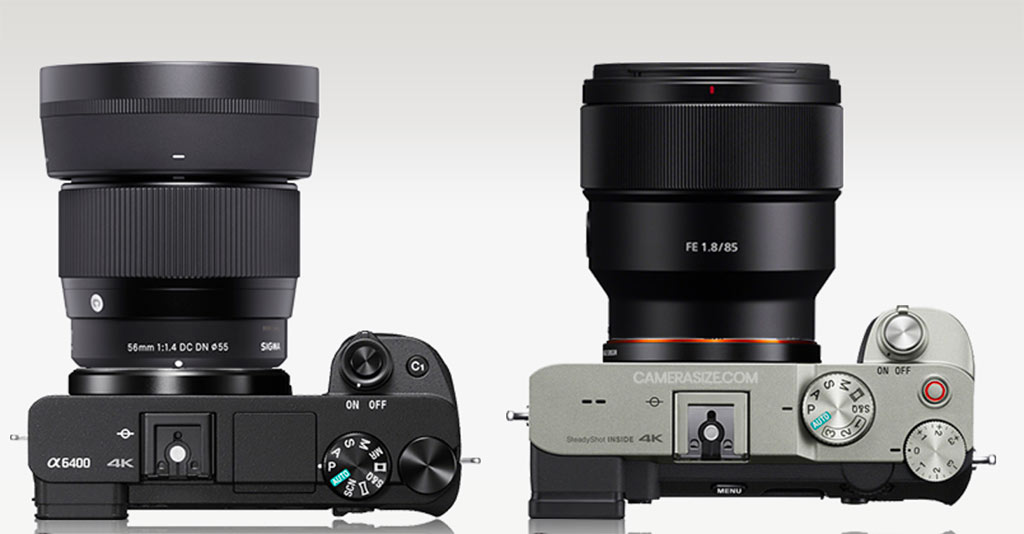
Physically, the 56mm f/1.4 follows the same clean, understated design as its siblings. The exterior mixes metal and polycarbonate with tight tolerances, a metal mount, and minimal branding. It’s made in Japan and weighs just 280g, light enough to balance well on compact APS-C bodies like the Sony a6400 or ZV-E10. There are no switches or buttons, just a wide, rubberized focus ring that turns smoothly with excellent damping. It’s a fly-by-wire system, but precision is good and manual focus feel is as good as it gets for a fly-by-wire lens.
There are no weather seals, aside from a gasket in the mount, providing basic dust and moisture resistance.
It’s fairly small for an f/1.4 telephoto. The small size makes it a discreet option for street and travel work, and it’s especially comfortable on a gimbal or handheld rig. It’s a favorite setup for video shooters who like to run and gun.
Autofocus is driven by a stepping motor that’s fast, quiet, and reliable. It locks confidently in stills mode and performs well with Sony’s best in class Eye AF. Focus accuracy is excellent overall, and while AF-S can occasionally miss in low contrast light and in back light, I don’t find it to be a showstopper.
Optical Performance
This is where the 56mm earns its reputation. Sharpness is outstanding across the frame, even wide open. Center detail is already excellent at f/1.4 and continues to improve slightly up to f/2, while edges and corners sharpen significantly by f/2.8. From f/2.8 to f/8, the image quality is as good as you’ll find from the best of the best APS-C primes, with consistent resolution and strong contrast throughout.
Color and contrast are rich but natural, and Sigma’s coatings do a good job maintaining clarity under backlit conditions. Flare resistance is excellent, a notable strength compared to many other portrait primes or medium telephoto primes in this price range. The lens does show some axial chromatic aberration (magenta and green fringing) at f/1.4, particularly around bright highlights and small bokeh edges, but this clears quickly when stopped down one stop. Lateral CA is minimal and easily corrected, while distortion is mild pincushion type. All easily corrected in post.
Bokeh is the reason you buy this lens. Background blur is smooth and clean in most cases, especially at portrait distances. The transition from focus to defocus is gradual and natural. The nine-blade diaphragm helps maintain round highlights when stopped down slightly. Some users will find the bokeh a little “busy” compared to the smoother look of full-frame 85’s, but, overall I would rate it as excellent.
Field curvature is low, and focus shift isn’t an issue. Vignetting is about a stop and a half at f/1.4, mostly gone by f/2.8. The lens handles high-contrast lighting well, and ghosting is rare.
All told, the Sigma 56mm produces consistently impressive results across a wide range of subjects. It’s a genuine all-rounder: portraits, travel, events, street, even product and landscape work.

Alternatives
The closest rival is the Sony 50mm f/1.8 OSS, which offers stabilization but is softer wide open and slower to focus. The full frame Sony 55mm f/1.8 Zeiss is also an interesting alternative, especially if you shoot full frame. It produces excellent images, has a different “look” but costs roughly twice as much and isn’t significantly sharper.
Verdict
The Sigma 56mm f/1.4 DC DN Contemporary is one of those rare lenses that simply gets everything right. It’s compact, fast, optically excellent and is priced well.
This is the kind of lens that makes APS-C systems worth using. A beautiful portrait lens from f/1.4 – f/2. Rendering skin tones without harshness. Stop it down to f/4 and it’s a completely different lens, capable of across the frame sharpness. A benchmark short telephoto prime for APS-C. Compact, fast, beautifully sharp, and priced just right. Highly, highly, highly recommended.
Specs:
Weight: 280 grams
Dimensions (Lxφ): 59.5mm x φ66.5mm / 2.3 inches x φ2.6 inches
Filter Size: 55mm
Check current street price: Sigma 56mm f/1.4 on Amazon
Also see:
The Complete List of Sigma Lenses for Sony Full Frame
Best Small Lenses for the Sony a6700
Guide to the Best Lenses for the Sony a6400
Complete list of Viltrox Lenses for Sony APS-C
Complete list of Tamron Lenses for Sony E-Mount (Full frame and APS-C)
Pingback: The Complete List of Sigma Full Frame Lenses for Sony E Mount (FE) - Compact Shooter
Pingback: Complete list of Viltrox lenses for Sony APS-C - Compact Shooter